Muslim Brotherhood turns to intimidation to counter European measures against its affiliates
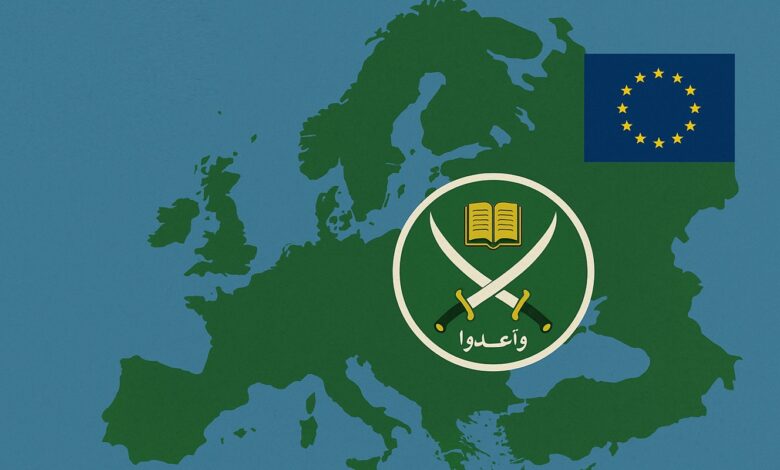
The Muslim Brotherhood’s response to a European Parliament resolution targeting its affiliates several weeks earlier followed the methods the movement has historically used against its opponents.
The movement sought to stigmatise and intimidate MEPs who voted for a measure intended to curb its activities, as part of an organised campaign.
The European Network Against Racism, described in the article as a Muslim Brotherhood affiliate, published the names and photographs of 306 European Parliament members who supported a resolution against the infiltration of political Islam in Europe. Several politicians compared the publication to “a wanted list”.
In various posts, the organisation described the resolution as “racist”, placing the following message beneath the lawmakers’ photographs: “Remember their names. Remember their faces. History does not forget.”
The network circulated photographs of 306 MEPs who voted on 8 October for the resolution opposing Muslim Brotherhood influence. The text explicitly distinguishes Islam from political Islam and calls for Muslim citizens to be protected against discrimination.
European Parliament President Roberta Metsola also appeared in one of the graphics published by the network.
Ironically, the network itself is mentioned in the parliamentary resolution because of connections to networks associated with the Muslim Brotherhood and political Islam.
Why is this conduct considered dangerous?
Nina Scholz, an expert on political Islam, told the Austrian newspaper Exxpress that she had never seen a campaign of this kind targeting lawmakers over a particular vote.
“Imagine right-wing or left-wing extremists acting this way against lawmakers because they disliked a decision,” she said, arguing that the network’s conduct fell outside legitimate democratic practice.
Scholz warned that publicly labelling people “Islamophobic” could endanger their personal safety. She called for the matter to be examined under criminal law.
Seyran Ateş, co-founder of the Berlin-based AK-Polis Foundation, joined those warning against the European Network Against Racism’s campaign. In an Instagram post on 6 November, she wrote: “I strongly welcome the resolution adopted by the European Parliament against political Islam.”
She continued: “What the European Network Against Racism is doing crosses a line. This is a veiled threat. This is intimidation. Given the Islamist violence Europe has already experienced, it is irresponsible to downplay a campaign like this.”
“I have lived under close protection for almost 20 years. I therefore know where attempts at intimidation can lead. Anyone who publicly vilifies people by name and face knows exactly what they are doing and what the consequences may be,” she added.
MEP Lukas Mandl, meanwhile, told the press: “Public pillorying is a practice from the dark days of the Middle Ages. These methods remind me of wanted lists. But I will not allow anyone to intimidate me.”
MEP Petra Steger described the campaign as “a blatant intimidation tactic” and “an overt threat”. She said: “Such methods are a direct attack on lawmakers’ freedom to make parliamentary decisions and have no place in a democratic Europe.”
Steger is calling for the Muslim Brotherhood as a whole to be placed on the EU’s terrorist list and for public funding to Islamist networks to be withdrawn.
Have lawmakers taken action against the network?
In a letter dated 29 October to Parliament President Metsola, five MEPs requested an examination of the European Network Against Racism’s campaign and steps to revoke its representatives’ accreditation and access passes to EU institutions in Brussels and Strasbourg.
The lawmakers warned of risks to the safety of the MEPs concerned and interference with their ability to exercise their mandates freely.
Why is the Muslim Brotherhood seeking to limit the resolution’s impact?
According to observers, the intimidation campaign attributed to the Muslim Brotherhood, particularly through the European Network Against Racism, represents a desperate attempt to obstruct the European measures advocated by the resolution and limit its impact at both EU and member-state level.
The resolution adopted by the European Parliament last month calls on member states to develop a joint strategy to counter Muslim Brotherhood networks.
Introduced by the European People’s Party (EPP), the text received support from conservatives and the far right, as well as some liberal lawmakers. It passed with 381 votes in favour, 167 against and 15 abstentions.
The resolution condemns “political Islam’s strategy of infiltration aimed at weakening democratic institutions across all EU member states”.
It also expresses opposition to legitimising networks seeking to undermine established civil institutions.
The text says it reviewed and calls on the European Commission vice-president and EU high representative for foreign affairs and security policy to propose that the European Council place the Muslim Brotherhood on the EU list of terrorist organisations.
It also demands the immediate and permanent suspension of all economic support, grants, subsidies and financial assistance funded by the EU budget to any organisation, institution, NGO or affiliated entity with direct or indirect links to political Islam networks, including the Muslim Brotherhood.