After the naval blockade, Washington tightens its grip on supply routes to Iran’s military industry
The United States has expanded its efforts to prevent the Iranian regime from rebuilding its military capabilities, targeting overland supply networks and financial transfers that enable Tehran to acquire equipment and technology subject to sanctions.
The initiative combines the creation of a new US military team with action against financial services companies outside Iran. Its aim is to disrupt import and financing channels that fall beyond the direct reach of the naval blockade.
US Central Command announced on Saturday the establishment of the “Iron Gate” team to monitor the movement of weapons and dual-use technology across Iran’s borders and the Caspian Sea. The announcement came a day after the Treasury Department imposed sanctions on eight financial services companies in Canada, accusing them of facilitating transactions linked to the Iranian regime, the Islamic Revolutionary Guard Corps and other actors subject to US restrictions.
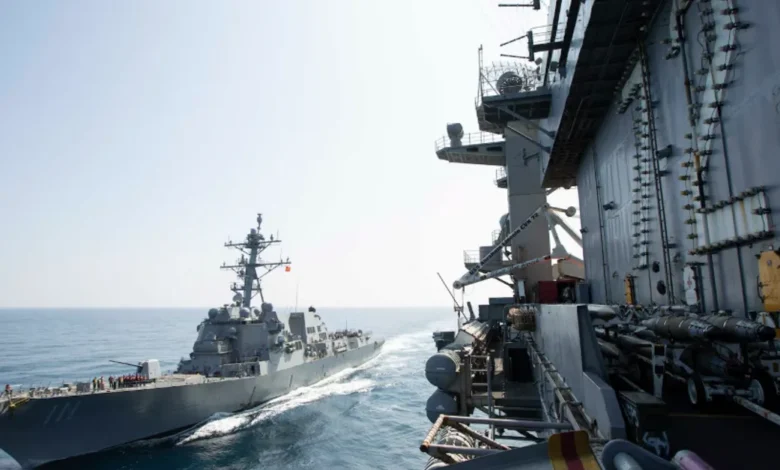
Together, the two measures illustrate the widening scope of US action to include those purchasing military components, transporting them or processing payments for them. They accompany continuing maritime measures that Washington says have prevented Tehran from exporting more than $25 billion worth of oil.
A US diplomatic source familiar with coordination between the National Security Council and the State and Treasury departments explained that the significance of this new phase lies in treating supply networks as an interconnected system, extending from overseas procurement through transport companies and financial intermediaries to end users inside Iran.
The source said that blocking a financial transaction or preventing sensitive components from reaching their destination could undermine Iranian military institutions’ ability to restart production lines, even when they manage to change shipping routes or find new suppliers.
Financial companies outside Iran
The sanctions announced by the Treasury on 6 November provide a recent example of the actors being targeted. They cover eight Canadian companies operating in money transfers, currency exchange and digital assets.
Those designated include “Million Exchange”, “Nia Nations” and “Farah Exchange”, which the department accused of conducting transactions with sanctioned Iranian platforms or digital wallets linked to the Revolutionary Guard and other designated actors.
According to official details, some networks converted traditional currencies into digital assets to complete international transactions. Other companies were linked to separate money-laundering operations, prompting US authorities to coordinate with Canada’s financial intelligence unit.
The diplomatic source said the practical value of these measures lies in targeting intermediaries based outside Iran, particularly those enabling funds to move between sanctioned institutions and international markets.
The source stressed that any subsequent expansion would require identifying the individuals and entities involved and specifying the alleged violations. It would also be necessary to distinguish between companies already subject to formal measures and those that might face future scrutiny.
Coordinating military and civilian action
The military component consists of about 20 civilian and military personnel based at Central Command headquarters in Tampa, Florida, under the direction of its commander, Admiral Brad Cooper.
Its stated mission is to prevent the movement of advanced weapons, dual-use equipment, prohibited goods and illicit revenues across Iran’s land borders and the Caspian Sea, in coordination with the relevant federal agencies.
A US military source said the mission requires linking information on the movement of sensitive materials with intelligence on the commercial and financial actors that facilitate their delivery to Iranian military institutions.
The source explained that enforcement tools vary according to the type of violation. Agencies responsible for financial sanctions, export controls and prosecutions take action within their respective mandates, while the military role focuses on intelligence and coordination relating to security threats.
The US announcement does not include the deployment of additional forces along Iran’s borders or the launch of naval operations in the Caspian Sea. The team’s effectiveness will therefore depend on its ability to support government action against supply networks, rather than on directly imposing a military closure of overland routes.
Alternative supply routes for military industries
The Caspian Sea and overland crossings are particularly significant because they can be used to transport equipment and goods into Iran while bypassing ports subject to the US blockade in the Gulf and the Gulf of Oman.
This gives the Iranian regime alternative routes for obtaining components needed by its military facilities, as restrictions remain in place on exports and financial transactions linked to its missile and drone programmes.
According to the military source, assessing any supply network requires examining both the nature of the commercial shipment and its intended recipient. Because dual-use equipment can serve either civilian or military purposes, the end user and whether the goods are subject to restrictions determine how a shipment should be handled.
The source added that a key US challenge is uncovering the relationships between suppliers, intermediaries and buyers. These details are important when preparing sanctions cases or pursuing legal action.
The diplomatic source, meanwhile, stressed that the expansion of financial and trade measures is intended to restrict Iranian military institutions’ ability to replenish equipment and resources, while preserving the legal distinction between prohibited goods and permitted humanitarian trade.
Washington’s measures are thus entering a phase targeting both sides of Iran’s rearmament process: access to the equipment needed for production and access to the channels that finance its purchase. The outcome will depend on US institutions’ ability to turn shared intelligence into enforceable measures against supply and financing networks.