Iran targets navigational aids to shut down oil shipping routes
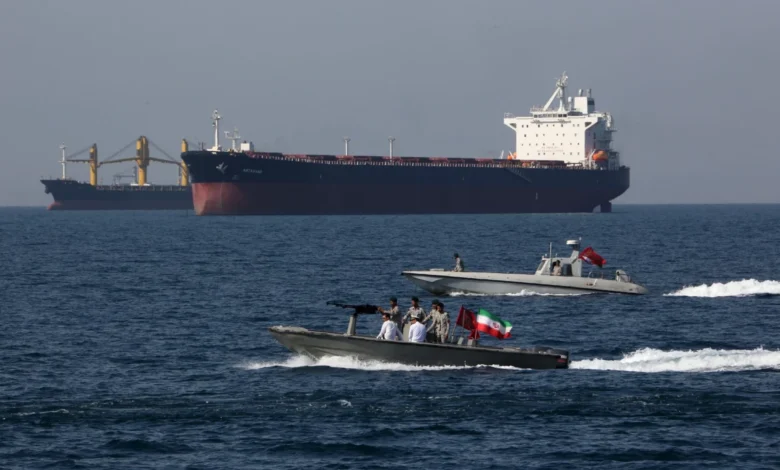
Tehran is seeking to redirect shipping into channels closer to its coastline, giving its naval forces greater capacity to monitor vessels and control their passage.
Iran’s Islamic Revolutionary Guard Corps announced on Monday that navigational aids in the southern part of the Strait of Hormuz had been destroyed. Tehran said the move had halted the passage of vessels violating its rules through a channel used for oil smuggling, marking a further escalation in its efforts to tighten control over shipping in the strait.
Iran’s Fars news agency on Monday quoted a source in the Revolutionary Guard’s navy as saying that the destruction of navigational aids on rocky formations in the southern strait had prevented any non-compliant vessel from entering the channel Tehran described as “illegal” during the previous night. The source added that oil-smuggling operations through that route had stopped entirely.
The move forms part of a series of Iranian measures intended to impose a new navigational order in the strategic strait. Oil equivalent to roughly one-fifth of global consumption passes through the waterway, which Gulf countries use to export most of their oil production.
Tehran began its efforts to reorganise shipping in the strait by imposing alternative maritime routes, citing concerns about naval mines in traditional transit lanes.
In April 2026, the Revolutionary Guard’s navy announced new routes for vessels entering and leaving the Gulf, requiring all ships to coordinate with it and comply with its navigational instructions.
Under the routes announced by Iran, ships arriving from the Gulf of Oman must head north and pass near Larak Island before entering the Gulf. Outbound vessels must follow a route south of the island towards the Gulf of Oman.
Tehran thereby sought to shift shipping into channels closer to its coastline, giving its naval forces greater capacity to monitor vessels and control their passage.
Oman, meanwhile, worked with the International Maritime Organization to propose an alternative southern channel, facilitating navigation away from the routes Iran requires vessels to use. This has created two competing arrangements for managing traffic through the strait.
Iranian measures have extended beyond imposing shipping routes to threatening vessels using passages Tehran has not approved. Iran has also warned that attempts to open new oil export routes would be regarded as hostile activity.
In October, Reuters reported, citing informed sources, that Iran had warned countries in the region that any attempt to open new oil export routes would be considered a hostile act. The sources said Tehran had drawn up plans to prevent the use of routes outside its control.
Iran is adapting its tactics for targeting ships transiting the strait as it seeks to retain leverage over the United States by restricting navigation and increasing the risks associated with oil transport.
Iranian threats include the use of missiles, armed drones and naval boats, as well as intercepting vessels and forcing them into Iranian waters.
In the latest developments, Iranian forces said in November that five oil tankers and a tugboat had caught fire in several incidents in the strait. The Revolutionary Guard also reported that vessels had struck naval mines.
Iran’s measures are also aimed at closing maritime channels that Tehran says are being used to bypass its shipping restrictions.
Brigadier General Mohammad Reza Naqdi, a senior adviser to the Revolutionary Guard commander, had announced that a small number of routes opened by non-compliant vessels would soon be closed by blasting and destroying certain rocky passages in the strait.
According to the latest Iranian announcement, targeting navigational aids on the southern rocky formations marks a shift towards attacking the infrastructure that helps ships determine their positions and navigate maritime channels.
News reports noted, however, that the Iranian statement did not identify who had destroyed the installations or when the operation took place. Nor did it provide independently verified details of the actual impact on shipping.
These measures allow Iran to increase the risks and costs associated with oil tanker transits without announcing a complete closure of the strait. Threats, potential attacks and route restrictions could prompt shipping companies and insurers to avoid the area or delay voyages.
Tehran is seeking to use its geographical position and naval capabilities to raise the cost of pressure against it and turn the security of global energy supplies into a negotiating tool.
Iran’s strategy therefore extends beyond preventing individual vessels from passing. It seeks to impose new conditions on navigation and control the routes used by oil tankers, expanding Tehran’s influence over one of the world’s most important maritime energy trade corridors.