A war without borders: How the conflict in Ukraine spread from Benghazi to the heart of Europe
The war in Ukraine is escalating sharply as prospects for peace recede. According to a CNN analysis, efforts to recast the negotiations as a matter of fundamental importance to European security and Washington’s commitment to it have failed.
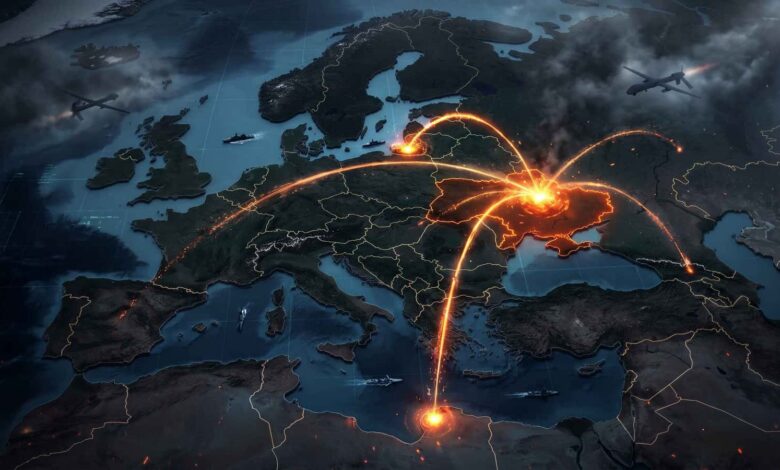
The escalation now extends beyond the traditional front lines. Ukrainian drones have struck Russian sites and vessels off Benghazi in the Mediterranean and off the Russian exclave of Kaliningrad on the Baltic Sea. At the same time, Russia has launched its heaviest wave of strikes deep inside Ukraine since the start of the year.
On Friday, Moscow launched what Ukrainian President Volodymyr Zelenskyy described as the heaviest attack since the beginning of the year. The sustained drone and missile barrage lasted six hours and followed weeks of attacks on bridges in Kyiv and power networks across the country. The bombardment killed dozens and caused repeated power outages in the capital and across large parts of Ukraine.
Kyiv responded with targeted strikes. In the days leading up to the “Schengen” meeting, Ukrainian forces attacked the strategic Crimean Bridge three times. Russian President Vladimir Putin had the bridge built to connect Russia to the occupied peninsula.
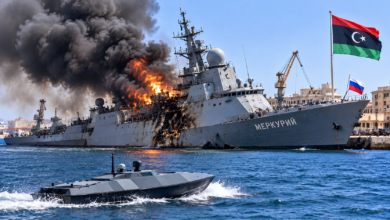
Late in the week, Ukrainian drones targeted a Russian military vessel off Kaliningrad before striking Russian naval targets near the port of Benghazi on Libya’s coast. As Moscow displays the brutality of its bombardment, Kyiv is responding with strikes whose range and precision have taken observers by surprise.
The strikes spread from the Baltic to the Mediterranean
The geography of Ukraine’s strikes carries considerable strategic significance. Wedged between Lithuania and Poland, two of the NATO members most hostile to Moscow, Russia’s Kaliningrad exclave is an isolated legacy of the Soviet era. Until recently, it was considered safe from attack.
The available evidence suggests Ukraine likely struck the Sparta 2, one of the vessels in the Sparta fleet known for carrying military cargo, with a drone. It may have been launched from another vessel or flown over Russian territory toward the Baltic Sea.
As expected, Moscow blamed a third party, alleging that Lithuania had allowed the drone to pass through its airspace, and thus through NATO airspace.
The allegation reinforces Russia’s longstanding claim that it is fighting the entire alliance. It also raises the prospect of further Russian sabotage and other violations in the Baltic region, increasing the risk of direct escalation with NATO.
The strikes off Benghazi hit a Russian warship and a Russian cargo vessel, according to Zelenskyy. They demonstrated that Ukrainian drones can put the Kremlin on the back foot deep within its spheres of influence. After a decade of Russian power projection in Africa, Russian ships now risk being targeted in any Mediterranean port where they call.
CNN notes that such a broad escalation would have been unthinkable five years ago. The war was initially confined to Ukraine, then reached deep inside Russia in 2024. It subsequently reached NATO’s eastern flank as acts of sabotage linked to Russia increased across allied countries. The war is gradually spreading across Europe, and two factors point to a particularly dangerous period ahead.
Washington’s race against time and the logic of scorched earth
First, what would a Democratic-controlled Congress mean for Ukraine? The Kremlin’s window is narrowing as pro-Ukraine Democrats move closer to taking control of the US Congress. Such a shift would put past conduct and current funding under intense scrutiny, along with the roles of Elon Musk and Pentagon officials at every level.
In the analysis’s view, that scrutiny would likely expose Donald Trump’s unusual sympathy for Russia. The prospect of a Democratic administration could lead Trump’s inner circle to focus more on securing its political survival and put its own priorities for handling Putin’s war on the back burner.
In an apparent attempt to obstruct negotiations, Moscow sought to persuade Washington to reframe the talks around the broader issue of “European security architecture.” The aim was to portray the war in Ukraine as merely a consequence of NATO’s eastward expansion.
Putin reinforced that hard line in his latest appearance at the “Schengen” summit. He refused to negotiate a ceasefire, which the analysis describes as the only immediate diplomatic way forward. He also insisted that Europeans wishing to join technical talks, as the US president’s son-in-law Jared Kushner had announced, would have to travel to Moscow to put the matter to him in person.
Second, battlefield calculations and the destruction of what remains of the Donbas. Putin appears to have discarded the basis for negotiations and pushed the prospect of a settlement further away. His position follows a brutal battlefield logic. His main war objective remains full control of the Donbas.
Ukraine has kept Russian forces from capturing Kostiantynivka for two full years. The neighboring cities of Kramatorsk and Sloviansk, however, have become nearly uninhabitable. Russian drone and air strikes have forced civilians to flee and reduced streets to rubble, setting the stage for months of brutal urban warfare.
At “Schengen,” Putin said it could become increasingly difficult for Kyiv to retain control of the remaining 10 percent of the Donbas.
Despite the heavy cost of this slow advance, estimated at at least 40,000 killed or wounded each month, the Kremlin appears to be betting that it can reduce what remains of the region to ruins and later accept a political settlement that allows it to proclaim “victory amid the rubble.”
A growing disconnect from reality undermines diplomacy
The analysis warns that the deepest danger now facing the war is the threat to diplomacy. Each side’s statements increasingly diverge from the other’s account. Kushner says Europe will take part in future multilateral peace summits, while the Kremlin flatly rules out European participation.
On the battlefield, Putin claims to control Kostiantynivka even though his forces do not hold the city. On Thursday, he again claimed that Ukraine started the war, an assertion that contradicts the facts.
The two sides’ demands are also growing further apart. Some reports say the Kremlin wants NATO to pull back westward. Others suggest that the United States has proposed bringing Ukraine into the alliance. The two positions amount to irreconcilable red lines.
Using diplomacy to pursue military gains
CNN concludes that the two sides are operating in separate realities that are drifting further apart, reducing the chances of a workable solution. That divergence serves Russia’s objective of using diplomacy to secure military gains. The result is a “diplomatic fantasy world” unable to stop the killing on the ground.
In the analysis’s account, a year of failed talks, rapprochement with Putin, pressure and intimidation directed at Kyiv, alarm across Europe, and continued escalation by Moscow has led to Europe’s largest conflict since the 1940s.
In this account, Ukrainian drones strike Russian ships wherever they are found, while Russian missiles and drones enter NATO airspace every month without fear of a military response. The peace process appears to have been reduced to a formality intended to appease Trump, at a bleak moment that points to a dangerous and destabilizing breakdown.