Winter giving in Europe: Warnings that charity fronts could be used to expand Muslim Brotherhood funding networks
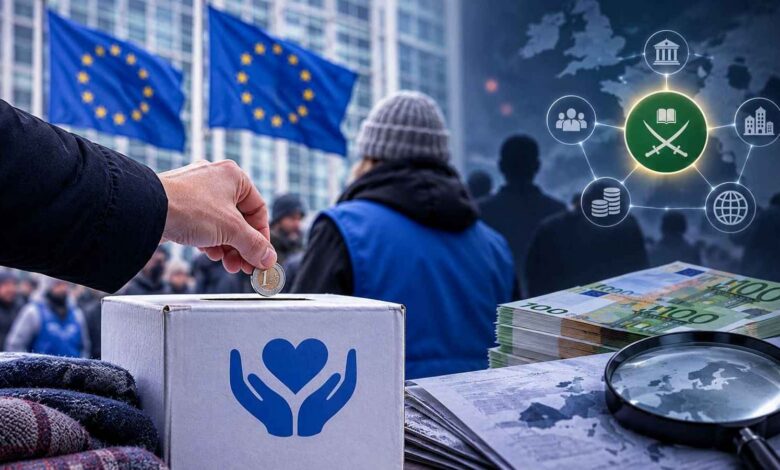
As winter approaches, fundraising campaigns are stepping up efforts to provide clothing, heating supplies, and essential aid to people most in need. In Europe, the seasonal rise in giving has renewed concerns that some networks linked to the Muslim Brotherhood could exploit humanitarian appeals to expand their financial operations and strengthen their institutional and social presence across borders.
These concerns have grown as Europe’s charity sector has expanded and more organizations have become involved in collecting and distributing donations. Financial ties between some nonprofits and commercial or investment companies operating in several countries add another layer of complexity. Authorities responsible for monitoring where money comes from and how it is spent face growing challenges, particularly when humanitarian work overlaps with financial and organizational structures whose connections are difficult to establish.
A former European official familiar with the financial oversight of associations and cross-border organizations warned that the winter giving season could allow some Muslim Brotherhood-linked networks to expand their funding systems and influence. Such networks, the official said, could take advantage of the seasonal rise in donations and the public’s readiness to support humanitarian initiatives for people affected by crises and other vulnerable groups.
The official said regulators now need to go beyond checking whether organizations that raise funds are legally registered and hold the necessary permits. They must examine who controls the money, who is authorized to manage it, and who ultimately benefits after it moves between institutions and intermediaries.
The scale of winter fundraising and the number of channels through which donations are collected make verification more complex, the official added. When money moves through associations, funds, and institutions operating in different countries, gaps in information sharing can make it difficult for authorities to reconstruct the full funding trail.
Financial networks that extend beyond charities
According to the former European official, the issue for regulators is as much about where the money goes after it reaches the bank accounts of the organizations that advertised the appeal as it is about the volume of donations collected.
In some cases, the money may move beyond the association that launched the campaign or the fund that received the donations. It can pass through intermediaries and other entities whose activities span charity work, commerce, real estate, and investment. These overlapping relationships make it harder to identify who actually controls the funds and may create opportunities to conceal financial ties between the parties involved.
Tracking the money becomes more complicated when it is spread across several bank accounts or transferred through organizations with different legal statuses. Tracing funds from their original source to their final destination can then be a lengthy process requiring coordination among regulators and judicial authorities in more than one country.
In the official’s view, a review of formal documents and legal permits alone offers limited insight into the full scope of an organization’s financial activity. An organization can meet administrative requirements while its financial and organizational relationships with other entities remain insufficiently clear.
The official therefore called for oversight focused on the movement of money as well as the legal status of the organizations that receive it. This means identifying the ultimate beneficiaries, examining how the money is spent, and checking whether the use of funds matches the objectives announced by campaign organizers.
The former official expects increased scrutiny of humanitarian organizations’ funding sources and overseas partnerships, along with closer coordination among financial intelligence units, charity regulators, and judicial authorities.
The official stressed that closer oversight is intended to protect the charity sector from abuse while preserving humanitarian organizations’ ability to operate. Its purpose is to safeguard donor trust, make sure aid reaches the people it is intended to help, and prevent humanitarian resources from being diverted to activities that conflict with the stated objectives.
Winter appeals offer opportunities to raise money and extend influence
Winter fundraising is one of the busiest seasons for charitable giving and public solidarity in Europe. Charities and humanitarian organizations launch appeals for clothing, blankets, heating supplies, and food, while also supporting people affected by wars, natural disasters, and economic crises.
These campaigns respond to needs that become more acute in winter. Some people are struggling with rising living and energy costs. Others face harsh conditions after being displaced, losing their income, or suffering damage to their homes.
The scale of these initiatives and the volume of cash and in-kind donations received over a short period put regulators’ ability to distinguish between organizations doing legitimate humanitarian work and those that may use charity as cover for other financial or organizational objectives to the test.
Against this backdrop, questions are growing about whether some networks linked to the Muslim Brotherhood could exploit seasonal humanitarian campaigns. By operating through charitable fronts, they could attract donations and build wider social and institutional ties, drawing on the public trust that relief initiatives enjoy.
A winter appeal alone is no evidence of wrongdoing or of an organization’s involvement in political or organizational activities. The concern is that complex financial structures could be used to exploit public trust in humanitarian work. This calls for transparent standards that apply equally to all organizations.
Beyond providing immediate funding, donations can help the institutions that manage them build relationships with local and international donors and partners, and expand their presence in the communities they serve. Donations can also help sustain their operations when traditional sources of funding fluctuate.
“Organized circumvention of the law” and how donations can become financial assets
Julien Moreau, a French political researcher specializing in political finance and cross-border networks, attributes the problem to what he describes as “organized circumvention of the law.” Without effective scrutiny of financial flows and relationships between the entities involved, he argues, some seasonal charity campaigns could become means of accumulating resources and expanding institutional influence.
Moreau said humanitarian appeals generally draw on an impulse to help whose legitimacy is difficult to question. That makes them particularly effective at attracting donors during crises and at times of year when vulnerable people’s needs grow.
He added that the sensitive nature of humanitarian issues can make some authorities reluctant to scrutinize appeals closely, for fear of appearing to obstruct charity work or question donors’ motives. He argued that such considerations are insufficient grounds for exempting organizations from their legal and financial obligations.
Financial and judicial investigations are especially important in these cases, Moreau said. They make it possible to examine links among associations, funds, companies, and assets, and to uncover relationships that may be absent from official disclosures and published administrative reports.
For Moreau, the amount raised tells only part of the story. The question is how the money was used, whether it reached the people the appeal was intended to help, and whether any portion was directed toward purposes other than those presented during fundraising.
The researcher said some complex financial arrangements may distribute resources among several entities. This can make humanitarian, operating, and investment expenses harder to distinguish and raise questions about the independence of the organizations that collect and manage the money.
Transactions that warrant scrutiny under this approach include the use of some funds to cover administrative and operating expenses in Europe, as well as the purchase of real estate or commercial assets that could generate ongoing income for the institutions that acquire them.
This issue becomes particularly important when money raised for specific humanitarian purposes becomes a long-term source of funding or goes into investments with no clear direct connection to the campaign’s stated objectives. In such cases, scrutiny must extend to the financial decisions themselves and to who made them.
Many European countries allow organizations to incur operating expenses and make investments within defined limits. Problems arise when funding sources and spending lack transparency, or when actual practices diverge from commitments made to donors and regulators.
Real estate and companies add links to the funding chain
Financial regulators pay close attention to ties between charitable institutions and certain commercial or real estate entities, particularly when they operate within the same network or when the interests of their executives and partners overlap.
Charities can generally own property or hold stakes in commercial companies. Financial flows between different entities do, however, warrant scrutiny of what the transactions involve, why they took place, and whether they comply with the laws and regulations governing charities.
This scrutiny becomes more important when the associations and funds concerned operate in several countries or rely on financial intermediaries and local partners to manage donations and distribute aid.
Regulators need to establish who received the money, who has the final say over how it is used, which entities it was transferred to, and who exercises effective control over the financial operations.
They must also review contracts and agreements between institutions to ensure that transfers correspond to genuine, disclosed activities. Such reviews can help detect opaque transactions or attempts to conceal the ultimate beneficiaries.
The issue is especially pronounced in cross-border structures. Each organization may be subject to different laws and oversight requirements, while the money follows a single path that is difficult to reconstruct from any one country’s database.
A European strategy aimed at reducing illicit financing risks therefore needs to extend beyond traditional charity oversight. It must examine financial networks as a whole, including affiliated institutions, intermediaries, and companies that do business with them.
The risk of aid diversion in conflict zones
Concerns about where donations go extend to conflict zones that receive a share of humanitarian aid. Relief needs in these areas coincide with difficult security conditions, and public institutions sometimes have limited capacity to track the movement of resources.
In areas affected by armed conflict or the partial collapse of institutions, humanitarian organizations rely on local partners and intermediaries to deliver assistance. This makes it harder to verify the identities of recipients and the nature of their activities.
Risks rise when funds or relief convoys are handed over to intermediaries whose backgrounds and relationships have been insufficiently checked. They also rise when reliable mechanisms are missing to document distribution and verify that aid reaches its intended recipients.
In some cases, weak oversight can allow resources to be diverted from their original purposes or exploited by local actors for financial or organizational gain. This reduces the effectiveness of humanitarian work and makes it harder to ensure that aid remains neutral.
Organizations that raise donations in Europe may have only partial knowledge of the parties responsible for distributing aid abroad, especially when assistance passes through a series of local partners and intermediaries.
Their responsibility therefore extends beyond transferring money or handing supplies to a partner. It includes monitoring spending and distribution and keeping clear records that allow the final destination of the resources to be verified.
The gray area between humanitarian relief and ideological mobilization
Austrian political researcher Lukas Wagner warned that insufficient scrutiny of what he calls the “gray area” between humanitarian relief and ideological mobilization is one of the main gaps European regulators should address as winter begins.
Wagner said money raised through humanitarian appeals could be directed to ineligible recipients outside Europe. It could also be used within European communities to support entities or activities that fall outside the objectives announced when the appeals were launched.
He explained that some organizations may use charity work to establish a presence in communities and among local institutions. By expanding their ties with donors, volunteers, and local organizations, they can gain influence in particular parts of society.
Legitimate charitable activity can coexist with other activities that warrant scrutiny, he added, particularly when there are signs that an organization’s financial resources are being used for work with no direct link to its stated humanitarian goals.
The implications extend beyond finance. When money raised to help people in need is found to have been spent on purposes other than those announced, public confidence in the wider charity sector can suffer.
Wagner said addressing the issue requires clear boundaries between humanitarian work and political or ideological activity. Laws should be applied on the basis of facts and evidence, avoiding broad assumptions or suspicions based solely on an organization’s field of work or background.
Protecting the charity sector also requires distinguishing organizations that provide genuine aid and comply with the law from entities that may use their humanitarian status as cover for other activities. Making that distinction requires thorough financial and administrative investigations.
Identifying ultimate beneficiaries tests European oversight
As calls for tighter oversight of cross-border associations and organizations grow in Europe, regulators are paying closer attention to the concept of the “beneficial owner.” Identifying who ultimately controls or benefits from the funds can help explain how money moves and expose attempts to conceal where it ends up.
This marks a shift in financial oversight. Alongside verifying the legal status of the organization that receives donations, authorities are seeking to identify the people and entities that exercise effective control over the resources or benefit from them directly or indirectly.
This approach is particularly important when several legal entities are involved in managing the money. An association may publicly announce the appeal while other institutions manage the accounts, make investments, or provide logistical services.
Identifying the ultimate beneficiary therefore requires tracing financial transactions from end to end, reviewing bank accounts, examining contracts and partnerships, and verifying the identities of the parties that receive the funds or control how they are allocated.
It also calls for closer information sharing among financial intelligence units, tax authorities, and charity regulators to build a more accurate picture of the financial activities of organizations operating across borders.
Oversight should also cover sources of income and categories of expenditure. Authorities need to check whether the volume of reported donations is consistent with the type of assistance provided and examine unusual transfers or transactions that appear unrelated to the organization’s declared activities.
Oversight after fundraising matters as much as the checks carried out before an appeal. Obtaining permits and submitting the required information offer only partial assurance that transactions conducted after donations are received will comply with the rules.
Ongoing monitoring should make it possible to establish how money is spent, verify that humanitarian projects are carried out, and document who received aid. It should also enable regulators to hold organizations to account when they cannot clearly explain how their funds moved.
Protecting the charity sector from financial abuse
The mounting warnings leave European authorities with a delicate balance to strike. They must protect the humanitarian initiatives on which millions of people in need depend, while preventing the sector from being used for financial or organizational activities that violate the law or depart from stated objectives.
Oversight measures need to preserve the ability of legitimate charities to do their work and give donors confidence to keep supporting humanitarian appeals. This is particularly important in winter, when social and material needs increase.
Lax scrutiny of opaque financial structures can damage the reputation of the entire sector and give entities that exploit charity work room to expand their activities without adequate oversight.
Common transparency and financial disclosure standards could require organizations to identify their funding sources and partners and explain how donations are spent. They should also require verifiable information about who receives the aid.
Oversight should cover intermediaries and companies that do business with charities, particularly when there are recurring transfers or commercial relationships whose justification or connection to humanitarian objectives is unclear.
Cross-border risks call for wider European cooperation. National measures alone may be insufficient to deal with networks that operate in several countries and use different legal structures to manage their resources.
Sharing financial data and information about who owns and effectively controls institutions could uncover relationships that a review of each charity in isolation might miss.
In conflict zones, stronger procedures are also needed to vet local partnerships, verify the identity of aid distributors, and document deliveries and spending. These measures would reduce the risk of resources being diverted from their original purpose.
Winter donations between humanitarian solidarity and the risk of abuse
As winter fundraising in Europe approaches its peak, funding for cross-border charities and organizations is likely to attract greater political and regulatory attention. Debate is increasingly focused on where the money comes from, how transparent institutions are, and whether existing laws can adequately address complex financial networks.
The warnings from the former European official and the French and Austrian researchers underscore the need for scrutiny at every stage of the funding trail. This extends from the initial collection and the charities’ bank accounts through intermediary institutions and commercial partnerships to the local organizations that distribute aid abroad.
These concerns raise a fundamental question about whether European authorities can distinguish charitable work intended to help people in need from possible attempts to use humanitarian activity as cover for building funding or influence networks outside the stated purposes.
Addressing that challenge calls for financial oversight that traces funds, identifies ultimate beneficiaries, and examines relationships between institutions. Administrative requirements are only one part of that work, and all organizations should be subject to the same standards without exception.
Public trust is one of the charity sector’s most valuable assets. Any abuse of that trust would harm donors and recipients and threaten the credibility of humanitarian institutions that play a vital role in alleviating the suffering of millions of people.
As winter appeals expand and European authorities scrutinize funding sources more closely, the test is whether they can ensure that donations intended for heating, clothing, and relief remain traceable and serve the humanitarian purposes for which they were raised.