A Floating Missile Platform: The Admiral Nakhimov Restores the Prestige of the Russian Navy
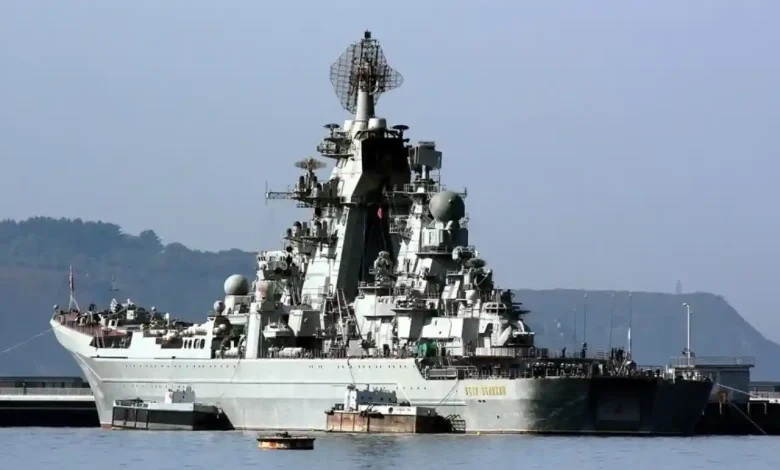
As the world’s largest nuclear-powered warship, the Admiral Nakhimov has long occupied a special place in Russia’s naval ambitions.
At the beginning of June, the Russian Navy deployed the nuclear-powered heavy cruiser Admiral Nakhimov to begin the final phase of its sea trials.
With this step, Moscow brought to an end a troubled modernization program that lasted nearly three decades, paving the way for the vessel’s return to front-line service, according to Military Watch magazine.
The Admiral Nakhimov is one of only two Kirov-class cruisers remaining in service. For the first time in twenty-eight years, the warship sailed under its own power in August 2025, following its refloating on July 25 of the same year.
The Kirov-class vessels remain the only operational nuclear-powered surface combat ships in the world, despite significant investments by the United States Navy in developing a new generation of ships using a similar propulsion system.
These vessels are also the largest and most heavily armed surface warships currently in service. With a displacement of 28,000 tons, each ship is larger than a Japanese Izumo-class helicopter carrier or the equivalent of three American Arleigh Burke-class destroyers.
The Admiral Nakhimov is equipped with 176 large-diameter missile launch cells, including 96 dedicated to surface-to-air missiles derived from a navalized version of the S-400 air defense system. This capacity is equivalent to three complete battalions of the land-based variant.
An additional 80 launch cells are allocated to cruise missiles. These launchers are capable of deploying the new Zircon hypersonic cruise missile, which combines a speed of Mach 9, a range of up to 1,000 kilometers, and exceptional maneuverability that enables it to penetrate advanced multilayered air-defense systems.
Russian sources have highlighted the capabilities of the Zircon missile, arguing that it gives Russian surface vessels a significant advantage over foreign competitors in long-range anti-ship warfare. According to these assessments, only China’s YJ-20 anti-ship ballistic missile can match or surpass its performance.
Although the Admiral Nakhimov is expected to join the Arctic Fleet, the future of the Kirov-class cruiser program remains uncertain.
On April 22, 2021, Andrei Diashkov, Chief Executive Officer of the Severnoye Design Bureau, stated regarding the ship’s modernization: “The extensive modernization potential incorporated into the vessel from the design stage made it possible to carry out significant upgrades and equip Admiral Nakhimov with the most advanced weapons systems, making it the most powerful surface warship in the world.”
However, while the Russian Ministry of Defense had previously planned to finance a comprehensive modernization of both Admiral Nakhimov and its sister ship Pyotr Velikiy, it was confirmed in July 2023 that the latter would be retired from active service ahead of schedule.
This decision is believed to result from a combination of factors, including high operating and design costs, the enormous expense of modernization, and the financial pressures generated by the war in Ukraine.
Since the collapse of the Soviet Union, the Russian shipbuilding industry has not constructed a single destroyer-sized warship for the Russian Navy, let alone a medium or heavy cruiser. This makes the Kirov-class vessels particularly distinctive within Russia’s relatively modest surface fleet.
According to projections, Russia’s destroyer fleet could become smaller than North Korea’s by the early 2030s. Moreover, it continues to rely on older and less capable vessels, with no clear indication of plans either to replace them or to revive the construction of large surface combat ships.
Investment priorities have instead focused on submarines, particularly the Yasen-M-class nuclear attack submarines, which are regarded among the most powerful in the world.
This emphasis on nuclear submarines stems largely from their value as asymmetric assets. Their stealth capabilities allow them to choose the time and place of engagement, enabling them to pose a credible threat to larger and more powerful naval forces while offering a highly cost-effective means of countering the combined fleets of the North Atlantic Treaty Organization (NATO).