Reuters: Iran’s Revolutionary Guards formed secret cells in Iraq to attack Gulf states
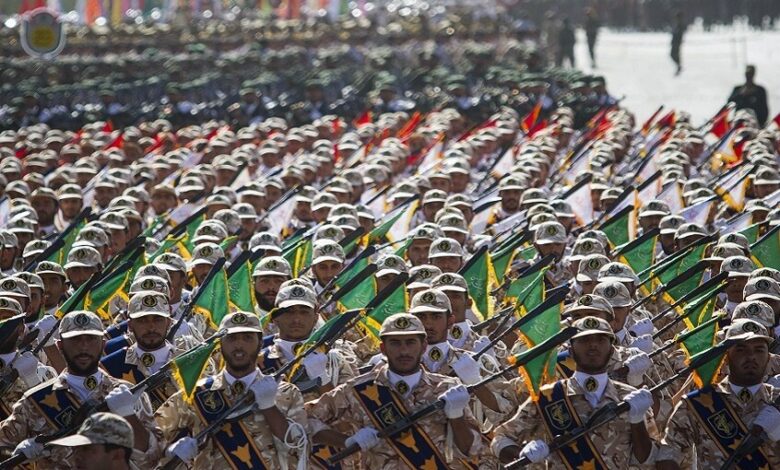
Reuters has revealed that Iran’s Islamic Revolutionary Guard Corps (IRGC) established new covert cells in Iraq to carry out attacks against Gulf countries hosting U.S. forces, bypassing existing militant networks in order to avoid detection.
According to three sources, three or four cells, each composed of around ten elite Iraqi Shiite fighters, launched at least seven drone attacks from desert locations near the southern cities of Basra and Samawah against targets in Kuwait, Saudi Arabia, and the United Arab Emirates between April 20 and May 17.
-
Explosions on Iran’s Coast… The Revolutionary Guard Responds with Fire, but Against Whom?
-
A Puppet in the Hands of the Revolutionary Guards: How Has the Role of Iran’s Supreme Leader Changed?
Several members of these cells belong to the so-called “Islamic Resistance in Iraq,” a coalition of Shiite factions comprising thousands of fighters. However, these newly established groups operate outside the alliance’s command structure and report directly to Iran’s Revolutionary Guards, according to the sources, which include two Iraqi military officials, a security official, and five leaders of local armed groups.
According to the five militia leaders, the formation of these new cells in Iraq—previously undisclosed publicly—reflects a shift in the IRGC’s methods aimed at preserving Iran’s ability to project influence across the region at a time when its allied armed groups are significantly weakening and experiencing the depletion of their military and economic resources.
-
Washington Offers Major Reward to Disrupt Iranian Revolutionary Guard Financing
-
Attempted infiltration by the Islamic Revolutionary Guard Corps into Kuwait… Iranian admission and Arab condemnations
Iraq, a Shiite-majority country, hosts a large number of armed factions, many of which maintain close ties with Tehran. These groups form a key pillar of the so-called “Axis of Resistance,” Iran’s regional alliance stretching from Gaza and Lebanon to Yemen and Iraq.
Groups operating under the banner of the “Islamic Resistance in Iraq” have claimed responsibility for dozens of drone and missile attacks targeting U.S. interests in the country, prompting deadly retaliatory airstrikes since the United States and Israel launched military operations against Iran on February 28. However, no large-scale mobilization of Iran-aligned groups has occurred within Iraq’s borders.
-
Iran in the grip of the Revolutionary Guards… and the Supreme Leader out of the picture
-
United Kingdom and the Islamic Revolutionary Guard Corps: imminent legislation to ban Iran’s military arm
Since last year, several influential Shiite factions have signaled their willingness to relinquish their weapons and focus on domestic politics in order to avoid escalating tensions with the administration of U.S. President Donald Trump. Retired Iraqi Army Major General Jassim Al-Bahadli and two lawmakers from the ruling Shiite coalition believe this development may have prompted the IRGC to establish groups under its direct control.
Two of these factions, Asaib Ahl al-Haq and Kataib Imam Ali, announced this month that they would begin handing over their weapons to state authorities following repeated U.S. warnings to the Iraqi government to dismantle armed groups operating on its territory.
Al-Bahadli, an expert on Shiite armed groups, stated that the newly established organizations appear to be smaller, more ideologically hardline, and more tightly controlled, reflecting Iran’s need to conserve resources amid economic pressures.
-
The Islamic Revolutionary Guard Corps attacks two vessels in Gulf waters
-
Most recently Argentina: Countries and blocs have designated the Islamic Revolutionary Guard Corps as a terrorist organization
U.S.–Iran agreement does not address Tehran’s support for armed groups
On Wednesday, the U.S. and Iranian presidents signed a temporary agreement aimed at ending the war, with further negotiations expected to address contentious issues such as the future of Iran’s nuclear program. However, Iranian officials stated that Tehran’s support for “resistance groups” is not open for discussion and that the agreement does not address the issue.
Neither Iran’s Ministry of Foreign Affairs nor its missions to the United Nations in New York and Geneva responded to requests for comment regarding the report.
The U.S. Department of State has repeatedly emphasized its expectation that the Iraqi government take immediate action to dismantle all instruments of Iran’s destabilizing activities in Iraq, including the Revolutionary Guards and Iran-aligned armed groups designated as terrorist organizations.
-
From the Revolutionary Guard to the negotiating table… Mohammad Bagher Ghalibaf takes center stage in Iran
-
Death of the Iranian Revolutionary Guard spokesperson.
During a meeting held on Monday, Iraq’s new Prime Minister Ali Al-Zaidi and U.S. envoy Tom Barrack discussed Iraqi plans to ensure the “complete disarmament and dismantling of armed groups” operating outside the authority of the Iraqi state and to ensure that “Iraqi territory is not used by any party to threaten regional peace,” according to a joint statement.
Sabah Al-Numan, spokesperson for the Commander-in-Chief of the Iraqi Armed Forces, declined to comment on the matter.
The war involving Iran has inflicted severe damage on the world’s most important energy-producing region, disrupting supplies and driving inflation sharply higher. Tehran responded to U.S. and Israeli airstrikes by closing the Strait of Hormuz, through which nearly one-fifth of global oil and liquefied natural gas shipments had passed.
-
How Iran’s Revolutionary Guard reorganized Hezbollah’s ranks
-
Washington mobilizes to designate the Revolutionary Guards and Hezbollah as terrorist organizations
The three Iraqi military and security sources stated, based on a combination of human intelligence, intercepted communications, and evidence gathered from launch sites, that new groups emerged in Iraq during the conflict. Operating under largely unfamiliar names and maintaining an extremely limited public profile, they carried out at least three drone attacks against Kuwait, two against Saudi Arabia, and two against the United Arab Emirates.
The sources added, without providing further details, that the targets included Ali Al-Salem Air Base in Kuwait, where U.S. forces are stationed, as well as a military building at Kuwait International Airport. They stated that the attacks against Saudi Arabia and the UAE were thwarted but could not confirm the intended targets.
Reuters was unable to independently verify these accounts.
-
The economic empire of Iran’s Revolutionary Guard: the dragon guarding its treasure
-
Defections shake Iran’s Islamic Revolutionary Guard Corps
A test for the new prime minister
Iraqi officials told Reuters that the Revolutionary Guards turned to these new cells in order to maintain plausible deniability, distance responsibility from Iran-backed mainstream armed groups in Iraq, and reduce U.S. pressure on Baghdad to disarm them.
The officials said Iraqi security forces possess only limited information about these groups but are working to uncover their command structure in order to help prevent future attacks. They added that the groups include elite operatives with expertise in drone operations and communications.
Tehran spent decades and billions of dollars building its network of regional alliances, which has been severely weakened since the Iran-backed Hamas attack against Israel on October 7, 2023.
-
The will buried with Khamenei: how the Revolutionary Guard overturned the father’s wish
-
Dispute between the army and the Revolutionary Guard over closing the Strait of Hormuz
Israel has inflicted significant losses on Hamas in Gaza and Hezbollah in Lebanon, while U.S. and British airstrikes have targeted Houthi militias in Yemen. Syrian President Bashar al-Assad was removed from power in December 2024, severing an important supply route for Iraqi armed groups and further increasing Tehran’s isolation.
According to Al-Bahadli, rather than maintaining a vast network of heavily funded groups in Iraq, Iran now appears to be relying on a smaller number of more hardline cadres willing to operate with reduced financial support, prioritizing loyalty, deniability, and operational effectiveness over mass recruitment.
-
Pressure to ban the Muslim Brotherhood and Iran’s Revolutionary Guard: the UK House of Lords escalates the debate
-
Iranian Revolutionary Guard drills in the Strait of Hormuz: readiness assessment and confrontation scenarios
The new groups represent an early test for Ali Al-Zaidi, who assumed office last month following U.S. pressure on the dominant Shiite political coalition to prevent the return of former Prime Minister Nouri al-Maliki, who is known for his close ties to Iran. Baghdad continues to walk a delicate tightrope between its two closest partners, Washington and Tehran, a balance that has become increasingly difficult during the war.
According to Reuters, “attacks launched from Iraq also threaten to undermine Baghdad’s painstaking efforts to rebuild relations with its Gulf neighbors, relations that deteriorated following Saddam Hussein’s invasion of Kuwait in 1990 but have begun to improve in recent years.”
-
Europe bans the Islamic Revolutionary Guard Corps: how will Iran’s arms be affected?
-
With major powers backing the move, Europe edges closer to designating Iran’s Revolutionary Guard as a terrorist organization
-
Pressure in Britain to designate Iran’s Revolutionary Guard as a terrorist organization