Erbil Under Iranian Fire
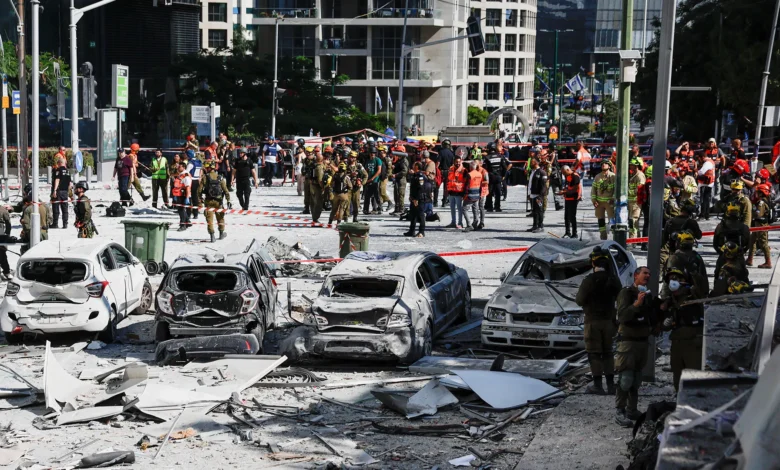
The international coalition’s air defence system successfully intercepted ten explosive-laden drones over Erbil, highlighting the scale of the Iranian threat facing the region.
The city of Erbil has once again entered the circle of regional military escalation after authorities in Iraq’s Kurdistan Region announced on Wednesday that the international coalition’s air defence system had intercepted ten explosive-laden drones in the province’s airspace. The development reflects the expansion of the confrontation between Washington and Tehran onto Iraqi territory and places the region directly in the line of Iranian fire.
Kurdistan’s Counter-Terrorism Service explained that the interception operation took place between 1:13 a.m. and 3:31 a.m. The drones were shot down and destroyed before they could cause any human casualties. The incident points to an increasing reliance on drones as a means of attacking sites hosting U.S. forces and interests in the region.
According to a security source cited by the Iraqi Kurdish news outlet Shafaq News, the relevant authorities also intercepted two drones over the city of Erbil. Meanwhile, Iran’s Islamic Revolutionary Guard Corps announced that it had targeted sites it claimed were linked to the U.S. military inside the city, including a maintenance centre, warehouses containing technical equipment, and an aerostat guidance system.
The escalation comes at a time when the region is experiencing one of its most intense periods of tension, amid the continuing confrontation between Washington and Tehran and the exchange of strikes between the two sides. Bases and facilities hosting U.S. military personnel have increasingly become potential targets for attacks linked to the conflict.
These incidents do not appear to be isolated from a series of attacks that have struck the region in recent months. Last month, a private office belonging to Iraqi Kurdistan Region Prime Minister Masrour Barzani and the residence of the head of the Kurdish intelligence agency were targeted in drone attacks, for which Tehran denied responsibility at the time. In March, a drone also targeted the residence of Kurdistan Region President Nechirvan Barzani, in an incident that added a political dimension to the threats facing the Kurdish leadership.
At the same time, sites belonging to Iranian opposition groups have been targeted in attacks attributed to the Revolutionary Guard, placing the region at the centre of a complex network of strikes linked to Iran’s internal conflict and the broader confrontation between Tehran and its regional and international adversaries.
Erbil is seeking to strengthen its ability to deal with such threats by expanding its security and military cooperation with the United States and Western countries. However, the limited nature of its independent defensive capabilities remains a major vulnerability. In an interview with Al-Monitor last month, Masrour Barzani called for the development of an air defence system capable of countering ballistic missiles and drones, stressing that the region still lacks independent and effective means of intercepting projectiles that could be launched from Iranian territory or by groups linked to Tehran.
Kurdistan authorities say that the number of attacks targeting the region since the outbreak of the U.S.-Israeli war against Iran on February 28 has exceeded 1,000. According to Kurdish officials, this figure reflects a fundamental shift in the security environment surrounding Erbil, as drones and missiles have become a recurring threat to vital and strategic sites.
Masrour Barzani believes that the region has provided no justification for being drawn into the circle of targets. He stressed that Erbil has not sought to threaten neighbouring countries or participate in the regional war. In his view, the continued strikes may be intended to exert pressure, intimidate the Kurdistan Region, and push it into a confrontation that its authorities do not wish to become part of.
As attacks continue to increase and reach political, security, and military sites, concerns are growing that the Kurdistan Region could become one of the open theatres of confrontation between Iran and the United States. Such a development would not only threaten Erbil’s security but could also increase the likelihood of a broader escalation across Iraq and the region, particularly if attacks move beyond targeting specific sites and begin striking civilian facilities or critical infrastructure.