Has the Zelensky Era Come to an End?
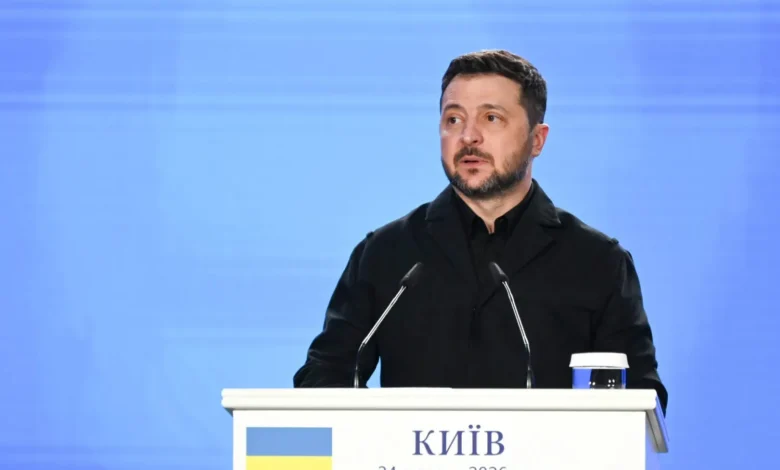
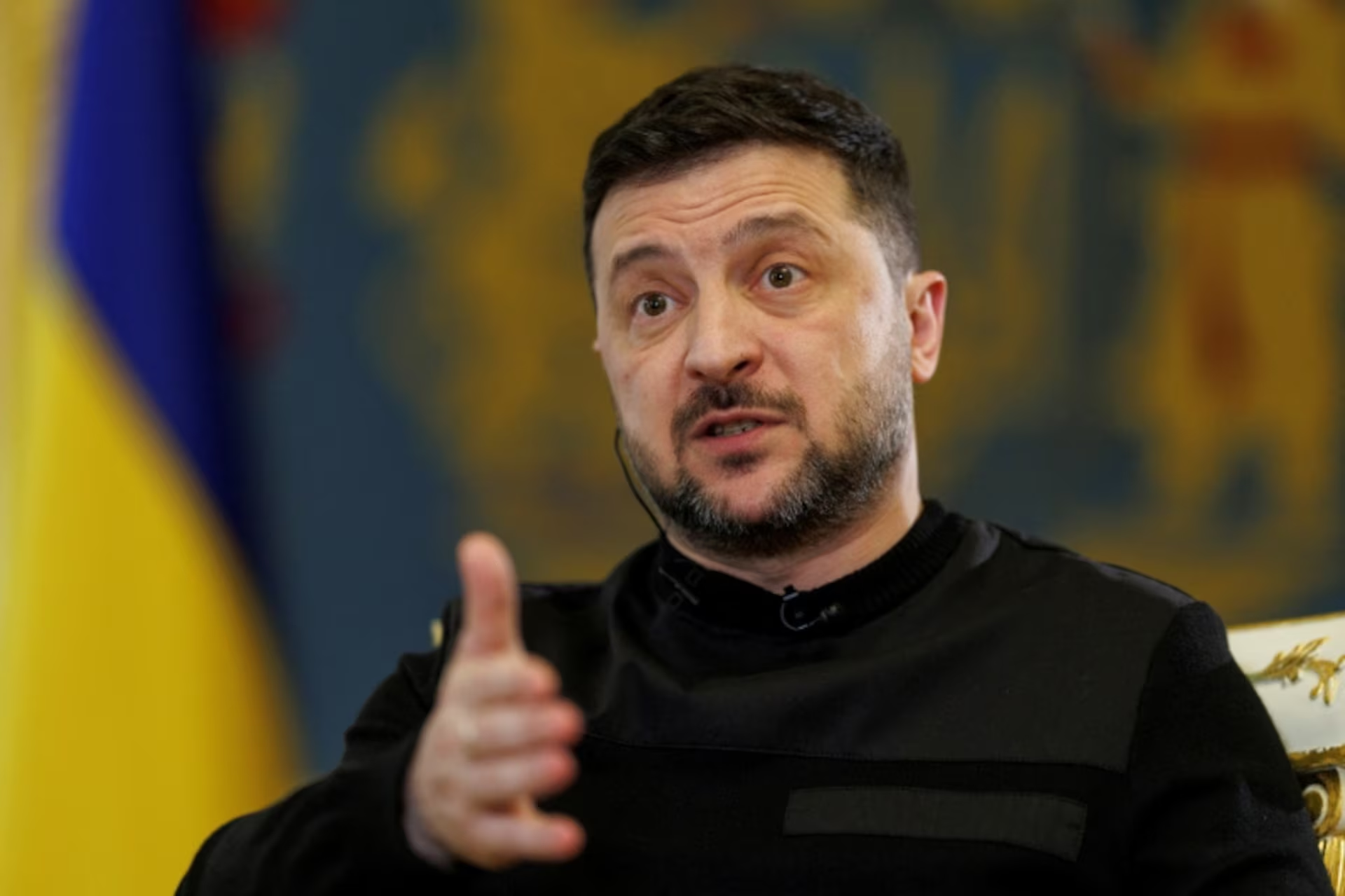
Caught between the desire for political change and the continuation of the war, Ukrainian President Volodymyr Zelensky is facing a democratic crisis.
Is it time for Zelensky to bring his political career to an end? That is the question raised by the forceful call from Ukrainian Defense Minister Mykhailo Fedorov for presidential elections to be held.
Although the move was met with widespread discontent in Ukraine, which remains under martial law and subject to daily bombardment, it has exposed a dilemma that is becoming increasingly acute with every additional year of war, according to the British newspaper The Telegraph.
The newspaper asked when the duty of national defense begins to erode democracy, when a wartime leader should step aside, and how long Ukraine can continue to set aside normal political life while opinion polls show that many Ukrainians are eager for a change of government.
Last Tuesday, 35-year-old Fedorov said in a televised video address: “Russia cannot hold democracy hostage. We must find a legal, safe and realistic mechanism that will allow Ukraine to fully restore its democratic process, even amid a prolonged war.”
The clear implication was his criticism of what he described as a “systemic crisis of governance” and his call to reform the “old system,” at a time when Zelensky’s presidential term officially expired in May 2024.
However, holding elections during wartime would violate the Ukrainian Constitution and appears impractical to many observers, since Russia’s continued bombardment would make traveling to polling stations a potentially deadly undertaking.
Fedorov served the government loyally for seven years in various positions, most recently as defense minister. He is credited with overseeing a new drone-inspired military strategy. However, a dispute broke out between Fedorov and Oleksandr Syrsky, the chief of the General Staff, prompting Zelensky to dismiss him last month. The decision sparked public outrage. Zelensky eventually relented and dismissed the chief of the General Staff, but Fedorov was not reinstated.
Despite his popularity, Fedorov’s call for elections backfired dramatically. A former security official said: “This is ridiculous. He is clearly trying to exploit his current popularity for his own political or party gains. It is childish behavior.”
Lawmaker Oleksiy Honcharenko, an outspoken critic of Zelensky’s government, also believes that holding elections is not feasible. “How can people be protected if they go to polling stations? How will military personnel vote? How will refugees vote? How will residents of areas bordering the front line vote?” he asked.
He added: “If Fedorov wants such elections to take place, he cannot simply say that it is difficult but that we will find a solution. No. Tell us what the solution is.”
Honcharenko warned that the winner of an election conducted under the shadow of war would never be able to claim the legitimacy of a free and fair election, thereby undermining national unity.
One Kyiv resident mocked the situation, saying: “It is convenient that Fedorov suddenly found his voice as an opposition politician in the very year he turned 35, the minimum age required to run for president.”
Dmytro Koziatynsky, a former soldier who organized protests calling for Fedorov’s reinstatement, said: “I view wartime elections negatively. I cannot imagine how it would technically be possible to enable thousands of soldiers currently serving on the front lines to vote. I am also concerned about social divisions during the electoral process and how they could affect the course of the war.”
Even Zelensky’s strongest potential presidential rivals, including former President Petro Poroshenko, former Prime Minister Yulia Tymoshenko, and former army chief and current ambassador to London Valerii Zaluzhnyi, continue to abide by the ban on political confrontation.
Fedorov may have misread the public mood, but he is reflecting growing frustration in Ukraine. Political analyst Volodymyr Fesenko said: “Most people who want a change of government believe that it should happen only after a ceasefire.”
A poll conducted by the Kyiv International Institute of Sociology in June last year showed that 67% of Ukrainians wanted a new president after the war, compared with 23% in 2023. However, the latest surveys show that only 15% of Ukrainians support holding elections during wartime.
A study conducted by the Kyiv International Institute of Sociology last month indicated that Zelensky enjoys the trust of at least 56% of Ukrainians as long as the war continues, while Fedorov has the confidence of 63%.
As the war drags on, tensions between these two imperatives are growing: unity against Russia on the one hand, and the desire for political change on the other. Zelensky’s team is aware of this and has discussed the possibility of holding elections if a ceasefire is reached.
Zelensky is also facing external pressure. The White House suggested last year that Kyiv was “using the war” to avoid elections. The Ukrainian president responded that his country could be ready to hold elections within 90 days if its allies helped guarantee security.
For now, these discussions remain theoretical. But with the prospects for a ceasefire still slim, the current consensus may eventually change, according to Orysia Lutsevych, deputy director of the Russia and Eurasia Programme at Chatham House.
Lutsevych pointed to a possible turning point three years from now. By then, Zelensky would have spent roughly ten years in power, equivalent to the maximum of two presidential terms, and public opinion could begin asking what kind of war the constitutional ban on elections was designed to address. And if the war were to last for decades, would that mean Zelensky’s presidency should also continue for decades?
Zelensky’s standing has been severely damaged by a series of corruption scandals involving close aides, as well as an apparent lack of accountability and his tendency to centralize power while excluding political opponents.
Some of Zelensky’s problems are also self-inflicted, including the decision to dismiss Fedorov, an unjustified move that turned an ally into an adversary and triggered protests that helped transform Fedorov into an opposition leader.
Last summer, under pressure from protests, Zelensky was forced to abandon a plan to undermine the independence of anti-corruption agencies. Months later, those agencies exposed the alleged involvement of several senior government officials in a major corruption case that led to the removal of the ministers of Justice and Energy, as well as the head of the presidential office, Andriy Yermak.
The crisis resurfaced last Wednesday when Zelensky was forced to dismiss Iryna Mudra, deputy head of the presidential office, following reports that her home had been searched in connection with new allegations related to the case.
Nevertheless, Zelensky has weathered previous political storms, and there is currently no reason to conclude that he will not survive this crisis as well. He remains the legitimate president, and constitutionally and practically, elections remain impossible under the current circumstances. In the meantime, there is still no clear solution to the persistent tension between national unity and democracy.