Ghannouchi and the Secret Apparatus Case of Tunisia’s Muslim Brotherhood: Absence as an Escape Does Not Halt Accountability
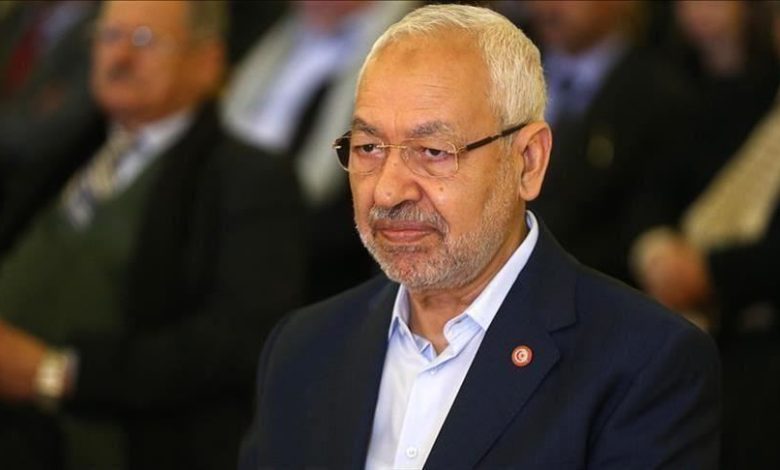
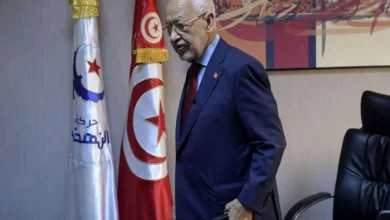
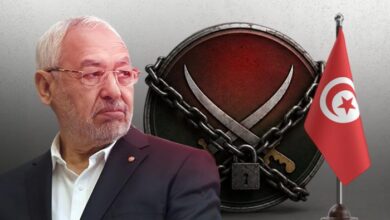
As the Tunisian judiciary approaches its verdict in the case of the alleged “secret apparatus” linked to the Ennahdha Movement, the movement’s leader, Rached Ghannouchi, continues to boycott court hearings, a move that analysts describe as “an attempt to evade accountability.”
A Tunisian court has postponed consideration of the case and the issuance of its verdict until next Tuesday after Ghannouchi refused to appear before the court for questioning.
On Friday evening, the Criminal Chamber specializing in terrorism cases at the Tunis Court of First Instance concluded the hearing of lawyers’ arguments in what is known as the “Ennahdha Secret Apparatus” case. The court scheduled a session for next Tuesday to hear the final requests of the defendants and deliver its ruling.
Rached Ghannouchi, who is among those investigated in the case, refused to appear before the court.
Under Tunisian law, the court may continue proceedings and try any defendant who refuses to appear in absentia.
Since his arrest in April 2023, Ghannouchi has refused to appear before judicial authorities for questioning in all cases in which he is being prosecuted, including charges related to corruption and terrorism.
Observers of Tunisia’s political landscape believe that Ghannouchi is attempting to evade both the judiciary and public scrutiny by hiding behind his absence from court proceedings.
Last week, the Criminal Chamber began its questioning process by hearing testimony from Ali Larayedh, a senior Ennahdha leader and former Minister of the Interior, along with his former adviser.
During a second session, the court questioned the former Director of Counterterrorism at El Gorjani, Ennahdha official Abdelaziz Daghsni, and the former Director-General of Specialized Services at the Ministry of the Interior. During a third session, it proceeded with the interrogation of the remaining defendants who are being prosecuted while at liberty.
The investigation involves 35 individuals, including five defendants currently in detention, among them Ennahdha leader Rached Ghannouchi, Ali Larayedh, and Fathi Beladi, a security official and former adviser to Larayedh. Twelve defendants are being prosecuted while free, while eleven others are fugitives, including Mustapha Khedher, who is accused of overseeing the movement’s secret apparatus.
The legal team representing politician Chokri Belaid, who was assassinated on February 6, 2013, considers the “Ennahdha Secret Apparatus” case to be part of the broader political assassination case.
Kethir Bouallag, a member of Belaid’s defense team, previously stated that “senior and mid-level Ennahdha leaders have been charged in more than one case,” explaining that “the Chokri Belaid assassination case is divided into several files, most notably the execution group, the surveillance and recruitment group, the secret apparatus, and the planning group.”
On January 22, 2022, Tunisian judicial authorities opened an investigation into Ennahdha’s secret apparatus, which has been accused of involvement in Belaid’s assassination, espionage activities, and infiltration of state institutions.
Escape Through Absence
Tunisian political activist Khaled Beltaher said that the secret apparatus played a role in political assassination cases, arguing that Ghannouchi’s refusal to appear before the court represents an attempt to evade justice and hide behind his absence.
He stated that Ghannouchi is trying to mislead public opinion and create the impression of innocence.
According to Beltaher, since coming to power, Ennahdha has established parallel structures within the state in sensitive sectors such as security, the judiciary, and labor unions.
He added that next Tuesday could represent a decisive day in the history of Tunisia’s Muslim Brotherhood organization, as the anticipated rulings could mark its end and deal it a severe blow.
He further noted that judgments have already been issued against the execution, recruitment, and planning groups in the Belaid assassination case, while the secret apparatus case, considered part of the assassination file, has yet to be resolved.
Case Details
Former Interior Minister Lotfi Ben Jeddou previously stated that Ennahdha possessed surveillance equipment exceeding the capabilities of Tunisia’s military and security services. The equipment, reportedly transported in suitcase-like devices inside closed vehicles, was capable of intercepting up to 4,000 calls simultaneously.
During a 2015 search of a driving school owned by Mustapha Khedher in El Mourouj, a suburb of Tunis, authorities reportedly discovered documents containing detailed lists of thousands of criminals in the Greater Tunis region, including their identities and telephone numbers.
Khedher was also responsible for handling the private correspondence of former Interior Minister Ali Larayedh despite holding no official position.
Khedher is considered a principal suspect in the Chokri Belaid assassination case. He was imprisoned in 2013 for concealing information related to the assassination, but according to the allegations, Ennahdha later secured his release and facilitated his departure from Tunisia eight years afterward.
A former military officer, Khedher belonged to a security group known for its links to Ennahdha and accused of attempting a coup against former President Habib Bourguiba in 1987. He was released from prison following the fall of former President Zine El Abidine Ben Ali’s regime.
According to the allegations, Khedher was tasked with collecting personal information on security personnel, journalists, and even taxi drivers who could potentially be relied upon to assist the movement’s plans.
Information previously disclosed by the defense team also described the secret apparatus as including an intelligence network within the state composed of approximately 21,000 individuals integrated into the Tunisian administration under the General Amnesty Law and appointed to sensitive positions.
According to those claims, the structure included several Ennahdha figures and leaders, among them Mustapha Khedher (currently abroad), Hichem Cherib, Charafeddine Krissaane, Khaled Triki, Taher Boubahri, Kaïs Bakkar, Belhassen Nakkach, Ali Ferchichi, Kamel Aifi, Ridha Barouni (also abroad), Aroussi Ben Ibrahim, Slimane Oues, Tammam Isbaï, as well as security officials such as former Tunisian intelligence chief Mahrez Zouari, Fathi Beladi, and Samir Hannachi.