The Coordination Framework leans more toward al-Maliki as candidate for Prime Minister
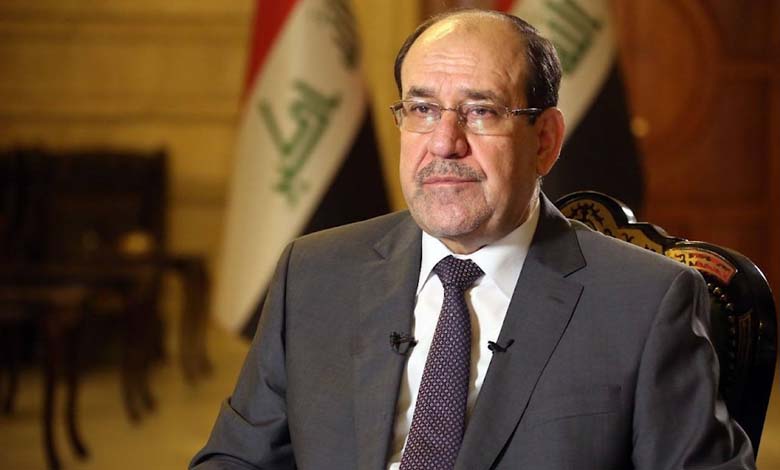
Informed sources reveal that the head of the State of Law coalition has secured the support of eight leaders within the Coordination Framework.
The “Coordination Framework,” which brings together political forces aligned with Iran, is approaching a resolution to the issue of the premiership. Reports indicate that the leader of the State of Law coalition, Nouri al-Maliki, is close to settling the matter either in his own favor or in favor of a candidate who enjoys his full backing, placing the ambitions of the caretaker Prime Minister, Mohammed Shia al-Sudani, under serious strain.
After days of sharp polarization, the political scene has begun to tilt clearly toward the “al-Maliki camp.” Well-informed sources confirmed that the rivalry, which had recently reached its peak, has gradually subsided due to al-Maliki’s strategy of “collecting signatures,” through which he managed to win over the majority of Framework leaders by securing between seven and eight votes out of twelve representing the leadership of the “Shiite house.”
The internal agreement within the Framework stipulates that whoever obtains eight votes automatically ensures the endorsement of the rest to ratify his choice, a threshold that the head of the State of Law coalition is now on the verge of reaching.
Despite al-Maliki’s progress, a strong front continues to express clear reservations about his return to power or any monopolization of decision-making. This front includes prominent political figures such as Mohammed Shia al-Sudani, who seeks a second term and is a direct rival, Ammar al-Hakim, leader of the Wisdom Movement, who will host the decisive meeting scheduled for Saturday, Qais al-Khazali, Secretary-General of Asa’ib Ahl al-Haq, and Haider al-Abadi, head of the al-Nasr coalition.
These reservations indicate that the battle is not merely about “numbers,” but rather a struggle over the shape of the next phase and the distribution of power centers.
As the decisive meeting approaches, several scenarios emerge. The first involves announcing Nouri al-Maliki as the official candidate of the Coordination Framework after surpassing the eight-vote threshold, a move that could provoke mixed reactions domestically and internationally.
The second scenario would see the head of the State of Law coalition use his voting bloc to impose an alternative “shadow” candidate who would act under his directives, thus ensuring his control over government decision-making without remaining directly in the spotlight. This option could represent a “middle ground” to appease opponents.
Informed sources have not ruled out the possibility of a last-minute consensus through pressure toward mutual concessions to prevent a fracture within the Framework, particularly given the narrow legal timeframe following the election of the President of the Republic.
This movement comes at a critical moment when there is no longer room for political maneuvering. The meeting scheduled for Saturday represents a “turning point”: either the Framework proceeds with a strong candidate backed by a comfortable majority, or it faces a division that could return the crisis to square one.