Sudan’s Muslim Brotherhood and Iran: how the threads of the spider’s web tighten around Al-Burhan
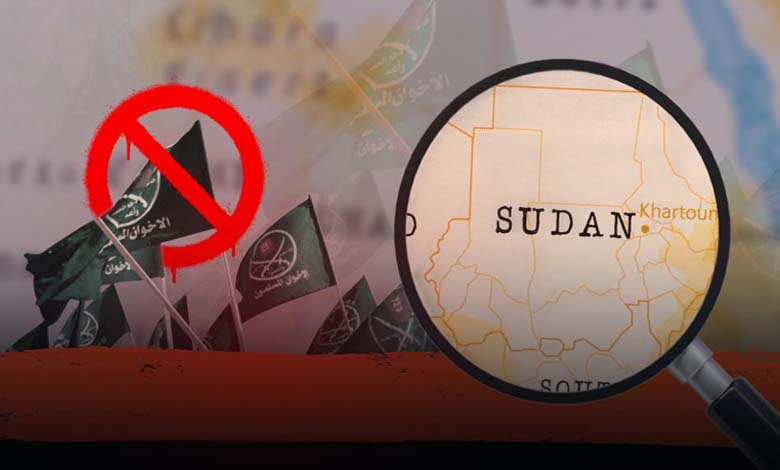
Is it truly possible to separate the Sudanese army from the Muslim Brotherhood and Iran, in other words to achieve a real division between components of a structure formed over decades?
This question arises as observers argue that the real issue lies not only in the relationship between the commander of the Sudanese army, Abdel Fattah al-Burhan, and the Muslim Brotherhood and Iran, but primarily in the nature of the institution itself.
They contend that the army itself is a product of this entanglement, as it represents a full structure built over decades, in which military authority has intertwined with ideological and economic networks to such an extent that separating them would resemble dismantling a body from within without causing it to collapse.
Sanctions: what role?
An analysis by the Washington Institute for Near East Policy suggests that imposing sanctions on Sudan’s Muslim Brotherhood could influence Al-Burhan’s approach toward the group. However, it notes that a genuine separation would likely require greater pressure given the networks’ role in the current conflict.
The analysis reviews the historical background of the Muslim Brotherhood in Sudan, noting that for three decades the group served as the backbone of the regime of Omar al-Bashir. Its influence did not end with the fall of the regime but continued through networks within state institutions.
With the outbreak of war in April 2023, the chaos of the conflict allowed these networks to maintain, and even strengthen, their positions through rhetoric framed as defending the state, which contributed to delaying accountability processes.
Based on these factors, it appears difficult to achieve a real separation between the army and the networks linked to it, especially as many officers promoted during Al-Bashir’s era remain directly or indirectly connected to them.
According to the article, any attempt to remove these officers would risk undermining the cohesion of the military institution during wartime, a gamble Al-Burhan cannot afford, even if he wished to.
On March 16, the U.S. State Department designated Sudan’s Muslim Brotherhood as a foreign terrorist organization, a decision that coincided with a critical turning point marked by increasing Iranian involvement in the Sudanese war and the deeper integration of the group within the military apparatus.
The article argues that the implicit message of this decision reflects Washington’s view of the group as a major obstacle to peace and stability rather than a secondary actor in the conflict.
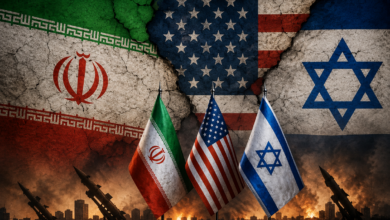
On the day of the designation, Massad Boulos, Senior U.S. Advisor for Arab and African Affairs, stated that “the United States continues to use all available tools to counter malicious Iranian influence.”
This statement places Sudan within the broader framework of containing Iran’s regional influence.
War as a means of survival
By banning the Muslim Brotherhood, Washington is targeting a key actor in the country. For 30 years, the movement served as the ideological pillar of Al-Bashir’s regime, turning Sudan into a hub for transnational Brotherhood activity.
Many events at the time reflected Al-Bashir’s deliberate policy of strengthening ties with armed and ideological networks across the region. After his removal, these networks largely remained intact within state institutions, even without formal roles.
The current war has given some of these networks an opportunity to regain influence through misleading slogans, delay accountability, and preserve their positions within the power structure. For Sudan’s Muslim Brotherhood, the war is not a crisis but an opportunity to be exploited.
Iran: an ally that never disappeared
According to the official U.S. statement accompanying the designation, Sudan’s Muslim Brotherhood helped recruit more than 20,000 fighters for Al-Burhan’s forces during the war, many of whom reportedly received training from the Islamic Revolutionary Guard Corps.
Regarding relations with Tehran, the article notes that the break in 2017 did not fully end these ties. Al-Burhan reopened communication channels with Iran in October 2023 to secure military support, including drones.
This timing was likely not coincidental, as reports suggest that one factor motivating Iran to restore relations with Sudan was the possibility of reopening supply lines to transfer weapons to the Palestinian movement Hamas via Sudan.
Tehran supplied drones to the Sudanese army, bringing Sudan back into Iran’s orbit in a manner reminiscent of Al-Bashir’s era, when Iran sought to use the country as a warehouse for storing weapons and rearming regional allies.
In this sense, Sudan has become not merely a partner of Iran but a logistical hub within its regional influence network, placing the country in a strategic alliance that far exceeds the scope of its internal crisis.
The analysis highlights a contradiction in Al-Burhan’s position, as he seeks to maintain relations with countries opposed to Iran while signs of rapprochement appear within his own camp.
It cites a viral video showing Sudanese soldiers in uniform declaring their readiness to defend Iran, which prompted Al-Burhan to distance himself from the footage.
In this context, the analysis refers to factions within the military institution, such as the “Al-Baraa Brigade,” which operate within the official structure while retaining a degree of autonomy, reflecting the complexity of decision-making within the army and raising questions about the extent of command control.
These factors, the analysis concludes, make any genuine separation between the army and these networks extremely difficult, especially since many officers promoted during Al-Bashir’s era remain linked to them, directly or indirectly, making any purge a risky endeavor.
Regarding pressure tools, the analysis suggests that sanctions can be effective if they precisely target these networks without harming state institutions, while closely monitoring attempts by these groups to reconstitute themselves under different names.