Shooting Down Two Iranian Aircraft in Qatar Changes the Rules of Engagement in the Gulf
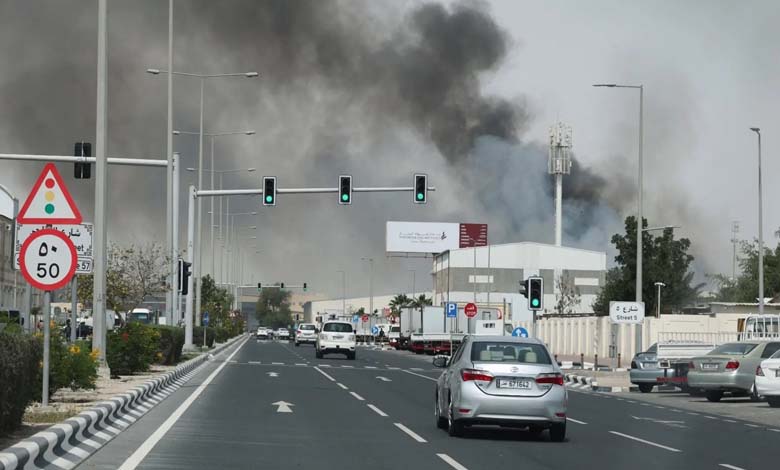
The successful interception of two Iranian Sukhoi-24 fighter jets reflects advanced integration between early warning and detection systems, air defense networks, and combat aviation forces in the Gulf states.
The Gulf region has entered a new phase of military tension following the announcement by Qatar’s Ministry of Defense on Tuesday that it had shot down two Iranian Sukhoi-24 fighters and intercepted several ballistic missiles and drones, which Doha stated were launched toward its territory as part of Iran’s response to recent U.S. and Israeli operations against Tehran. This development marks a regional precedent, as it is the first official acknowledgment of downed Iranian combat aircraft, carrying military and political implications beyond the incident itself.
-
The war against Iran: a conflict aimed at shaping the future of the global system
-
US and Iran: The Venezuela Scenario Deemed Improbable Without Ground Intervention
The Qatari statement noted that air defenses engaged seven ballistic missiles and five drones, successfully intercepting all targets before they could reach sensitive sites. The statement did not address the fate of the Iranian pilots, but the mere downing of the two aircraft represents a qualitative shift in the nature of the confrontation, moving from unmanned attacks to direct engagement with manned combat aircraft.
This escalation comes as part of a broader Iranian response to strikes targeting installations within the Islamic Republic in recent days. With the expansion of the response, Gulf states are now within the operational theater, placing the region in a more complex security equation, particularly given the overlap of military and economic dimensions in an environment heavily dependent on stable energy facilities and critical infrastructure.
-
Unprecedented Double Missile Strike from Lebanon and Iran Hits Israel
-
NATO Defenses Intercept Ballistic Missile Launched from Iran Toward Turkey
Strategically, the Qatari announcement signals a shift in the previously unspoken rules of engagement. Iran had previously relied on missiles and drones as relatively low-cost pressure tools, allowing it to send political messages without sliding into direct conventional confrontation with regular Gulf forces. The downing of fighter jets now implies that any airspace violation will face immediate retaliation, redefining the boundaries of mutual deterrence.
Additionally, announcements from Saudi Arabia, Bahrain, the United Arab Emirates, and Kuwait regarding the interception of numerous missiles and drones indicate that Gulf states now possess unprecedented deterrence capabilities, enabling them to protect their citizens.
-
The Iran War in the “MAGA” Balance: Supporters Outnumber Opponents
-
Shooting Down Two Iranian Aircraft in Qatar Changes the Rules of Engagement in the Gulf
Military experts note that the successful interception reflects advanced integration between surveillance and early-warning systems, air defense networks, and combat aviation. Handling multiple simultaneous targets—ballistic missiles, drones, and fighter jets—requires managing a complex aerial battle in record time, along with the ability to allocate defensive resources efficiently to prevent saturation of defense systems.
This development strengthens Doha’s position within the Gulf security framework, demonstrating operational readiness capable of protecting national airspace and critical infrastructure. It also sends a clear deterrence message, signaling that the cost of any direct aerial escalation would be high. In a region marked by intertwined alliances, this dimension is especially significant, raising the stakes for any party considering expanding the conflict.
-
The Map of the Day After the War… Scenarios of Governance and Control in Iran
-
The Major Wave Has Not Yet Begun… Latest Developments in the War in Iran
Economically, the event is no less sensitive than its military implications. Qatar announced a temporary suspension of liquefied natural gas production as a precautionary measure following the attacks, highlighting the vulnerability of energy supply chains to military threats. As one of the world’s largest LNG exporters, any disruption to production or shipments immediately impacts international markets in Europe and Asia, potentially causing sharp price volatility if tensions persist.
Analysts warn that repeated attacks on Gulf energy infrastructure could generate prolonged market uncertainty, especially if operations extend to shipping lanes or liquefaction and storage facilities. Protecting these assets is therefore no longer just a national concern but part of global energy security.
-
Israel strikes the Iranian leadership complex, the regime’s most central and strategic headquarters
-
Iran Strikes Ignite a Constitutional Battle Between Congress and the White House
Politically, the Qatari announcement underscores Doha’s role as a regional actor capable of making decisive decisions in critical moments. Rapid military action, followed by a clear official statement, demonstrates the desire to establish an independent deterrence equation, while aligning with broader security commitments within Qatar’s network of international defense partnerships.
The incident also opens a regional debate on the future of aerial balance. Engaging manned aircraft differs qualitatively from downing drones, in terms of political risk and potential escalation. Should Tehran respond to the downing of its fighters, the region could enter a more dangerous phase requiring intensive diplomatic containment efforts to avoid open confrontation.
-
After its involvement in the Iran war, Lebanese calls grow to ban Hezbollah
-
Iran shuts the door on negotiations with the United States
Operationally, the interception’s success reflects the evolution of the “integrated defense” concept, in which intelligence information is fused with radar systems, launch platforms, and interceptor aircraft within a single network. This model aims to reduce response times and increase engagement accuracy, a crucial element when facing complex and simultaneous threats.
Moreover, the escalation highlights the need to secure critical infrastructure through multiple layers, not limited to air defenses but including ground protection, risk distribution, and business continuity planning. Past regional experience has shown that limited strikes can have economic impacts far exceeding their military scale.
-
The black Tomahawk: a new weapon in the skies of the Iran conflict
-
The end of the war with Iran: three scenarios between collapse and negotiation
The downing of the two Iranian fighters thus represents a pivotal moment in Gulf-Iran tensions. It demonstrates advanced defensive capability, reshapes aerial deterrence boundaries, and places energy security at the center of military calculations. While the next steps will depend on reciprocal responses, it is clear that the Gulf now faces a more sensitive security reality requiring a careful balance between military firmness and diplomatic openness to prevent escalation.
-
Here is the Iranian Supreme Leader’s complex… Satellite images reveal extensive destruction
-
After Strikes Targeting the Supreme Leader and the President: Key Pillars of the Iranian Regime