Legal challenges facing Iran in imposing transit fees in the Strait of Hormuz
The United Nations Convention on the Law of the Sea has become part of customary international law. However, some non-signatory states, such as Iran, may argue that they are not bound to comply with it.
Tehran is seeking to tighten its control over the Strait of Hormuz by imposing fees on vessels to ensure safe passage, in coordination with the Islamic Revolutionary Guard Corps, but this effort is surrounded by numerous legal complications.
-
Legal challenges facing Iran in imposing transit fees in the Strait of Hormuz
-
Maritime threat level in the Strait of Hormuz at its highest
The Strait of Hormuz is a maritime passage linking the Persian Gulf to the Gulf of Oman, located between the territorial waters of Iran and Oman. It can arguably be described as the most important energy shipping route in the world, as roughly 20 percent of global oil supplies pass through it.
The waterway stretches approximately 104 miles (167 kilometers). Its width varies and, at its narrowest point, it consists of two shipping lanes, each two miles wide for inbound and outbound traffic, separated by a two-mile buffer zone.
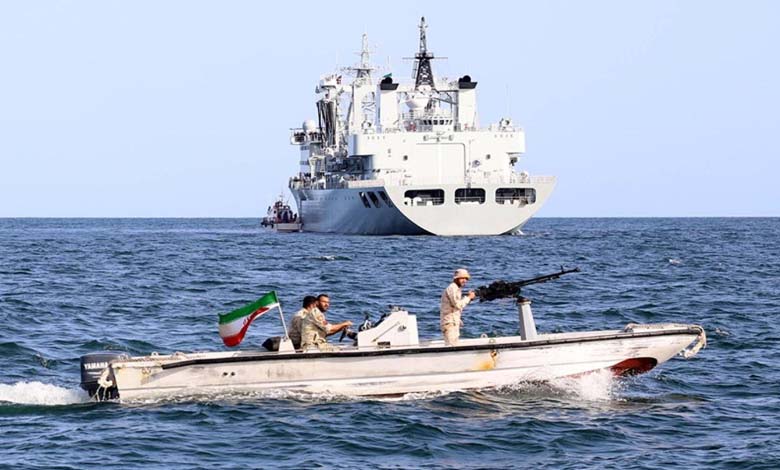
Iran has effectively closed the strait following strikes carried out by the United States and Israel on its territory and is claiming the right to collect transit fees as a precondition for ending the war. No confirmed collection of such fees has been reported so far.
-
Advanced techniques and striking power: how the United States besieges Iran and clears the Strait of Hormuz
-
U.S. threats push oil tankers to avoid the Strait of Hormuz
The United Kingdom’s Home Secretary, Yvette Cooper, rejected any imposition of transit fees, stating that “any proposal to impose charges for safe passage through the Strait of Hormuz undermines our global economic security.”
The United Nations Convention on the Law of the Sea was adopted in 1982 and entered into force in 1994.
Article 38 grants vessels the right of unimpeded transit through more than 100 straits worldwide, including the Strait of Hormuz.
The convention allows any state bordering a strait to regulate traffic within its “territorial waters” up to 12 nautical miles from its coastline, while permitting “innocent passage.”
-
Report: Iran cannot open the Strait of Hormuz, even if it wanted to
-
Trump proposes U.S. support to ensure smooth navigation in the Strait of Hormuz
Passage is considered innocent as long as it does not threaten the security, order, or safety of the state. Military activities, serious pollution, espionage, or fishing are not permitted. The concept of innocent passage was central in a 1949 ruling by the International Court of Justice concerning the Corfu Channel between Albania and Greece.
Around 170 states and the European Union have ratified the convention. Iran and the United States have not. This raises the question of whether the rules guaranteeing freedom of maritime navigation have become part of customary international law or apply only to signatory states.
Experts argue that the convention has become, or is generally regarded as, customary international law. Nevertheless, some non-signatory states may claim they are not legally bound by its provisions.
-
U.S. intelligence expects a long-term Iranian grip over the Strait of Hormuz
-
Trump ready to stop the war on Iran without reopening the Strait of Hormuz
There is no formal enforcement mechanism for the convention. The International Tribunal for the Law of the Sea in Hamburg and the International Court of Justice in The Hague can issue rulings, but they lack the means to enforce them.
States and companies, however, have other potential tools to counter such fees.
Any state or coalition of states may act to uphold the convention’s principles. The United Nations Security Council may pass a resolution opposing the imposition of such charges.
Companies can also reroute their shipments away from the Strait of Hormuz, a process that has already begun. States may further expand sanctions targeting financial transactions believed to benefit the Iranian government by sanctioning companies willing to pay such transit fees.
-
Toward an alliance to secure Hormuz: meeting of the chiefs of staff of 35 countries
-
Twenty countries prepare to take part in securing the Strait of Hormuz