Al-Qaeda before the Malian storm: leadership changes and the choking of arteries
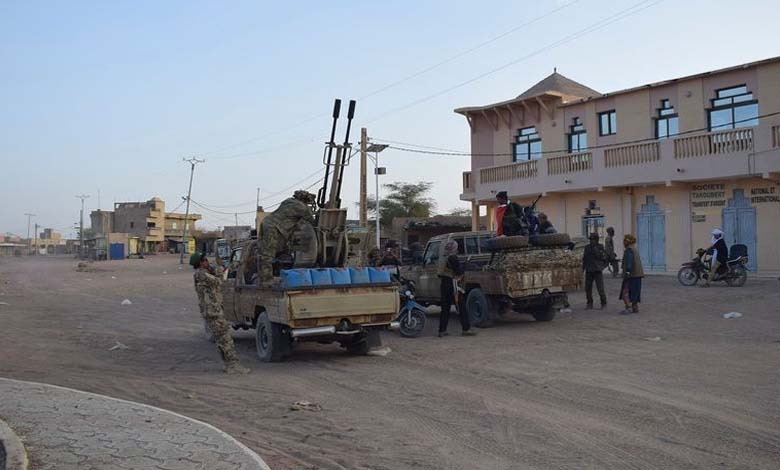
A dramatic shift is unfolding in Mali, foreshadowing repercussions beyond the country across the wider Sahel region of Africa, following the takeover by Al-Qaeda’s branch of a strategic northern city.
Extremists affiliated with Al-Qaeda, allied with armed rebels, took control on Monday of the strategic northern city of Kidal after two days of fighting with the army, in a development that casts a shadow over the country’s future.
Mali has faced a security crisis for more than a decade, but the attacks carried out on Saturday by terrorists from the Group for the Support of Islam and Muslims, affiliated with Al-Qaeda, along with elements of the Azawad Liberation Front, are unprecedented since the military council took power in 2020.
In a notable development, Defense Minister General Sadio Camara, 47, considered one of the council’s key figures, was killed in an attack carried out by the Group for the Support of Islam and Muslims, amid reports that these extremist forces continue advancing in other towns.
This development was preceded by significant steps and changes in the leadership of the terrorist organization in Mali in particular, as noted in a report by the United Nations panel of experts on counter-terrorism, presented to the Security Council last month, a copy of which was reviewed.
Major concern
The report states that terrorism in West Africa, particularly in the Sahel region, remains “a major source of concern for Member States,” highlighting the “significant gains” made by groups affiliated with Al-Qaeda and the Islamic State.
It notes that the Group for the Support of Islam and Muslims, in particular, has carried out several attacks over a wider geographical area and has remained active in Mali, Burkina Faso, and Niger, while continuing to expand southward toward coastal states and northwestern Nigeria.
Leadership change
According to the report, Member States reported “changes within the leadership of the Group for the Support of Islam and Muslims.” Donam Daghiri, known as Abdelrahmane al-Jaziri, replaced Abdelrahmane Talha, nicknamed “Abu Talha al-Liby,” as head of what is referred to as the “Emirate of Timbuktu,” a strategic northern Malian city.
Member States also indicated that the group has a new media chief, Abu Sufyan al-Muhajir, appointed in November 2024.
Meanwhile, Seko Mouslimou, a Burkinabe national and one of the group’s senior leaders in that country, was appointed head of the group’s branch in eastern Burkina Faso and tasked with expanding its presence into Niger, Benin, Togo, Côte d’Ivoire, and Ghana, while Sheikh Albani was appointed to what the group calls the position of “Emir of Benin.”
A new front in Mali
In Mali, Al-Qaeda’s branch had concentrated its activities in the northern and central regions, while the western region has recently emerged as a new front, according to the report.
It adds that “the group has demonstrated its ability to carry out large-scale coordinated attacks on multiple fronts and expanded its operations beyond military targets to include economic ones, notably attacking mining sites and industrial facilities run by foreign investors, as well as conducting kidnappings for ransom and attacking key strategic logistical routes.”
Cutting the arteries
According to the report, last August Al-Qaeda mobilized fighters along Malian highways coming from Senegal, Côte d’Ivoire, Mauritania, and Guinea, in preparation for the siege it imposed on fuel supplies to Bamako.
“Starting in September, the group implemented the siege by systematically targeting fuel convoys arriving from neighboring countries, destroying hundreds of fuel tankers, disrupting fuel transport to Bamako, and thereby exerting economic pressure on the Malian government,” the report states.
Security blows
The report notes that in late October Malian security forces targeted the group’s positions, killing several of its leaders, including Ridouane al-Ansari, near the Boucle du Baoulé forest west of the capital, Bamako.
In mid-November, Abu Salam Amrou, another key leader, was killed in Soumpi in the Timbuktu region during an operation carried out by the Malian armed forces.
Objective of the siege
The report explains that “despite the pressure on Bamako, Member States assessed that it is unlikely the Group for the Support of Islam and Muslims will overrun the city in the near future, as it lacks the capacity to occupy it.”
However, it adds that the group is likely to continue the siege in an attempt to force the Malian government into negotiations.
The report also notes that between August and October, clashes erupted between the Islamic State in the Greater Sahara and the Group for the Support of Islam and Muslims in Burkina Faso, Niger, and Mali, in a struggle for influence that “ended the period of détente between them.”
Indicators
Extremism expert Maher Farghali said he had warned more than a year ago about Al-Qaeda’s rise in Mali, noting that many indicators had pointed to what is now happening.
Farghali explained that several countries had not paid sufficient attention to the threat posed by the Group for the Support of Islam in the Sahel, particularly in Mali, as well as by the Al-Shabab movement in Somalia, noting that both organizations control territory in those African countries and warning that the rise of such terrorist movements to power would lead to further national and societal divisions.