War attrition and the conscription crisis: signs of internal anger threaten the cohesion of Ukraine’s front
As the war enters its fourth year, Ukraine faces mounting pressures that extend beyond the military front lines into the social and economic spheres, where the crisis of mandatory conscription has become one of the most controversial issues.
According to an analysis published by Responsible Statecraft, Ukrainians have gained “increased confidence” due to territories they are believed to have reclaimed, and the population remains determined to continue what appears to be an endless fight. However, this stance is difficult to reconcile with the worsening conscription crisis, clearly reflected in the increasingly violent resistance to forced mobilization policies.
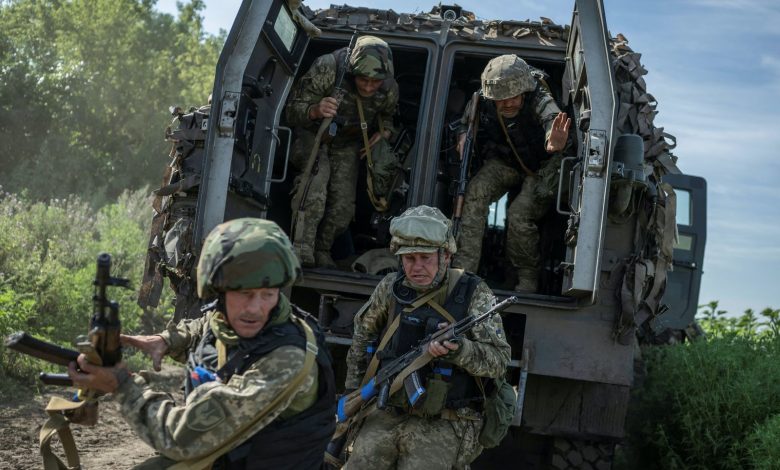
For years, videos have circulated showing ordinary Ukrainians being “enlisted” for military service—or more accurately, abducted from streets or homes by sometimes masked men and dragged into small vehicles to be taken away.
This was part of the war mobilization effort, which has been marked by numerous controversies, including bribery scandals, widespread allegations of mistreatment, and the enlistment of men with mental and physical disabilities, according to Responsible Statecraft.
Mandatory conscription is unpopular. A petition calling for an end to mobilization in public spaces surpassed the 25,000-signature threshold required for a presidential response, while recruitment officials began facing angry protests from local communities.
Last year, Ukraine’s Human Rights Commissioner, Dmytro Lubinets, publicly described the system as “coercive,” revealing that complaints against recruitment officials at regional centers had increased by more than 33,000% since the start of the war, rising from just 18 complaints in 2022 to over 6,000 in 2025.
As the war continued, anger toward conscription practices intensified. The year 2025 witnessed a series of killings targeting recruitment officers.
In late January 2025, a man stormed a military training center and shot a recruitment officer in retaliation after the officer had “enlisted” one of his acquaintances.
In December 2025, a recruitment officer was fatally stabbed by a man who had asked him to check his papers, then attacked three other officers before fleeing.
In its report on the incident, the local newspaper The Kyiv Independent, which is not an anti-war outlet, noted that videos documenting violent “recruitment” practices were initially dismissed as exaggerated and fueled by Russian disinformation, but were in fact widespread due to manpower shortages and a sharp decline in volunteering.
December also saw a group attack recruitment officers attempting to verify their documents, resulting in one officer suffering a broken rib.
Since early 2026, violence has escalated significantly. In late January, a man killed a recruitment officer and fled with one of the conscripts he was escorting.
February witnessed at least two separate attacks against officers from the anti-draft evasion unit in Kharkiv and the Lviv region. Police suspect that in the latter case, the attacker was attempting to help a conscript escape. A month later, a group intercepted a van carrying conscripts and stormed it to free one of them.
The first week of April recorded three stabbings within four days, including a conscript stabbed in the neck by a customs officer after attempts to forcibly recruit his brother.
A group of teenagers also attacked anti-draft officers to protect a man they were trying to recruit. The month ended with a 48-year-old soldier absent from duty opening fire with an automatic weapon on a vehicle carrying recruitment officers, sending two of them to hospital. Days earlier, a person described as a draft evader stabbed two conscripts who attempted to check his papers.
According to official statistics, these incidents represent only a fraction of more than 600 attacks against recruitment officers since the war began, with their number nearly tripling between 2024 and 2025.
This rise in attacks raises questions about how it aligns with opinion polls suggesting that the Ukrainian people are prepared to fight indefinitely until military victory.
Commenting on this, Volodymyr Ishchenko, research associate at the Institute for East European Studies at the Free University of Berlin, stated that “almost all these polls are conducted only in territories controlled by the Ukrainian government. This means they do not include Ukrainians in Crimea, Donbas, EU countries, or those who sought refuge in Russia, and they number in the millions.” He added that “up to one third of Ukrainian passport holders have therefore not been surveyed.”
Other indicators reveal a silent disengagement from the fight. This year, Ukraine’s Minister of Defense disclosed that two million people had evaded conscription and that 200,000 desertion cases had been recorded.
While voluntary enlistment drove the early months of the war, forced conscription now accounts for 70% of recruitment. Ukrainians who fled to Europe at the start of the war resisted European efforts to return them, and in some cases to recruit them at the request of the Ukrainian government.
While wealthy Ukrainians manage to avoid conscription through bribery, the commander of the Ukrainian National Guard has urged those “facing financial hardship” to join the army.
An analysis of Ukrainian casualty figures shows that the vast majority of those killed in battle come disproportionately from small towns with higher poverty rates.
The continuation of the war has created a severe economic and demographic crisis in Ukraine, threatening its future as a stable and functioning state.
Last week, the head of Ukraine’s Migration Policy Office estimated that 70% of those currently abroad may not return, foreshadowing labor shortages in vital sectors.