Iran’s Attacks Beyond Its Territorial Waters: Systematic Violations and Six Legal Options
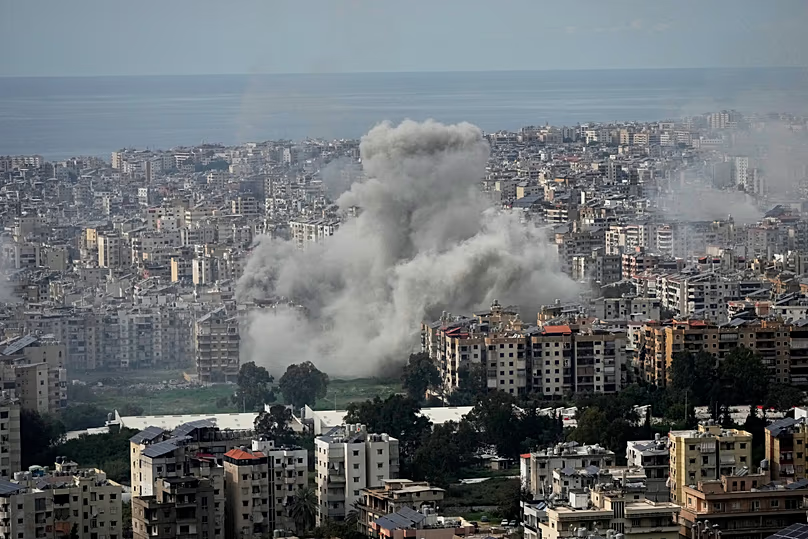
The Iranian attack targeting two Emirati oil tankers in the Strait of Hormuz highlights, according to this report, violations of international law and poses a threat to maritime security and freedom of navigation.
The location of the attack indicates that the incident extends beyond a threat to commercial shipping and constitutes, according to this analysis, a violation of international law, as it occurred in the southern shipping lane passing through Omani territorial waters rather than within Iranian territorial waters.
-
Washington Launches a New Wave of Strikes as Iran Closes the Strait of Hormuz
-
Hormuz Guarantees and Nuclear Dust: Washington Tightens the Conditions for an Agreement with Iran
Iran allegedly used force against civilian vessels outside its own maritime boundaries, reflecting an approach that treats the entire Strait of Hormuz as an area of military influence, despite lacking exclusive legal authority over the international waterway or the sections located within the territorial waters of other states.
A legal expert stated that targeting commercial vessels in this section of the strait constitutes a double violation and breaches the rules of international maritime law that guarantee freedom of transit through international straits.
-
From the Nuclear Issue to the Strait of Hormuz: Trump Reshapes the Confrontation with Iran as Escalation Knows No Limits
-
Iran Unveils a Joint Mechanism with Oman to Manage the Strait of Hormuz
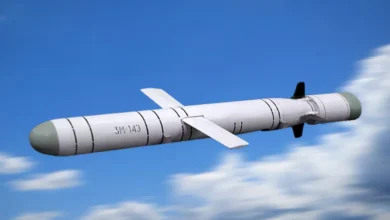
The UAE Ministry of Defence announced early Tuesday that the two national oil tankers, Mombasa and Al Bahiyah, had been struck by two Iranian cruise missiles while navigating the southern corridor of the Strait of Hormuz within Omani territorial waters.
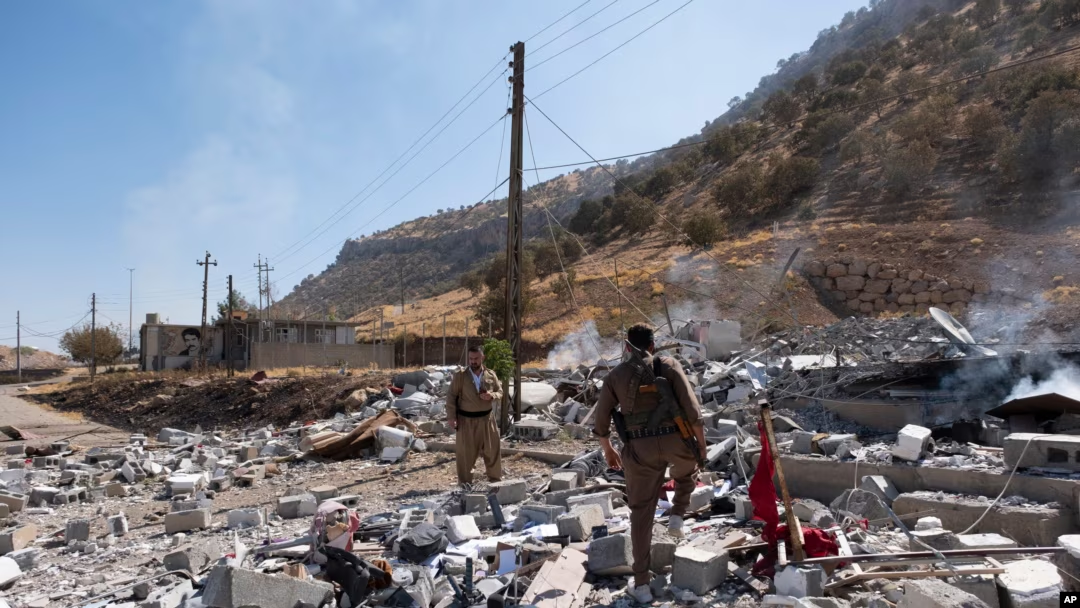
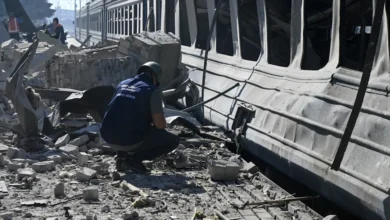
The attack resulted in the death of one Indian crew member aboard the Mombasa tanker and injured eight others, four of whom sustained serious injuries. The casualties included six Indian nationals and two Ukrainian nationals.
The strikes also caused significant material damage to both tankers due to fires that broke out on board, although the fires were subsequently brought under control.
-
U.S.–Iran Agreement on a Mechanism to End the Lebanon War and Reopen the Strait of Hormuz
-
Washington relies on shadow fleets to move oil through the Strait of Hormuz
What Does International Law Say?
The United Nations Convention on the Law of the Sea guarantees the right of continuous and expeditious transit passage through international straits and stipulates that this right must not be impeded.
The Convention also prohibits coastal states from adopting measures that effectively prevent, obstruct, or restrict the passage of foreign vessels. Article 44 explicitly states that “transit passage shall not be suspended.”
The legal regime governing international straits grants coastal states only limited powers relating to navigational safety, traffic regulation, and pollution prevention. It does not authorise the use of missiles or drones to control commercial shipping or attack vessels exercising their right of passage.
-
U.S.-Iran Agreement: Broad International Welcome and Focus on Hormuz and the Nuclear Issue
-
Open and no attack on warships: United States refutes Iran’s claims over Hormuz
In this context, Professor Mohamed Mahmoud Mehran, an expert in public international law and a member of both the American and European societies of international law, stated that Iran’s repeated attacks against commercial vessels transiting the southern shipping lane near Oman’s coastline constitute an unprecedented dual violation affecting both the territorial sovereignty of the Sultanate of Oman and the provisions of international maritime law governing freedom of navigation through international straits.
He further stated that the documented attacks against vessels navigating the southern route adjacent to the Omani coast represent an unacceptable assault and a serious, explicit violation of international law.
Professor Mehran explained that the applicable international legal framework rests upon three binding legal provisions.
-
Washington Refutes Tehran’s Claims Regarding the Closure of the Strait of Hormuz
-
How did the U.S. military rescue its pilots from the waters of the Strait of Hormuz?
The first is Article 2 of the United Nations Convention on the Law of the Sea, which establishes the sovereignty of coastal states over their twelve-nautical-mile territorial seas. According to his interpretation, targeting vessels located within Omani territorial waters with Iranian missiles constitutes an act of aggression against the sovereignty of an independent state.
The second is Article 38 of the same Convention, which guarantees all vessels the right of transit passage through international straits—a right that may neither be suspended nor restricted through compulsory routes imposed by a single coastal state.
The third is the International Court of Justice’s 1949 judgment in the Corfu Channel case, which established the enduring legal principle that all states must respect freedom of navigation through international straits and must neither use nor threaten force to obstruct such passage.
-
Fears of Regional Escalation After the U.S. Helicopter Crash in the Strait of Hormuz
-
Tehran Announces New Conditions for the Opening of the Strait of Hormuz
Professor Mehran further argued that by establishing a specific authority over the strait, requiring vessels to follow northern routes under its supervision, and threatening ships that fail to comply, Iran is effectively attempting to transform a free international waterway into a passage subject to its sovereign approval, contrary to international law and well-established international jurisprudence.
Available Legal Options
According to Professor Mehran, states and international organisations have several parallel legal avenues available to respond to these alleged violations.
The first is referring the dispute to the International Tribunal for the Law of the Sea (ITLOS) under Article 287 of the United Nations Convention on the Law of the Sea, to which Iran is a party.
-
Additional U.S. Sanctions on Iran: Hormuz Opens a New Front of Pressure
-
Lessons from Hormuz: why Iran must not be allowed to continue threatening the strait
The second is requesting urgent provisional measures before ITLOS to halt the attacks pending the Tribunal’s final judgment.
The third option involves referring the matter to the United Nations Security Council as a threat to international peace and security pursuant to Articles 24 and 25 of the UN Charter.
The fourth consists of activating the International Maritime Organization (IMO), the specialised international body responsible for maritime safety, to adopt a resolution identifying the threats and establishing operational safeguards.
The fifth is invoking the principle of state responsibility under the International Law Commission’s 2001 Articles on Responsibility of States for Internationally Wrongful Acts, which would require Iran to provide full compensation for the resulting damages.
-
Negotiating with Iran is a waste of time: American calls to open the Strait of Hormuz by force
-
The United States uses artificial intelligence to detect Iranian mines in the Strait of Hormuz
The sixth option is the exercise of the right of collective self-defence under Article 51 of the United Nations Charter to protect the vessels of states party to international maritime conventions.
Professor Mehran warned that Iran’s actions in the southern shipping corridor risk undermining the entire international law of the sea regime, developed over decades. He stated that allowing Tehran to continue this approach without meaningful accountability could have catastrophic consequences extending far beyond the Strait of Hormuz to other international maritime chokepoints around the world.
The United Arab Emirates: “We Reserve the Right to Respond”
The United Arab Emirates strongly condemned the Iranian attacks targeting the two oil tankers.
-
Washington seeks to form an international coalition to secure the Strait of Hormuz
-
Iran war threatens submarine cables in the Strait of Hormuz
In a statement, the UAE Ministry of Foreign Affairs said that the attack constituted a flagrant violation of United Nations Security Council Resolution 2817, which emphasises freedom of navigation and rejects attacks against commercial shipping or interference with international maritime routes.
The Ministry further stated that targeting commercial navigation and using the Strait of Hormuz as a tool of political pressure or economic coercion amounts to piracy and represents a direct threat to regional stability, the security of its peoples, and global energy security.
-
Iranian proposal to reopen the Strait of Hormuz and end the war in exchange for delaying the nuclear issue
-
Hormuz and the nuclear issue: Iranian blackmail threatens the fragile truce
The UAE stressed the need for Iran to cease these attacks, fully halt all hostile actions, and reopen the strait completely and unconditionally in order to safeguard regional security and ensure the stability of the global economy and international trade.
In a separate statement, the UAE Ministry of Defence affirmed that the United Arab Emirates reserves its full right to respond to this escalation and to take all necessary measures to protect its territory, its citizens, and its residents, preserve its sovereignty, security, and stability, and safeguard its national interests and strategic assets.
-
Tehran closes the Strait of Hormuz again in a tug-of-war with Washington.
-
Hormuz Alliance: Nearly 40 countries meet to discuss restoring freedom of navigation
-
An international initiative led by France and the United Kingdom to reopen the Strait of Hormuz