Student Protests in Europe: Where Does Solidarity End and Coordination Begin?
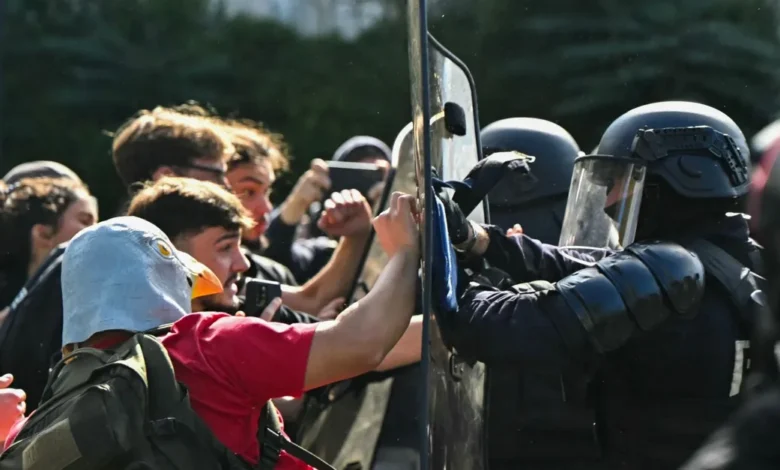
Student mobilizations across Europe in October 2026 brought renewed attention to the relationship between local youth organizations and transnational networks, particularly when calls to protest coincide with statements of solidarity issued by organizations operating in several countries. In this context, the Forum of European Muslim Youth and Student Organisations (FEMYSO) drew attention after expressing solidarity with students in France and Belgium on October 9.
On October 15, Étudiants musulmans de France (EMF), a French Muslim student organization, called for support for the French mobilizations scheduled for October 17. The Forum subsequently published a statement concerning students in Albania on October 18. This sequence provides a basis for examining the relationship between European-level messaging and local mobilization. On its own, however, it does not offer conclusive evidence of a unified campaign or centralized leadership of the demonstrations. Rigorous journalism must therefore begin with the published facts and distinguish declared institutional relationships from hypotheses requiring independent investigation.

Understanding this sequence starts with the nature of FEMYSO as a European network of Muslim youth and student organizations. Its official website states that its activities include campaigning, networking among members, training and representation before institutions. These activities can enable local organizations to exchange experience and bring their demands to a wider audience. From an organizational perspective, this model does not necessarily mean that every member follows the same directives on every issue. It does, however, raise questions about how collective decisions are made, how much autonomy members retain and how general positions are translated into local activities. These questions become particularly important when statements address political or social issues that are also the subject of street protests, because expressing solidarity and helping organize a protest carry fundamentally different implications for responsibility and influence.
In France, EMF’s October 15 post is a key document for understanding the organization’s position on the student mobilization. It expressed support for the action scheduled for October 17 and referred to several French cities, establishing that a public call to participate in or support the mobilization had been issued. Demonstrating a broader organizational role, however, requires examining the nature of that appeal, its connection to the groups that initiated the protest and whether EMF undertook specific coordination, publicity or mobilization tasks. It is also necessary to determine whether the post merely endorsed the students’ demands or included practical instructions for participants. These details make it possible to assess the organization’s actual role, rather than drawing sweeping conclusions from the mere publication of a statement or appeal.
The relationship between EMF and FEMYSO should likewise be treated as an institutional matter requiring clear documentation. Membership, if confirmed by a reliable official register, establishes a connection between two organizations. It does not, by itself, settle the nature of that connection or its influence on local decisions. A distinction must be drawn between network membership, cooperation on campaigns, coordination around a particular event and subordination to a shared administrative authority. Each requires different evidence. Relevant material may include joint statements, published meeting minutes, explicit comments by officials from both organizations and documents setting out each party’s role. Comparing the timing and content of publications may also help frame research questions, but it cannot replace documentation establishing a causal relationship or a joint organizational decision.

This approach is especially important when examining allegations of links between these networks and the Muslim Brotherhood. Describing FEMYSO as a European youth front for the Brotherhood, or EMF as its local front, is an allegation requiring independent substantiation. It cannot be presented as an established fact simply because it is repeated in an analysis. Assessing it requires specifying what is meant by an organizational link: ideological affinity, personal relationships, formal membership, funding or direct control over decisions? These are distinct concepts, and none can automatically serve as proof of another. The responses and official positions of the organizations concerned must also be examined. Analysis should rely on documents whose authenticity can be verified, rather than solely on reports that assume their conclusions in advance or conflate religious identity with organizational affiliation.
Comparing France and Albania helps clarify the issue. In France, FEMYSO’s October 9 statement addressed educational conditions, funding, and students’ rights, while EMF’s October 15 appeal called for support for the mobilizations scheduled for October 17. In Albania, the Forum expressed solidarity on October 18 with students and young people demanding accountability and quality education. These texts establish that the Forum publicly took positions on more than one mobilization. They do not, by themselves, demonstrate the existence of a joint command center, a centralized plan, or direct instructions to protesters. Testing those hypotheses would require examining whether local organizations announced cooperation, whether meetings took place before the protests, and whether organizational communications matched in their specific details. It would also require comparing each movement’s actual demands with the messages adopted by the Forum.
An organizational analysis must also avoid overlooking the social conditions that prompted students to protest. Demands concerning educational quality, funding, employment prospects and living conditions may arise from genuine local problems and attract people from different political backgrounds. Civil society organizations may adopt or support these demands, and they may also seek to influence the public debate surrounding them. The presence of a supporting organization, however, does not automatically negate protesters’ autonomy or the legitimacy of their demands. Nor does it justify attributing that organization’s political positions to everyone who took part in the demonstrations. A balanced analysis therefore examines the movement’s motivations, the nature of the organizations supporting it and the evidence of coordination together, without reducing any one of these elements to another.
Published statements remain the starting point of an investigation, rather than its conclusion. Professional analysis can trace publication dates, compare wording, identify declared institutional links and then ask specific questions about funding, governance, resource sharing and participation in organizing protests. It can also draw on independent journalism and official statements, while verifying dates and context and avoiding the projection of facts specific to one country onto another. If evidence emerges of direct coordination around a particular event, that coordination should be described precisely, identifying the parties involved and its scope, rather than turning it into a general conclusion about every mobilization associated with the network. Where evidence is unavailable, the relationship should be explicitly described as unresolved, rather than filling the gap with assumptions.
Ultimately, the available facts show public activity by FEMYSO in support of student demands in France, Belgium and Albania, alongside an appeal issued by EMF in France before the mobilizations of October 17, 2026. Establishing whether these activities formed part of a single coordinated campaign, or reflected direction from a broader political organization, requires additional evidence beyond the chronology of the statements. Maintaining this distinction makes reporting more rigorous and verifiable, while enabling readers to distinguish confirmed facts from hypotheses that still require proof.