From France to Albania, Social Unrest Engulfs Europe’s Streets
From France to Albania, anger is spreading through European streets over rising living costs and fuel prices.
For weeks, crowds have taken to the streets in major cities, with the unrest resulting in looting, arrests, injuries and violence in France, Italy and Albania.
In Spain and Portugal, protest camps have been established over rising rents and housing costs that residents say they cannot afford.
These developments come as major European Union economies, including France, Italy and Spain, approach pivotal elections.
Meanwhile, far-right parties have made electoral gains in Germany and could advance elsewhere, according to the Associated Press.
Europe also faces a critical moment in its support for Ukraine as President Donald Trump makes overtures to his Russian counterpart, Vladimir Putin.
A Sudden Spark
María Silvestre, a sociology professor at Spain’s University of Deusto, told the Associated Press that young Europeans were experiencing “a strong sense of uncertainty and loss of control”.
“When certain conditions come together, a sudden spark can channel that discontent and bring people onto the streets,” she added.
France
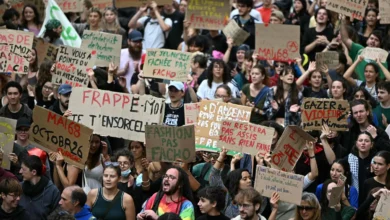
In France, where popular protest has a centuries-old tradition, the movement began with student demonstrations demanding more resources for schools. Participants say schools are understaffed and their buildings are deteriorating, particularly in low-income neighbourhoods.
The protests subsequently broadened as the General Confederation of Labour (CGT) union and other activists joined, while students temporarily paused their demonstrations for the autumn holidays.
The movement now also includes demands concerning rising living costs and public services.
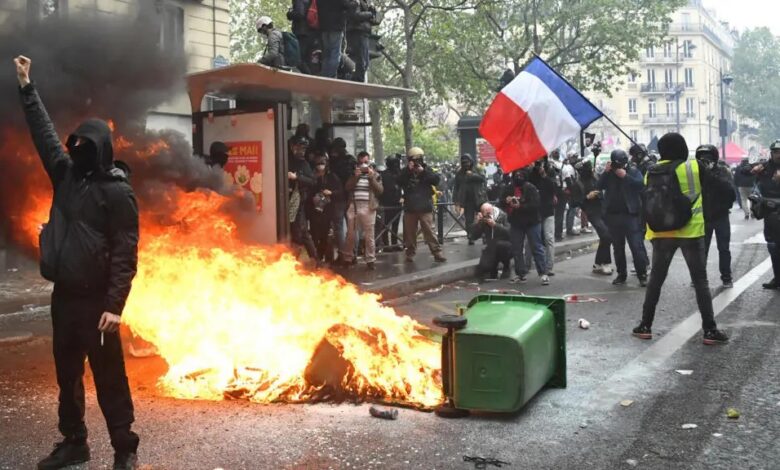
Rioting, looting and fires have been reported in several French cities, including Paris, Marseille, Lyon and Bordeaux.
In Limoges, flames engulfed the nineteenth-century city hall, nearly destroying it completely. Some schools were also set on fire.
Students and rioters threw petrol bombs as security forces responded with tear gas, leaving hundreds injured.
Authorities reported approximately 2,400 arrests during the weekend’s unrest, which also left hundreds injured.
At the same time, large peaceful marches took place across the country.
President Emmanuel Macron condemned Saturday’s violence, accusing far-left activists of trying to create chaos by attacking buildings and police officers.
“Those who looted will have to pay for the damage, and everyone who sought to undermine the Republic will be held accountable,” Macron said in a rare televised address on Sunday.
Spain
In Spain, primary and secondary school teachers in Madrid began an indefinite strike last week, demanding better pay and working conditions.
Tents made from plastic sheeting have stood for weeks in Puerta del Sol, in central Madrid, in protest against rising housing costs.
The protests began after the eviction of Maricarmen, an 87-year-old woman who subsequently died in hospital. Smaller protest camps then appeared in other Spanish cities.
Public pressure prompted the government to approve measures intended to provide affordable housing. However, the measures failed to secure parliamentary support, leading Prime Minister Pedro Sánchez to call an early election for November.
A general strike has also been announced for the same month, the first in fourteen years.
According to an analysis by the business newspaper Expansión, Spain’s minimum wage stands at €1,221 (1,370),while the average monthly rent for an 80-square-metreapartmentisapproximately€1,130(1,270).
Portugal
Similar protests over the housing crisis have emerged in Portugal’s largest cities, Lisbon and Porto.
Italy
The “Italy in the Squares” initiative mobilised thousands of demonstrators demanding better employment opportunities, healthcare, education and access to housing, alongside higher wages.
Government figures show that inflation in Italy rose to 4.2 per cent in September, exceeding the eurozone rate of 3.8 per cent.
Peaceful marches were followed by violent riots in Turin, Bologna and Milan, Italy’s financial and fashion centre. Masked rioters clashed with police, looted shops and set property on fire.
Milan police announced 271 arrests and said fourteen security personnel were injured during two days of unrest.
Meanwhile, a newly formed group calling itself the “October 17 Movement” announced the start of what it describes as a “permanent mobilisation”, with demonstrations every Saturday at 3 p.m. in cities across Italy.
Albania
In Tirana, Albania’s capital, protests have continued for more than a week. Clashes intensified after secondary school and university students joined the broad “Flamingo” movement demanding the resignation of Socialist Prime Minister Edi Rama.
Protesters threw stones at police, who responded with tear gas to disperse the crowds.
Rama described the protesters as “ideological and extremist”, influenced by “Antifa”, an umbrella term for loosely organised far-left groups in the United States, where President Donald Trump designated it a terrorist organisation.
Combating corruption is a central demand of the movement, which takes its name from the natural habitat of flamingos.
According to its website, the movement also calls for the protection of public healthcare, education and pensions.