US-Iran Confrontation: The Strait of Hormuz Becomes a Battleground Threatening the Global Economy
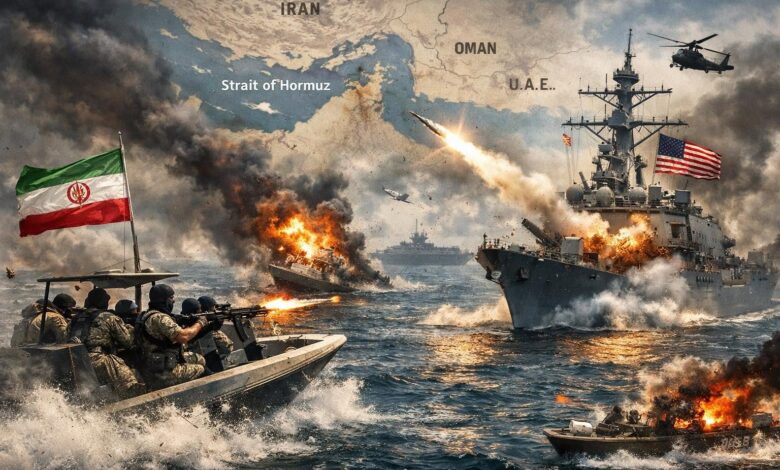
Escalation between the United States and Iran is no longer confined to political threats or direct military calculations. It now extends to the Strait of Hormuz, one of the world’s most sensitive maritime passages, through which vital oil and gas supplies reach international markets. As attacks on merchant vessels increased during October 2026, concern grew that the conflict could trigger a global economic crisis extending beyond the Middle East and placing energy security and international trade under severe strain.
In a report published by Reuters on 23 October 2026, data compiled by a research organisation specialising in maritime security indicated that October had recorded the highest number of attacks on merchant ships in the Strait of Hormuz and surrounding waters since monitoring began. The data counted 28 confirmed or reported attacks during the month and 113 incidents since the US-Israeli war with Iran began on 28 February 2026. A review of International Maritime Organization data also showed that dozens of very large oil tankers had been damaged since the conflict began.
These figures reveal a dangerous shift in the confrontation. Military operations are no longer confined to land-based sites and military facilities: commercial shipping itself has become part of the exchange of pressure. This threatens countries that are not directly involved in the war but depend on stable maritime routes for trade and energy supplies.
The Strait of Hormuz: The Key Strategic Lever
The strait’s importance stems from its geography, linking the Arabian Gulf to the Gulf of Oman and the Arabian Sea. It is a major route for Gulf oil and gas exports to global markets. Before the war, approximately one-fifth of global oil and liquefied natural gas supplies passed through it, making it one of the international economy’s essential arteries.
Iran recognises that its location allows it to influence navigation despite US military superiority. Damaging ships or raising the security threat can reduce tanker traffic, increase marine insurance premiums and drive up transport costs without completely closing the strait.
The United States, by contrast, regards freedom of navigation as a strategic interest it cannot abandon. Disruption can affect fuel prices, inflation and the American economy, alongside the interests of European and Asian allies. Protecting shipping is therefore more than a military mission: it also involves preventing Iran from using the passage as political and economic leverage.
The difficulty lies in the parties’ differing perspectives. Tehran views its ability to affect navigation as a means of countering the blockade and military pressure. Washington considers restrictions on shipping a threat to international interests. Between these positions, merchant vessels face risks even when they are not parties to the conflict.
Escalating Attacks Leave Shipping Companies Facing Difficult Choices
Reuters reported that attacks were not merely isolated incidents but had accelerated during October. More than thirty very large oil tankers had been damaged since the war began, including eleven in October alone, according to a review of International Maritime Organization data and vessel movement records.
These developments force shipping companies to reassess the risks of crossing the strait. Their calculations include not only fuel and crew costs but also insurance, protection, potential delays and the possibility of losing ships or cargo.
Transit could become so expensive that some companies postpone voyages or seek partial alternatives. Rerouting is nevertheless difficult because alternative oil and gas transport infrastructure is limited compared with the trade passing through the region. Diverting cargo can also increase distances, journey times and costs.
Higher risks can therefore disrupt markets even without a complete interruption of oil flows. Markets do not wait for an actual shortage before reacting: they begin pricing in its likelihood as risks and uncertainty increase.
Oil and Gas at the Heart of Economic Calculations
The Hormuz crisis directly affects energy markets because threats to supplies raise concerns about producers’ ability to export regularly. Continued attacks could force companies to pay more to insure shipments, while shipowners may demand premiums for additional risks.
These costs affect importers and may ultimately reach consumers through higher fuel, transport and goods prices. Energy-intensive industries, including petrochemicals, fertilisers and aviation, could also face additional production costs.
Poorer energy-importing countries are especially vulnerable because they often have limited capacity to absorb shocks. A larger fuel import bill can force governments to increase spending or cut other budgets, while higher transport and fertiliser costs add pressure to food prices.
This does not mean every attack automatically produces a sustained oil-price increase. Prices also reflect global inventories, production from other sources and demand. Prolonged risks can nevertheless make markets more sensitive to each new incident and complicate planning for governments and businesses.
Washington and Tehran Use Pressure to Reshape Negotiating Terms
Maritime escalation cannot be separated from the broader political and military conflict between the United States and Iran. Navigation through Hormuz has become a major negotiating lever as Washington uses economic and military pressure to push Tehran towards arrangements ending the war.
Iran, meanwhile, seeks relief from the blockade and export restrictions, alongside assurances against continued military operations. Influencing shipping becomes a way to demonstrate that pressure on Iran’s economy will also impose costs on the rest of the world.
Reuters reported on 11 October, citing an Iranian official, that the US response to an Iranian proposal to reopen the strait was inadequate and that Tehran linked normal navigation to several conditions. This reflects continuing disagreement over the sequence of steps needed to resolve the crisis and which side should concede first.
One major obstacle is each party’s fear of surrendering leverage before receiving guarantees. If Washington eases its blockade without a clear agreement, it may believe it has relinquished an important tool. If Tehran relaxes navigation restrictions before tangible political progress, it may consider itself to have lost a key bargaining instrument.
Persisting with this logic could nevertheless produce the opposite of the intended result. The longer the confrontation lasts, the higher its economic and military costs, the wider its effects, and the harder it becomes to prevent a new incident from triggering escalation that cannot easily be contained.
Gulf States Between Protecting Facilities and Avoiding All-Out War
Gulf states face a delicate balance. They need to maintain oil and gas exports, protect ports and industrial facilities, and ensure the safety of ships operating in regional waters. At the same time, they recognise that a wider confrontation could expose their cities, airports and vital infrastructure to additional danger.
These circumstances may encourage stronger air and maritime defences, expanded intelligence cooperation and arrangements to sustain navigation. Defensive measures alone cannot resolve the crisis while its political and military causes remain.
Gulf countries do not necessarily share identical risk assessments or diplomatic choices. Some may emphasise military deterrence, while others prioritise containing escalation and maintaining communication with Tehran and Washington.
Regional coordination becomes increasingly important because shipping disruption does not affect just one country. Trade, energy and maritime infrastructure are interconnected, and widespread disruption could impose costs throughout the region, including on states seeking to remain outside the confrontation.
Can Markets Adapt to a Prolonged Crisis?
Producers may use alternative pipelines or increase exports through ports that do not depend on the strait, where infrastructure permits. Some countries can draw on strategic reserves to cushion temporary shortages, while shipping companies can adjust schedules or redistribute vessels.
These options do not fully replace Hormuz. Pipeline capacity is limited, and new projects require time and substantial investment. Neither can every type of cargo or market be accommodated quickly.
The global economy’s adaptability therefore depends heavily on the crisis’s duration and severity. A brief disruption may be relatively manageable. Attacks continuing for months raise costs and increase the likelihood of difficulties spreading beyond energy into other sectors.
Individual developments should not be overstated either. Prices can rise or fall for many reasons. The central danger lies in persistent uncertainty disrupting investment, shipping and production decisions.
Civilians Pay the Price of Confrontation
Behind tanker figures and oil prices are equally important humanitarian consequences. More expensive fuel can raise public transport, electricity and food costs, particularly in import-dependent countries. Trade disruption may also delay essential goods or make them more expensive.
Maritime workers face direct risks when vessels operate in conflict areas. Attacks and damage threaten crews’ lives and livelihoods and increase psychological pressure on those required to continue sailing under dangerous conditions.
Continued war also consumes resources that could support health, education, infrastructure and economic development. Protecting navigation should therefore encompass more than major commercial interests: it must include seafarers’ safety and reduced risks for populations and vulnerable economies.
Diplomacy Offers the Least Costly Exit
The crisis requires diplomatic action prioritising safe navigation while addressing the political disagreements driving the use of the strait as leverage. Practical steps could begin with agreements not to target civilian vessels, direct communication channels between naval forces, and clearer transit and incident-reporting rules.
Temporary arrangements might allow more regular shipping alongside negotiations on sanctions, security guarantees and ending the war. Any agreement would nevertheless need clear verification mechanisms: commitments resting on promises alone may collapse at the next crisis.
Countries affected by disruption should also participate in mediation, while international institutions should focus on freedom of passage and civilian crews’ protection. Stability in Hormuz is not solely an American or Iranian interest. It concerns energy and food security and trade worldwide.
Ultimately, the escalating attacks of October 2026 reveal a fundamental reality: using maritime passages in political conflicts can provide leverage, but also threatens to turn a regional crisis into a global economic emergency. Unless diplomacy halts the escalation, the confrontation’s costs could exceed the parties’ ability to control its consequences.