After 70 Years… Declassified Documents Challenge the Story Behind the Collapse of the West’s Most Ambitious Operation Against Albania
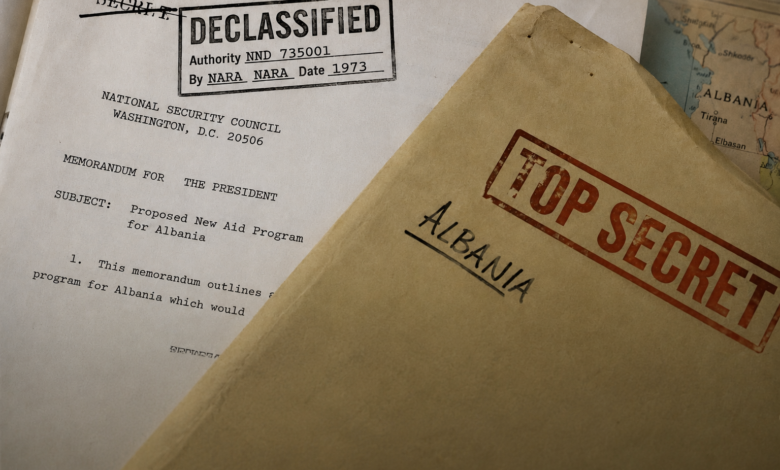
For more than seventy years, intelligence literature has maintained that the first Western attempt to overthrow Albania’s communist regime failed because of the betrayal of renowned British intelligence officer Kim Philby, who allegedly passed the details of the operation to the Soviet Union, which in turn relayed them to the Albanian authorities.
-
Saudi FM: Kingdom Has Always Demanded Declassification of All 9/11 Documents
-
Frightening Sightings and Glowing Orbs: The Pentagon Reveals Its Secrets on Unidentified Flying Objects
That account, which became one of the best-known stories of the Cold War, is now facing a major historical reassessment following the publication of a new book by political scientist Stephen Long. He argues that the operation failed not because of a Soviet spy, but because of a series of organizational and operational failures committed by those who planned and executed it.
Drawing on newly declassified British and American documents, along with dozens of interviews, Long’s book, A Rich Harvest of Bitter Fruit, concludes that the operation’s true objective was not necessarily to overthrow Enver Hoxha’s regime, but rather to test its resilience and ability to withstand pressure in a country that was then considered politically unstable.
Long also argues that Moscow—and perhaps even Kim Philby himself—did not play the decisive role attributed to them for decades. He raises a fundamental question: why would Soviet intelligence risk exposing its most valuable asset for a relatively peripheral country such as Albania?
-
Ambiguity, delays and internal pressure complicate Starmer’s European agenda
-
Radiation-saturated land: eight sites that encapsulate the cost of the nuclear venture
A Secret Operation That Became a Chain of Failures
The book reveals that the operation was plagued by deep structural weaknesses from the very beginning. The United States and the United Kingdom recruited dozens of Albanian refugees, trained them in West Germany and Malta in sabotage, intelligence gathering, and covert warfare, before infiltrating them into Albania through airborne and maritime operations.
However, execution fell far short of planning. During the first missions in 1950, nearly half of the participants withdrew because of internal political disagreements, while the operation itself was later postponed due to adverse weather conditions.
When it was finally relaunched, the agents wore clothing unsuitable for harsh winter conditions. Some were forced to tear apart their reserve parachutes to use them as makeshift blankets before being dropped a full day’s journey away from their designated landing zone.
-
With fighter jets and ships… The British Army participates in America’s Independence celebrations
-
The American Dark Eagle… the formidable missile that could join the war against Iran
The mistakes did not end there. Equipment landed in a nearby village, immediately exposing the team’s presence. The agents were forced to hide in forests for several days before eventually escaping into Yugoslavia.
Similar scenes unfolded during later missions. Other teams landed in incorrect locations, one commander led his group while intoxicated, and others spent two weeks hiding with nothing to eat except raw corn before fleeing across the border.
Meanwhile, Albanian security services already possessed information about most landing zones—not because of sophisticated intelligence penetration, but because the agents themselves lacked discipline and openly discussed their missions within Albanian refugee communities across Europe, allowing information to reach the authorities in Tirana.
As a result, many agents walked directly into ambushes. Over six years, casualty rates reached approximately 36 percent, while Enver Hoxha remained in power until his death in 1985.
-
Selfie costing $600,000: a maneuver and a collision between two F-15 fighter jets
-
Securing a British aircraft carrier: London and Paris against the tide of history
A Lesson Beyond the Cold War
Stephen Long argues that the failure stemmed not only from the shortcomings of the agents but also from the excessive confidence of senior CIA officials.
According to the book, American officials ignored clear evidence that several teams had already been captured and continued dispatching new groups to the same locations, even after imprisoned operatives failed on seven consecutive occasions to transmit the agreed recognition signals—clear proof that they were operating under Albanian security control.
Rather than acknowledging reality, American leadership turned an initial setback into a prolonged disaster.
-
London follows Washington’s lead: a British FBI to combat terrorism
-
Texas reopens a long-suppressed American file… What lies behind the decision to classify the Muslim Brotherhood and CAIR?
The book concludes that Albania’s experience offers lessons extending well beyond the Cold War. It demonstrates that the greatest threat to regime-change operations is not always intelligence infiltration or espionage, but overconfidence and poor strategic judgment.
It further argues that warnings from CIA Director John Ratcliffe about the risks and futility of pursuing regime-change strategies went largely unheeded. According to the author’s assessment, the same mistakes that led to the Albanian disaster more than seven decades ago continue to reappear whenever political arrogance overrides realistic assessment, sending operatives into missions that are effectively doomed before they even begin.
-
The screen is more dangerous than the weapon… terrorist propaganda from training camps to artificial intelligence
-
The Third Reich and the Graf Zeppelin: A Dream Turned Nightmare