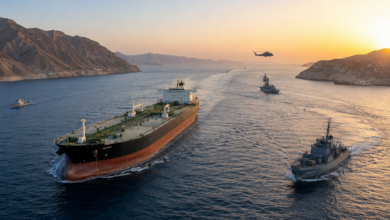
Iran announces complete halt to oil exports as a result of the US blockade
The governor of Iran’s central bank says the bank and the government had anticipated the possibility of reaching this stage and had therefore prepared a set of precautionary measures to deal with its consequences.
Iranian Central Bank Governor Abdolnasser Hemmati said on Thursday that his country’s oil exports had come to a complete halt as a result of the US naval blockade, warning that continued restrictions on the movement of exports and imports could have far-reaching consequences for the Iranian economy. Tehran, however, says it had taken measures in advance to prepare for such a scenario.
-
NATO warns Iran: We are ready to deal with any threat
-
Iran Targets Ships and the U.S. Does Not Retaliate: Why Is Trump Keeping His Cool?
Speaking on Iranian television about the impact of the blockade on Iran and the countries of the region, Hemmati said oil exports had fallen to zero, adding that several neighboring countries, including Qatar and Iraq, were also facing a sharp decline in their exports. He said the government and the central bank had anticipated the possibility of reaching this stage and had therefore prepared a series of precautionary measures to address its consequences.
The governor nevertheless pointed to a fundamental difference between Iran and some other countries: those countries are able to draw on their reserves and assets held abroad, whereas Tehran faces US restrictions preventing it from accessing a substantial portion of its foreign-held funds. The loss of oil revenues, which constitute a major source of foreign currency, therefore places additional pressure on public finances and limits the government’s ability to meet the needs of the domestic market.
-
Iran’s plan to escalate the war: empowering the Guards, pursuing a policy of coercion, and activating its proxies
-
Cyberattacks ordered by the Revolutionary Guards: US charges 17 Iranians
These developments come as US President Donald Trump’s administration continues to tighten economic pressure on Tehran. The US president has threatened to launch what he described as the strongest economic campaign ever imposed on a country, warning that Iran would face unprecedented isolation and that countries and entities providing it with any form of support would be punished. This approach indicates that US pressure is expanding beyond the targeting of specific sectors to a broader effort to restrict Iran’s trade and financial channels.
The escalation is not limited to financial sanctions. It is also accompanied by a tightening of the blockade imposed on Iranian ports and maritime shipping, threatening to disrupt the flow of goods and essential supplies into the country while also obstructing oil exports and other shipments. Given the Iranian economy’s heavy reliance on maritime trade, the continuation of these restrictions could significantly increase import costs and place additional pressure on domestic markets.
-
Washington Signals a New Package of Measures to Squeeze the Iranian Economy
-
The Iranian Axis Arsenal Under Israeli Control: Russian and Iranian Weapons and Nazi-Era Surprises
A decline in foreign-currency inflows could also affect the value of the rial, prices, and the government’s ability to subsidize essential goods and services, at a time when Iranian households are already suffering from the effects of sanctions and declining purchasing power. Businesses could likewise face greater difficulties in securing raw materials and spare parts, potentially affecting production and employment.
Concerns are growing inside Iran that the accumulation of economic pressures could intensify social tensions, particularly if shortages of goods or rising prices are accompanied by declining incomes and fewer employment opportunities. In this context, maintaining market stability and preventing the expansion of domestic discontent could become a challenge comparable to the external confrontation, particularly if the blockade persists for an extended period.
-
Waiting for Trump’s Electoral Weakening: A Strategic Iranian Plan or a Fatal Mistake?
-
U.S. Report: Five Flashpoints That Could Turn the Iran War into an International Conflict
The current crisis is linked to a series of developments that began with the outbreak of the US-Israeli war against Iran on February 28, followed by a ceasefire agreement in April. On June 18, Washington and Tehran signed a memorandum of understanding concerning freedom of navigation in the Strait of Hormuz, but its implementation stalled because of disagreements related to the security of the vital maritime corridor.
On July 14, the United States reinstated the naval blockade of Iran at Trump’s direction, bringing economic pressure into a more intense phase. With oil exports halted, access to foreign-held assets restricted, and tighter controls imposed on maritime traffic, Tehran is facing mounting economic pressure that could force it to reassess its financial and trade priorities.
-
Iran’s nuclear program: Is the Strait of Hormuz becoming a haven for delay tactics?
-
After Hormuz, Pakistan turns to diplomacy between the United States and Iran
While the Iranian government maintains that it has prepared contingency plans to cope with the blockade, its ability to withstand the pressure will depend on how long the restrictions remain in place and whether alternative channels for trade and financing can be established.
Domestically, widening economic hardship could increase the likelihood of popular unrest, particularly if the revenue crisis leads to a sharp rise in prices or shortages of essential goods. The consequences of the blockade could therefore extend beyond the economy and affect Iran’s social and political stability.
-
The Forgotten Prisoners of War: Iranian Maritime Piracy Turns Sailors’ Lives into a Nightmare
-
The Flying Banana arrives in the Middle East: are the United States preparing to determine the fate of Iran’s nuclear program?