Fortune Teller and Money Laundering: Crises Hit Ukraine’s Former Number Two
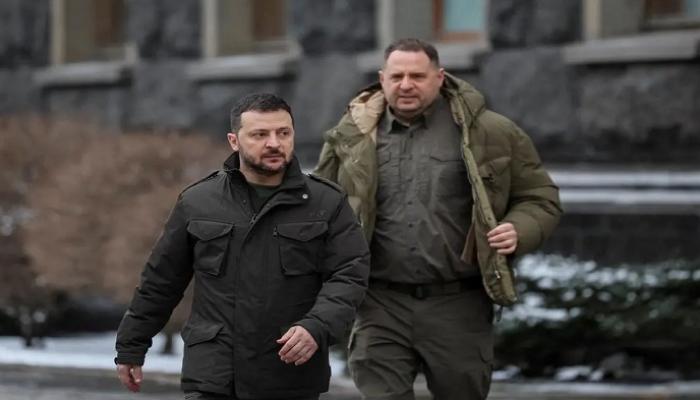
Until late last year, Andriy Yermak, who spent nearly six years as head of the Ukrainian Presidential Office, was widely regarded as the second most powerful man in the country and the figure pulling the strings of power behind the scenes.
Today, however, he wears an electronic ankle monitor after seeing his influence collapse to a level that, according to his critics, not even his personal fortune teller could have predicted. Accused of embezzling and laundering millions of dollars through a luxury housing project outside Kyiv, he has been forced to seek bail contributions from hundreds of supporters, according to The New York Times.
The story began last November when investigators raided Yermak’s home and office as part of a broad corruption probe targeting several individuals close to President Volodymyr Zelensky.
Yermak abruptly resigned, declared his innocence, and disappeared from public life, while Zelensky quickly moved to publicly distance himself from one of his closest allies.
Yet corruption cases in Ukraine rarely disappear; they merely enter a period of temporary dormancy. This became evident when Yermak re-emerged last month in handcuffs, facing money-laundering allegations whose unusual nature surpassed even the succession of scandals to which Ukrainians have become accustomed.
The prosecutor’s accusations extend beyond financial wrongdoing. Investigators allege that the man who once managed the inner workings of Ukrainian decision-making regularly consulted a fortune teller named Veronika Anikevych regarding senior government appointments and major political decisions. Her contact information was reportedly saved in his phone under the name “Veronika Feng Shui Office.”
These revelations triggered a political storm in Parliament. Outraged lawmakers introduced legislation aimed at banning fortune-telling and occult services and summoned the fortune teller herself to testify, although she has not yet appeared.
Yermak, 54, categorically denies both the corruption allegations and the claims that he consulted a fortune teller. Nevertheless, the reality of his downfall became evident in a scene unfamiliar to Ukrainians: the man once described as the hidden architect of the war effort was forced to appeal to supporters in order to raise a bail amount of $3.5 million. It took several days for roughly 300 individuals and companies to gather the required sum.
He is now prohibited from leaving Kyiv without direct authorization from investigators. Yet, in comments to The New York Times, he claimed that he was on his way to the front lines to support Ukrainian forces, a statement that stands in notable contrast to the restrictions imposed under his conditional release.
Yermak’s predicament represents a political time bomb for Zelensky at a particularly sensitive moment. The Ukrainian president had only recently regained some stability after a turbulent year marked by battlefield setbacks and American pressure to bring the war to an end.
However, the case contains a striking paradox. Analysts, lawmakers, and diplomats argue that Yermak’s arrest has not undermined Ukraine’s anti-corruption efforts; on the contrary, it may have strengthened the country’s credibility on a crucial issue in its urgent bid to join the European Union.
Oleksandr Merezhko, chairman of the parliamentary foreign affairs committee, stated: “This is a good thing. If we were not fighting corruption, we would not see scandals like this, which means the fabric of our society is still alive.”
Meanwhile, Ukrainians remain preoccupied with what they see as more immediate threats: the possibility of new Russian strikes on Kyiv and growing concerns that interceptor missiles capable of countering ballistic missiles may be running low.
Yet Yermak’s story is far from over. He will return to court, the fortune teller may eventually testify before lawmakers, and questions will continue regarding the nature of any communication he may still have with his longtime associate Zelensky.
Between “Vova’s Palace” and the “Veronika Feng Shui Office,” the affair stands as a reminder of the fragility of power even in times of war, and of how bail can become the first price paid when a hidden architect of decision-making falls from grace.