Qaani to Iraqi factions: No surrender of weapons, no confrontation with the state
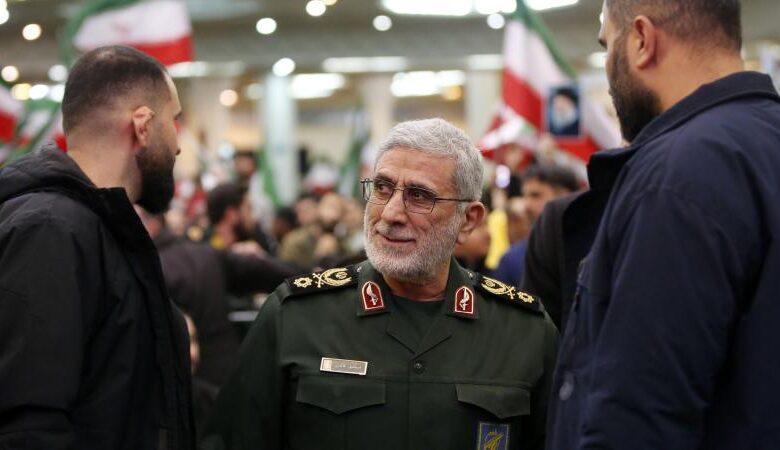
The commander of the Quds Force drew red lines concerning the issue of placing weapons exclusively under state control during his unannounced visit to Baghdad and meetings with militia leaders and leaders of the Coordination Framework.
-
The mystery of Iran’s permanent survivor: Qaani’s disappearance fuels speculation of espionage for Israel
-
Changes in the Iranian Leadership Create Uncertainty Among Iraqi Factions
The commander of Iran’s Islamic Revolutionary Guard Corps Quds Force, General Ismail Qaani, set red lines regarding the weapons held by Iraqi factions during meetings in Baghdad with leaders of the Coordination Framework and armed factions, at a time when the Iraqi government is moving toward settling the issue and enforcing the state’s exclusive control over weapons.
According to exclusive information reported by the Iraqi Kurdish agency Shafaq News, citing sources familiar with the content of the meetings, Qaani stressed during his talks that Iraqi factions should not hand over their weapons to the state at the present time. The position reflects a desire to keep the factions’ military capabilities outside any direct weapons-transfer process until political and security conditions emerge that these groups consider suitable for reconsidering the future of their arsenals.
-
Ismail Qaani: A Faint Appearance After Rumors of Death and Arrest
-
Iran Investigates Qaani Amid Suspicions of His Office Manager’s Espionage for Israel
However, Qaani’s message was not limited to rejecting the handover of weapons. He also drew another red line: preventing the dispute with the Iraqi government from developing into an armed confrontation with the security forces. According to the sources, the clear priority was to avoid any internal clash that could threaten Iraq’s existing political and security balance.
Iran’s approach therefore appears to rest on two parallel tracks: maintaining the factions’ weapons while preventing their use against the state. This formula reflects an attempt to manage the dispute rather than settle it militarily, by keeping channels of negotiation and political pressure open with the government and political forces.
In this context, the information indicates that Qaani called for political pressure to be exerted on Prime Minister Ali Faleh al-Zaidi’s government to reach an arrangement that would prevent the handover of weapons at the current stage. This would allow the confrontation over the issue to be postponed without turning it into an open security crisis.
-
Ismael Qaani Back in Iraq Again… What Are the Objectives of the Visit?
-
Dead and injured in missile attacks and airstrikes on Baghdad
The position comes at a particularly sensitive time, with September 30 approaching—the deadline set by the main political forces for placing weapons under the authority of official state institutions. The State Administration Coalition had reaffirmed at a meeting held in early August the need to end any armed activity outside the state framework, warning that any armed activity conducted outside official institutions after the deadline would be dealt with under the counterterrorism law.
These developments place al-Zaidi’s government before a complex test. On the one hand, it is pushing to unify security decision-making and place weapons under the control of official institutions. On the other, it faces opposition from armed factions that view relinquishing their military capabilities under the current circumstances as a threat to their position and role.
-
Ismail Qaani in Baghdad: What is behind the suspicious visit of the commander of the Quds Force?
-
War-weary Iran: why did it choose the Strait of Hormuz as the arena for retaliation?
Through his latest meetings, Qaani appears to have sought to establish clear boundaries for the factions and political forces: no handover of weapons for the time being, but no armed confrontation with the state either. Between these two positions, political compromise emerges as the path Tehran seeks to keep open in order to prevent the dispute between the government and the factions from escalating into an explosion.
This equation becomes even more significant given the differing positions among the factions themselves. Some have shown a willingness to reorganize their relationship with the state, while others refuse to relinquish their military capabilities and link the future of their weapons to the withdrawal of foreign forces and guarantees that Iraq will be protected against external attacks.
-
Iran Holds Official Funerals for Military Commanders and Scientists Killed in Israeli Strikes
-
Iran Criticizes U.S. Sanctions Policy Ahead of Key Cairo Nuclear Meeting
Accordingly, the red lines drawn by Qaani do not mean that negotiations are off the table. Rather, they establish preconditions for negotiations: preserving the factions’ weapons at the current stage, while freezing the option of confrontation with the state and giving political forces room to seek a formula that postpones a final settlement and prevents the weapons issue from turning into an armed conflict inside Iraq.
In a development that adds a new dimension to Iraq’s weapons-control debate, Kurdistan Region President Nechirvan Barzani revealed that Iranian officials had expressed their willingness to help Prime Minister Ali Faleh al-Zaidi implement a policy of placing weapons under state control. The position is particularly significant given the sensitivity of the issue and its connection to armed factions close to Tehran.
-
Iran Complains to the International Atomic Energy Agency About Israel
-
U.S. Report: Iran Supplies Long-Range Missiles to Iraqi Factions for the First Time
He stressed that weapons must be placed exclusively under the authority of the state and used only on the orders of the commander-in-chief of the armed forces, underscoring the need to unify security decision-making and end the existence of multiple centers of armed power. He said that Iranian officials he met during his visit to Tehran had told him they were prepared to assist the Iraqi government on this issue and had conveyed the same message to the prime minister.
According to Barzani, the Iranian officials responsible for the Iraqi file linked their willingness to help to the principle of supporting a neighboring state and preserving its stability, arguing that Iraq’s stability is also in Iran’s interest. These statements carry notable political significance, particularly as pressure on Baghdad to resolve the issue of armed factions intensifies while some armed groups continue to reject relinquishing their military capabilities.
-
New Details on Haniyeh’s Assassination: What is the Involvement of Mossad and Iran’s Revolutionary Guard?
-
New York Times Reveals: Iranian Supreme Leader Ordered Direct Strike on Israel
The position comes amid growing U.S. pressure on al-Zaidi’s government to fulfill its commitments regarding state control over weapons. September 30 has been set as the deadline for relinquishing the weapons, alongside the milestones associated with the end of the international coalition’s mission in Iraq.
Barzani’s remarks about Tehran’s willingness to assist suggest that Iran’s position may not be fully aligned with that of all the factions. They also open the possibility that Iran could play a role in shaping a political settlement to the issue, rather than allowing it to develop into a direct confrontation between the government and the factions.
-
Iraqi factions threaten to target European interests in support of Iran
-
Iran Authorizes Al-Sudani to Decide the Fate of Iraqi Factions Loyal to It
-
Iraqi Factions Shell Israel: A New Offensive after the Golani “Breach”
-
Iraqi cleric’s on the sideline of Iran-backed factions run risks of clash