Explosions on Iran’s Coast… The Revolutionary Guard Responds with Fire, but Against Whom?
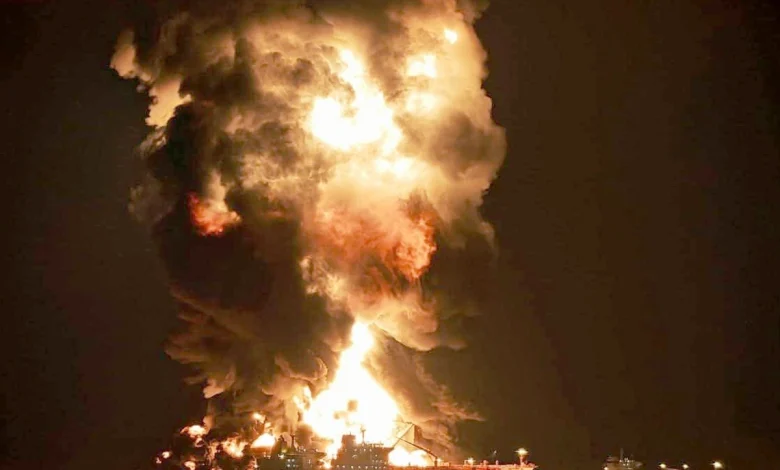
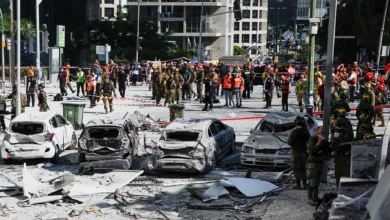
Just hours after U.S. President Donald Trump announced the suspension of a planned attack on Iran and expressed optimism about a forthcoming agreement to end the war between the two countries, explosions were heard along Iran’s coastline.
Iranian media reported blasts in two locations, Sirik and Bandar Abbas, but it took some time before Tehran clarified what had occurred.
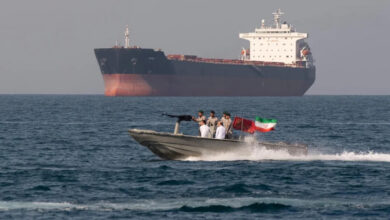
Later, Iranian state television, citing the naval forces of the Islamic Revolutionary Guard Corps, stated that “the explosions heard in Sirik resulted from the interception of a vessel attempting to cross the Strait of Hormuz,” while the explosions reported in Bandar Abbas remained unexplained.
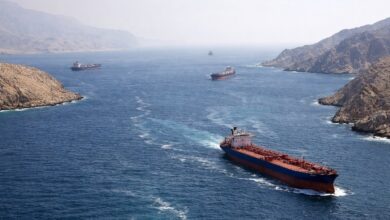
The Revolutionary Guard further stated that it “continues to monitor the Strait of Hormuz and will deal with extreme firmness toward any vessel attempting to pass through it.”
This development came only hours after Trump announced that the United States was close to signing an agreement with Iran that could resolve the crisis and end the conflict that erupted at the end of February.
Iran’s Ministry of Foreign Affairs acknowledged that the final version of the agreement was ready, while maintaining that discussions regarding the date and venue of its signing remained purely speculative.
Any use of force against vessels in the Strait of Hormuz could complicate peace negotiations at a stage when the parties appear to be approaching the end of a crisis that has cast a shadow over the Middle East and affected the global economic landscape.
What Is Behind the Escalation?
Iran’s escalation in the Strait of Hormuz, a vital route for global oil supplies, raises questions about whether a potential agreement with Washington is being opposed by a hard-line faction within Iran’s ruling establishment.
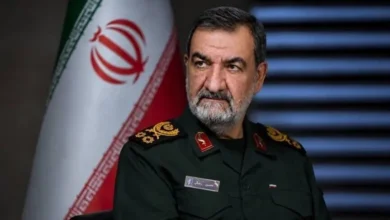
Over recent weeks, several international reports have pointed to divisions within Iran’s political structure between two main camps: on one side, the more hard-line leaders of the Revolutionary Guard; on the other, the administration of Iranian President Masoud Pezeshkian, viewed as reformist and supportive of greater engagement with the international community.
Gabriel Soma, a political analyst and former member of President Donald Trump’s advisory council, argued that Iran’s internal divisions are among the key factors contributing to the deterioration of relations with the United States.
He explained that conservatives tend to adopt a more confrontational stance toward Washington and view closer relations with the United States as a threat to Iran’s independence, whereas reformists have sought to establish diplomatic channels.
He also noted that Iranian foreign policy is not managed solely by the civilian government but is heavily influenced by institutions such as the Revolutionary Guard. This multiplicity of actors can sometimes produce contradictory messages or dual-track policies toward the United States.
According to Soma, these internal divisions have significantly contributed to the complexity and inconsistency of bilateral relations.
This interpretation of the contradictions within Iranian policy regarding negotiations and de-escalation efforts raises another important question: was the Revolutionary Guard’s firing on a vessel in the Strait of Hormuz merely a warning to its crew, or was it a political signal directed at the faction seeking an agreement with Washington?