The January specter looms over Niger… what is happening at Niamey Airport?
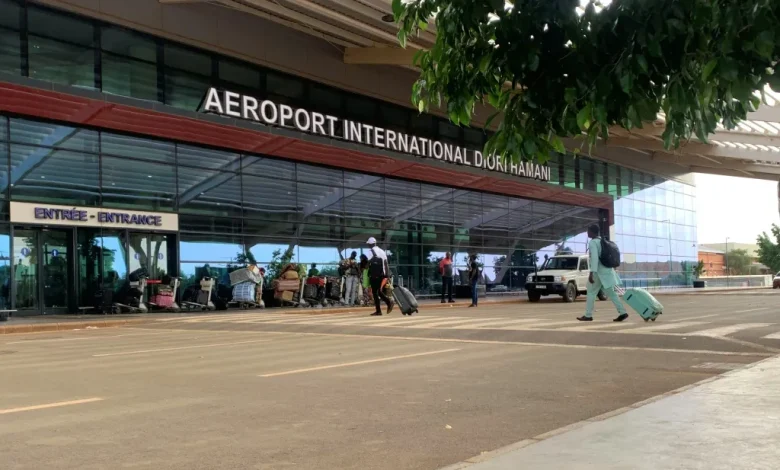
Under the cover of night and into the break of dawn, in a strategic location, gunfire and explosions once again shattered the silence of the Nigerien capital.
What happened?
During the night from Wednesday to Thursday, heavy gunfire and violent explosions were heard around “Diori Hamani” International Airport, located on the outskirts of Niamey, sparking panic among residents of nearby neighborhoods, who rushed to share information on social media, in a scene made even more obscure by the darkness, according to reports from local media sources.
-
Lakurawa: Intelligence Report Warns of the Mysterious Group in Nigeria
-
Terrorism Toll in Nigeria: 13,000 Militants Killed in One Year
In the early hours of Thursday morning, gunfire was again heard shortly after 6 a.m. near the main entrance of the airport.
A resident of Niamey told the website “Afrik”: “I confirm hearing gunfire very early this morning near the airport. But the situation is now calm. We are trying to understand what actually happened.”
Security cordon and the January specter
Meanwhile, security forces imposed a strict security perimeter around the area and blocked roads leading to the airport, while the source of the gunfire remained unknown for several hours.
-
From the Heart of Boko Haram Strongholds: Nigerian Army Frees 360 Hostages in Borno
-
Boko Haram escalates attacks: 33 killed among fishermen and woodcutters in Nigeria
“Diori Hamani” International Airport is not merely a civilian facility; it also hosts Military Base 101, which makes it a target in Sahel conflicts, where armed groups regularly carry out attacks against military and government targets.
The incident coincided with a state of heightened alert in the capital, particularly after the attack carried out by the Islamic State on January 29, when armed men stormed the airport, targeted civilian aircraft parked on the runway, and then moved toward the military base where they destroyed military equipment before security forces intervened.
At this stage, Nigerien authorities have not issued any official statement regarding the nature of the incident or whether it was a clash, an attack, a drill, or an air-defense-related event.
-
Terrorism bloodies Nigeria: 29 killed in an attack claimed by the Islamic State
-
17 killed in a terrorist attack in northeastern Nigeria
However, media outlets have reported, citing security sources, that the situation is “under control.”
Like its Sahel neighbors Mali and Burkina Faso, Niger is struggling to counter attacks carried out by extremist groups affiliated with Al-Qaeda and the Islamic State, which have caused thousands of deaths and displaced millions across the three countries.
Niger in brief
Niger is a landlocked country in West Africa, largely covered in the north by the Sahara Desert and in the south by savannah. It is crossed by the Niger River, from which it takes its name, and which serves as a vital source of water and life for its population.
-
Terrorism escalates in Nigeria ahead of elections: a western hotspot and a struggle for influence
-
Washington allows its embassy staff in Nigeria to depart… Abuja responds
The country is also a mosaic of peoples and cultures, with diverse ethnic groups including the Hausa, Zarma-Songhai, Tuareg, Fulani, and Kanuri.
Each group brings its own language, traditions, music, and artistic practices, creating a rich cultural heritage.
Colorful markets, traditional festivals, and live music are essential aspects of the country’s social and cultural life.
-
Education challenges terrorism: schools reopen in northern Nigeria despite threats
-
Christmas strikes… Nigeria discloses the U.S. weapons used against ISIS
Historically, Niger has a rich and complex past. It was a crossroads of trans-Saharan trade routes and witnessed the rise of powerful empires and kingdoms, notably the Songhai Empire.
Colonized by France in the early 20th century, it gained independence in 1960. Since then, the country has experienced periods of political instability, but also progress toward democracy.
Niger’s economy is mainly based on rain-fed agriculture and mining, particularly uranium.
Despite its natural resources, the country faces major challenges, including poverty, food insecurity, and the impacts of climate change, especially desertification.
-
Cooperation to Establish Security: 100 U.S. Soldiers Arrive in Nigeria
-
Staff evacuation… rising Islamic State threat reshapes US presence in Niger