The Muslim Brotherhood and Nazism: The Threads of a Relationship Dating Back to the Second World War
A British researcher has reopened the debate surrounding the relationships that developed between Nazi Germany and several Islamist movements, most notably the Muslim Brotherhood, during the Second World War.
During an interview as part of the program “Heretics,” hosted by British journalist Andrew Gold, who invites researchers and academics to discuss controversial historical, political, and intellectual issues, Dr. Daniel Allington, a British scholar specializing in extremism and political violence at King’s College London, presented his assessment of these relationships.
-
The Far Right and Ukraine’s Military: The Nazism Controversy Cracks the Wall of Western Support
-
A European Blow to Brotherhood Terrorism
Allington based his analysis on historical documents and accounts that, in his view, demonstrate a convergence of political interests between the two sides during that period.
According to Allington, the Muslim Brotherhood was among the movements with which Nazi Germany established relations as part of its strategy to counter British and French influence in the Middle East during the war.
He argues that the collapse of the Ottoman Empire following the First World War gave rise to political movements seeking to restore the influence the region had lost, while Britain and France had become the dominant colonial powers in the Middle East.
According to his interpretation, Nazi Germany regarded certain Arab and Islamist movements as potential partners because of overlapping political interests and sought to exploit this convergence in order to weaken British and French influence during the Second World War.
-
The Lost Paths of Destiny: The Memory of Nazism Reveals a Secret from Decades Ago
-
History Competes with War: The Memory of Massacres Strains the Warsaw–Kyiv Alliance
An Alliance of Shared Interests
Allington notes that the Muslim Brotherhood, founded in Egypt in 1928, sought to restore the Islamic Caliphate and recover what it viewed as a former era of political greatness.
In his view, the movement’s project shared ideological and political similarities with European nationalist movements of the time, particularly the Nazi Party in Germany and the Fascist Party in Italy, through their common emphasis on restoring a glorious past.
He argues that Nazi Germany provided support to the Muslim Brotherhood whenever circumstances allowed, while also backing the anti-Zionist Arab movement in Mandatory Palestine as part of its broader strategy to weaken Britain and its allies.
-
The Battle of Itter Castle, the strangest battle of World War II
-
Horten Ho 229: The Nazi Bomber That Preceded the Stealth Aircraft Era
The Grand Mufti of Jerusalem: The Connecting Figure
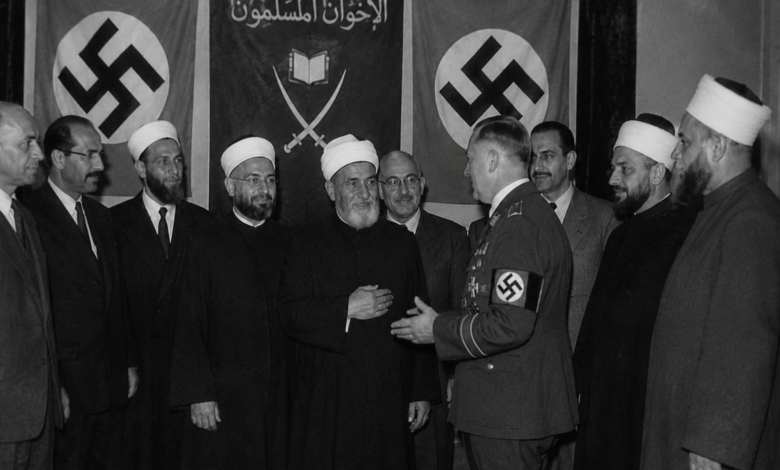
Allington also discusses Haj Amin al-Husseini, the Grand Mufti of Jerusalem, stating that he considered himself aligned with the Axis Powers during the Second World War and lived in Berlin for most of the conflict before returning to the Middle East after the war.
In the same context, the website WND Daily published an interview conducted in 1998 for the television program “60 Minutes” with a former individual associated with the Nazi regime regarding alleged contacts between Adolf Hitler and the Muslim Brotherhood.
According to that account, Hitler intended to cooperate with the Muslim Brotherhood during the Second World War. It further claims that Haj Amin al-Husseini met Adolf Hitler in 1941 and requested an official alliance with the Muslim Brotherhood, while Hitler allegedly made such cooperation conditional upon the successful Nazi capture of Moscow.
-
20 Minutes and a Weapon Hidden in a Shoe… the Story of the First Plane Hijacking in History
-
Japan Doubles Shelters… Preparing for World War III?
The website also states that al-Husseini maintained close ties with Hassan al-Banna, the founder of the Muslim Brotherhood, and became the movement’s first representative outside Egypt.
Similarly, a German investigative report entitled “Nazism and the Crescent: Inherited Ideologies of Hatred,” produced by the political investigative program “Report München,” examined aspects of the relationship between Nazi Germany and several Islamist figures and movements during the Second World War, citing what it described as newly uncovered documents.
The report states that Adolf Hitler received Haj Amin al-Husseini in 1941 and that cooperation between the two continued inside Germany throughout the war years. According to the report, they shared a common position toward the Jewish people.
-
The British Far Right Uses These Methods to Brainwash Children as Young as 9 Years Old
-
Egypt… Uprooting the “Brotherhood”
It further claims that al-Husseini called for what he described as a “holy war” under the banner of Nazi Germany. According to the report, he played a role in supporting the Bosnian Waffen-SS Handschar Division and led propaganda efforts to recruit Muslims into its ranks, whose members were trained in Germany.
The report adds that al-Husseini resided in Berlin throughout much of the war before being relocated to the German state of Saxony in 1944, where the Nazi regime reportedly provided him with accommodation. He eventually left Germany after the war and returned to the Middle East.
According to the report, Hitler based this rapprochement on what he regarded as the existence of a common enemy, although the project ultimately remained unfinished following Nazi Germany’s defeat in the Second World War.
-
What is the Relationship between the Founding of the Muslim Brotherhood in Egypt, Iraq, Syria, and the Greater Israel Project?
-
“Year of Lies and Blood”: Major Terrorist Crimes Committed by the Muslim Brotherhood in Egypt
After the Second World War
Allington distinguishes between developments in Europe and those that occurred in the Middle East after the end of the war.
According to his analysis, Europe underwent a comprehensive process of denazification and prosecuted numerous collaborators with the Nazi regime, whereas no comparable process took place in the Middle East.
He argues that several Arab collaborators with Nazi Germany, along with a number of former German officials associated with the Nazi regime, continued to serve in Middle Eastern countries as government advisers or in military and administrative positions, remaining influential within regional political life for many years.
-
A new slap to the Brotherhood in Egypt; The failure of calls November 11 marks the end of the terrorist organization
-
Rumors spread by Egypt’s Muslim Brotherhood ahead of January 25: a repeated tactic exposed by public awareness
A Historical Continuity
Allington considers Hamas to be the Palestinian branch of the Muslim Brotherhood and argues that this organizational connection represents a continuation of a historical trajectory that began during the Second World War.
He emphasizes that his research is not directed against Islam as a religion but rather against Islamism as a political ideology, maintaining that his conclusions are based on historical archives and documentary evidence.
He further argues that studying the relationships between Nazi Germany and certain Islamist movements as well as Arab nationalist groups during the Second World War has become a sensitive subject within universities and parts of the academic community.
-
72 years since the dissolution of the Muslim Brotherhood: the story behind Egypt’s Revolutionary Command Council decision
-
Echo-less rumors: Egyptians’ awareness foils the Muslim Brotherhood’s plan ahead of the January 25 anniversary
In his opinion, researchers working on these issues may encounter obstacles related to funding, publication opportunities, or academic review, leading some scholars to avoid pursuing this field of research.
In conclusion, Allington stresses the importance of distinguishing between Islam as a religion and Islamism as a political project. He maintains that the discussion concerns political movements and their historical alliances, rather than the Islamic faith or Muslims as a whole.
-
Muslim Brotherhood rumors in Egypt: public awareness thwarts the blank shots
-
The Muslim Brotherhood Has Betrayed the Egyptian Army Since the 1948 War… A Journalist Presents the Evidence
-
Egypt and the Muslim Brotherhood: Talha’s Release Exposes Double Standards and Threatens Regional Security