Iran Builds in the Shadows… Mount Pickaxe Triggers a New Nuclear Alarm
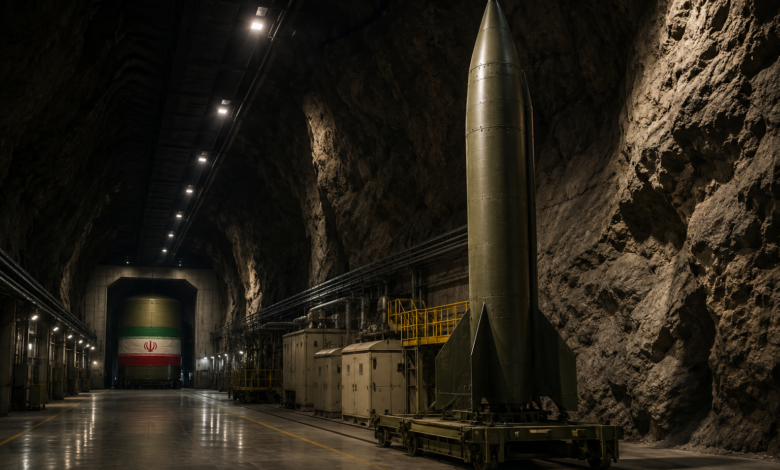
While the memorandum of understanding between the United States and Iran stipulates that the status quo at Iran’s nuclear facilities must be maintained, Tehran has continued construction work at a secret underground nuclear site located in the Pickaxe Mountains.
-
U.S. intelligence warns: Iran’s nuclear program continues despite the war
-
Iran’s nuclear program under fire: third attack on Bushehr in 10 days
These developments have not yet been subjected to any international inspections, prompting one of the leading U.S. research institutes specializing in monitoring Iran’s nuclear program to issue a warning about Tehran’s plans.
Inspectors from the International Atomic Energy Agency (IAEA) have not been permitted to visit the secret site known as “Mount Pickaxe.”
Experts believe that the heavily fortified facility raises serious questions about Iran’s compliance with the provisions of the memorandum of understanding reached with the administration of U.S. President Donald Trump. On February 28, 2026, the United States, in coordination with Israel, launched Operation “Epic Rage,” targeting Iran’s nuclear and missile capabilities.
-
Natanz under fire again: escalation targeting Iran’s nuclear program
-
Operation behind enemy lines: a U.S. plan to take control of Iran’s nuclear material
Satellite images reveal ongoing construction
The institute published a detailed analysis of satellite images taken in late June 2026, showing that activity at the site is continuing.
According to the report, “vehicle traffic along the roads leading to the western tunnel entrances indicates that construction work inside the complex is ongoing, alongside continued reinforcement and fortification of the tunnel entrances.”
The report added that the U.S.-Iran memorandum of understanding requires maintaining the existing situation, effectively prohibiting any construction work at facilities linked to the nuclear program, including the Mount Pickaxe site.
-
Iran’s Nuclear Program Surpasses the Threshold of Military Resolution: Uranium at a Dangerous Level
-
Pekaks: The Mountain Hiding Iran’s Nuclear Bomb
Spencer Faragasso, a senior researcher at the Institute for Science and International Security specializing in Iran, North Korea, nuclear proliferation, and illicit trade, wrote on the social media platform X: “The update we released at the Institute for Science and International Security is extremely significant. The continued work at the Mount Pickaxe site is deeply concerning. Construction has proceeded at a steady pace since at least 2020.”
He added: “I believe Iran is building this site as a contingency plan in case negotiations fail, allowing it to possess a nearly completed nuclear facility. Our assessments indicate that the site is large enough to accommodate a uranium enrichment facility.”
Iran already uses the Natanz, Fordow, and Isfahan facilities to enrich uranium, the essential material required for the production of nuclear weapons.
-
Iran’s Nuclear Program Back in the Spotlight… and Trump Seeks Political Breakthrough
-
“Iran’s Nuclear Program”: IAEA Condemnation and Tehran’s Response
A real test
Experts from the Washington-based Institute for Science and International Security (ISIS) stated that halting construction at Mount Pickaxe and allowing IAEA inspectors access to the site would constitute a genuine test of Iran’s good faith and its willingness to abandon what they describe as its previous policy of concealment and deception, according to the U.S. network Fox News.
Faragasso further stated: “If Iran is genuinely committed to negotiations, it should halt construction at Mount Pickaxe as a gesture of goodwill. But what can be expected from a regime characterized by such levels of ruthlessness and cunning?”
-
Iran’s Nuclear Program Has Crossed ‘All Red Lines’, Says Israel PM
-
The United States will sanction more than two dozen people and entities about Iran’s nuclear
Lack of international oversight
In late June, the International Atomic Energy Agency declined to comment on whether it would seek access to the site.
Satellite imagery obtained by the institute showed that activity at the Natanz facility remains limited. The entrances to the underground enrichment halls have not been repaired, staff access points remain destroyed, and the vehicle entrances continue to suffer extensive damage.
The images also identified only a single vehicle near the Pilot Fuel Enrichment Plant (PFEP), which was destroyed in June 2025 before Iran subsequently covered the visible damage.
-
Trump rejects Iran’s proposal to postpone the nuclear file
-
Nuclear Negotiations: U.S. Red Lines and Iran’s Firm Response
Fordow and Isfahan
The report also noted that, as of June 29, 2026, no activity had been detected at the Isfahan nuclear facility, while the tunnel entrances remained covered with earth.
At the Fordow facility, built inside a mountain north of the city of Qom, the institute reported that between May 10 and May 18 Iran established passive defensive fortifications, including earth and rock berms as well as carefully positioned obstacles along the roads leading to the tunnel entrances.
The report emphasized that these barriers do not appear intended to block the roads completely but rather to slow any rapid movement of vehicles toward or away from the tunnels.
Finally, the institute confirmed that the latest satellite images, captured on June 21, showed that these defensive fortifications remain in place and that the tunnel entrances at Fordow continue to be covered with earth.
-
France Says Iran’s Space Launch ‘Regrettable’ amid Nuclear Deal Talks
-
Intelligence Report: Iran’s Support for Its Regional Proxies Will Not Be Affected by Understandings with Washington
-
Iran’s Revolutionary Guards relied on Iraqi shadow cells in attacks against Gulf states
-
Reuters: Iran’s Revolutionary Guards formed secret cells in Iraq to attack Gulf states
-
U.S.-Iran Agreement: Broad International Welcome and Focus on Hormuz and the Nuclear Issue