The United Kingdom Under Threat: Farage’s Rise Revives the Specter of Disintegration
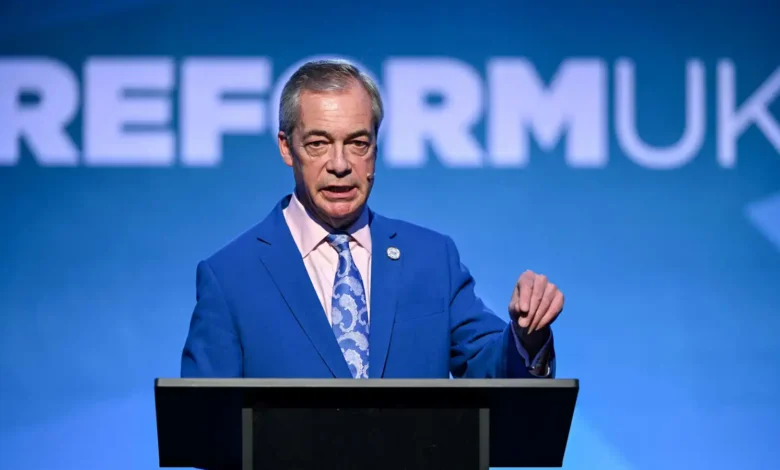
The rise of Nigel Farage, leader of Reform UK, has prompted political leaders in Ireland, Northern Ireland, Scotland, and Wales to contemplate what once seemed unthinkable: the possible breakup of the United Kingdom.
According to The Guardian, both unionists seeking to preserve the Union and nationalists determined to bring it to an end are preparing for potential constitutional upheaval if Reform UK prevails in the next general election, with Farage becoming either Prime Minister or the official Leader of the Opposition.
-
Operation “Kinova” reveals details of a British “conspiracy” in Ireland
-
Israel in the Crosshairs of British Justice: The 800 Memo Corners Tel Aviv
Representatives from both sides believe that a government led by Farage could trigger a hastily organized referendum on Irish reunification and pave the way for anti-immigration campaigns similar to those pursued by U.S. President Donald Trump, generating concern across all four nations of the United Kingdom. They also fear that a strong Reform UK opposition or a coalition involving the party could produce similar political consequences.
Mark Drakeford, the former First Minister of Wales, said that “within just a few years, people on the island of Ireland could look across the Irish Sea at a country where arrest teams resembling the U.S. Immigration and Customs Enforcement (ICE) agency are detaining people directly from the streets.”
-
5 Days of Unrest in Britain: A Trap for Starmer and a Major Challenge
-
Queen Elizabeth Told to Rest by Doctors, Cancels Visit
Drakeford, who has repeatedly stated that he would fight to preserve the Union, believes British politics has changed irreversibly. He fears there “may not be enough time” to conduct a thoughtful national debate about the future of the United Kingdom if Farage reaches 10 Downing Street or if Reform UK significantly expands its current representation of eight seats in Parliament.
He argued that English nationalism threatens to drive Scotland and Northern Ireland out of the Union, leaving Wales as “a small progressive entity” within what remains of the United Kingdom.
“The United Kingdom is a voluntary union of four nations,” Drakeford said. “In any voluntary union, people must have the option both to remain and to leave.”
-
The United Kingdom fears cyber strikes : a warning cry and a margin for prevention
-
Israel–Hezbollah war: UN concern and European call
The former Welsh Labour leader made these remarks last week during a conference in Belfast organized by the Social Democratic and Labour Party (SDLP), where political figures from across the United Kingdom and Ireland expressed concern over the possibility of being “forced” into holding a referendum on Irish unity.
Irish political leaders believe that the United Kingdom’s annual financial support for Northern Ireland, estimated at between £6 billion and £20 billion, could become a powerful campaign slogan for Farage, much like the Brexit-era claim that the European Union cost Britain £350 million every week.
Claire Hanna, leader of the SDLP, said: “Just wait until people see our bill. I believe that if English nationalists truly examine the level of resources Northern Ireland requires, it could become both a political issue and a political liability.”
-
Due to increasing threats, the United Kingdom targets Iran’s proxies with new legislation
-
United Kingdom and the Islamic Revolutionary Guard Corps: imminent legislation to ban Iran’s military arm
Conor Murphy, the former Sinn Féin Finance Minister at Stormont and now a member of Ireland’s Senate, stated: “We cannot afford to gamble on what London may decide in the future.”
Murphy estimates Northern Ireland’s financial support at less than £6 billion but believes Farage could use the £20 billion estimate as a political weapon. “He could simply say, ‘We’ll save this money by letting the Irish go. Good luck and goodbye.’ He could do that. I’m not saying he will, but that’s the nature of their politics. It’s very similar to Trump’s politics—highly unpredictable.”
-
An international initiative led by France and the United Kingdom to reopen the Strait of Hormuz
-
Admiral Nakhimov: The Nuclear Giant Gives Russia a New Strategic Advantage
Murphy added that Sinn Féin is urging Dublin to engage with its counterparts in the United Kingdom—”as long as there are still reasonable people left in Whitehall”—to clarify the terms and conditions of any future referendum. “The foundations need to be laid, the ground rules established, and safeguards put in place to protect against any potential constitutional disorder,” he said.
Nigel Farage has stated that he wants the United Kingdom to withdraw from the European Court of Human Rights and renegotiate the Good Friday Agreement, which underpins the current constitutional framework, in an effort to stop small migrant boats from crossing the English Channel into England.
-
Discover the 10 Most Powerful Armies in Europe: The United Kingdom in First Place
-
Australia Faces Simultaneous Threats: Cyberattacks, Incitement, and Iranian Espionage
-
Five Challenges Facing Britain’s New Prime Minister
-
The Muslim Brotherhood in Britain: A Growing Threat and Countermeasures Facing Obstacles