Sudan: A Meeting Point of Opposing Powers — Cairo, Tehran, and Ankara’s Convergence and Europe’s Strategic Dilemma
The war in Sudan has evolved into a unique geopolitical laboratory where the interests of regional powers—despite their longstanding rivalries—intersect around a single tactical objective: preventing the defeat of the Sudanese Armed Forces. In an unusual geopolitical configuration, Egypt, Iran, and Turkey have found themselves supporting the same side, or at the very least backing the same actor. This convergence has created a complex regional support network that raises numerous questions while placing Europe before a genuine strategic dilemma in interpreting developments on the ground.
The Convergence of Opposites: The Logistics of an Undeclared Alignment
The Sudanese conflict is no longer merely a confrontation between the Sudanese Armed Forces and the Rapid Support Forces. It has become a focal point for regional powers seeking to establish or expand their influence.
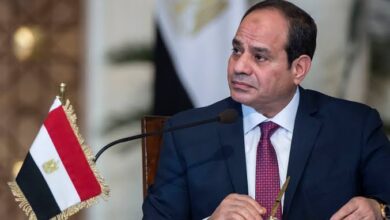
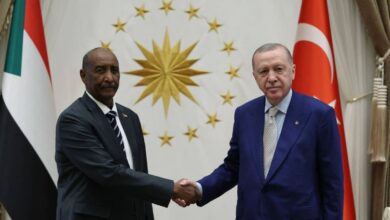
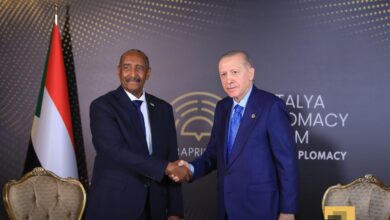
Iran supplies the Sudanese military with Mohajer-6 unmanned aerial vehicles in an effort to strengthen its strategic presence along the Red Sea. Turkey has established an air and logistical bridge to provide military expertise and combat systems. Egypt, meanwhile, offers strategic depth and political backing while allowing its airspace and certain facilities to serve as transit points for Turkish flights carrying military equipment.
This tactical convergence does not necessarily represent a strategic alliance between Cairo, Tehran, and Ankara. Rather, it illustrates the ability of Sudan’s leadership and Islamist groups aligned with it to exploit regional competition for their own benefit. Each regional actor contributes support that advances its own strategic interests, while Sudanese Islamist movements leverage this assistance to reinforce their domestic political and military positioning.
The European Perspective: Between Supporting State Institutions and Indirectly Financing Armed Factions
This is where Europe’s principal dilemma emerges. European capitals have at times viewed assistance provided to the Sudanese military as support for a legitimate state institution confronting rebel formations or armed groups backed by external actors.
However, this interpretation overlooks important realities on the ground. According to this analysis, the Sudanese Armed Forces have evolved into a hybrid entity. As Turkish and Iranian weapons flow through Egyptian and Sudanese airports, the ultimate beneficiaries extend beyond regular military officers to include networks of Islamist brigades and mobilization forces.
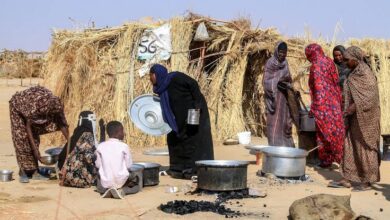
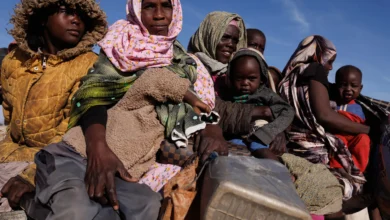
While Europe continues to prioritize efforts against irregular migration and terrorist financing, it risks overlooking the extent to which the continuation of the conflict—sustained by this overlapping regional support—further weakens the Sudanese state, facilitates the expansion of smuggling networks, and generates additional waves of displaced people moving toward the Mediterranean.
Regional Implications: From the Red Sea to the African Sahel
The continuation of this convergence in external support could push Sudan toward the consolidation of a militarily fragile state model in which ideologically driven militias exercise substantial control over territory with the backing of foreign powers.
According to this perspective, such a scenario would threaten not only Egypt’s national security because of geographical proximity and ideological linkages but also European security.
The use of Egyptian airspace and airports as transit hubs for Turkish and Iranian military shipments destined for Sudan raises a fundamental question for Europe: how can the proliferation of weapons across the Sahel and the Horn of Africa be effectively contained while sophisticated military equipment continues to flow into the Sudanese conflict, with the risk of those weapons falling beyond any effective control once the war eventually ends?
The conflict in Sudan has demonstrated the capacity of regional rivals to overcome their differences whenever their immediate strategic interests converge. Nevertheless, this undeclared alignment among Cairo, Tehran, and Ankara in support of the Sudanese Armed Forces and Islamist groups fighting alongside them is portrayed in this analysis as a potential long-term source of instability.
For Egypt, it represents a strategic gamble that may secure temporary influence while simultaneously contributing to the emergence of future ideological threats. For Europe, it reflects a misreading of the nature of the entity receiving external support. According to this assessment, the assistance is directed not solely toward a sovereign state but toward a hybrid system combining military structures with ideological networks—a system whose long-term consequences could undermine stability in the Red Sea and the security of Europe’s southern borders for many years to come.