J-15T: China’s Winning Card in Aircraft Carrier Warfare
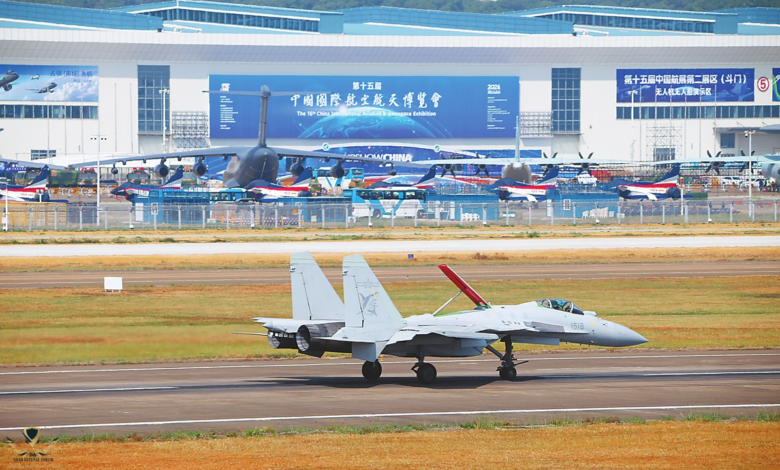
China has unveiled the world’s largest carrier-based strike aircraft, the J-15T fighter, during a ceremony held aboard the giant aircraft carrier Fujian.
The long-range J-15T carrier-based fighter is armed with four YJ-83K anti-ship cruise missiles.
These aircraft have been acquired to modernize the air wings of China’s two older aircraft carriers, Liaoning and Shandong, as well as the country’s newest supercarrier, Fujian.
The J-15T stands out not only for its substantial weapons payload and longer operational range compared with Western carrier-based fighters, but also for its ability to take off with heavier loads thanks to an electromagnetic catapult launch system—a capability currently available only on the U.S. aircraft carrier USS Gerald R. Ford.
-
Two serious incidents: Japan protests China’s use of fire-control radar
-
By land, sea, and air: China unveils its latest weapons at military parade
Exceptional Capabilities
The YJ-83K is a subsonic anti-ship missile known for its high effectiveness. It weighs approximately 700 kilograms and has a range of around 230 kilometers.
As a result, a J-15T carrying four missiles of this type takes off with nearly 2.8 tons of anti-ship ordnance, even before accounting for air-to-air missiles or external fuel tanks.
This achievement highlights the aircraft’s significantly increased payload capacity, made possible by its reinforced airframe compared with earlier J-15 variants, as well as the integration of the electromagnetic catapult launch system.
The new launch system substantially expands both the aircraft’s operational range and its combat effectiveness.
-
J-20 Fighters: Beijing under the Protection of the “Phantom”
-
Following the Stealthy F-35: Seoul Joins the Elite Club with an Air Superiority Fighter
In many respects, the J-15T is now regarded as the world’s leading carrier-based strike fighter. Its exceptionally long range and heavy missile payload significantly surpass the capabilities of all other carrier-based fighter aircraft currently in service, complementing China’s advanced new generation of military systems.
Meanwhile, the Fujian aircraft carrier has a displacement of approximately 85,000 tons, compared with roughly 100,000 tons for the U.S. Gerald R. Ford and Nimitz-class aircraft carriers.
The Chinese carrier Fujian also relies on KJ-600 airborne early warning and control aircraft to enhance situational awareness and provide long-range targeting support. These systems are considerably more modern and are believed to incorporate more advanced avionics and more powerful radar capabilities.
-
The Sixth-Generation Fighter Bet: Germany Seeks Leadership of Europe’s Skies
-
The collapse of the European dream… France and Germany abandon the future fighter jet
-
Pilots survive… Two U.S. fighter jets collide during an air show
-
Selfie costing $600,000: a maneuver and a collision between two F-15 fighter jets
-
Disagreements over a U.S. fighter jet deal unsettle Peru: resignation of the Foreign and Defense Ministers
-
Gripen: Brazil unveils its first locally manufactured supersonic fighter jet
-
The era of stealth fighters… Why has Israel returned to buying the F‑15?
-
Seoul deploys fighter jets after nine Russian and Chinese bombers enter its air defense zone