Putin’s Party Retains Its Grip on the State Duma, Clearing the Way for Constitutional Reform
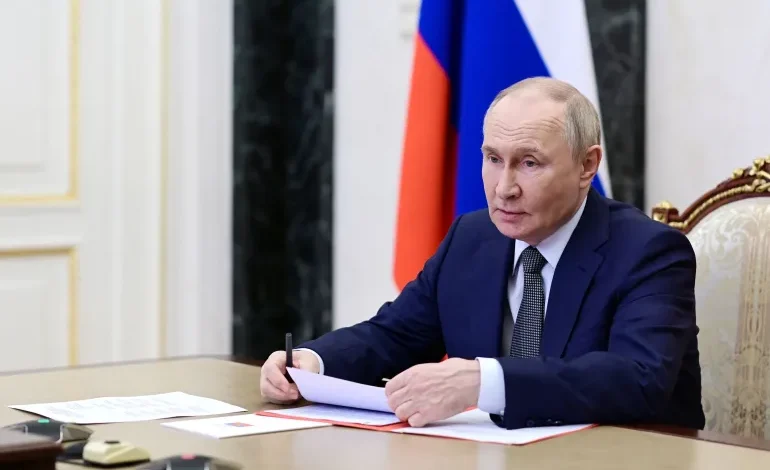
Russian President Vladimir Putin’s party secured an overwhelming majority in Sunday’s parliamentary elections, according to preliminary results, in a vote held amid cyberattacks and Ukrainian air strikes.
The election is widely viewed as a referendum on the war in Ukraine. Voting also took place in regions that Russia has declared annexed, while the outcome could pave the way for a constitutional referendum aimed at clarifying the legal status of the territories incorporated into the Russian Federation and restructuring the country’s system of government in the coming years.
Putin does not, however, require any further constitutional amendment to legitimize his continued rule. Amendments approved in 2020 already provide him with a comprehensive constitutional framework allowing him to remain in the Kremlin until 2036.
According to results reported by Russian news agencies after approximately 71% of the ballots had been counted, the United Russia party received 57.5% of the vote.
It was followed by the Communist Party and the nationalist Liberal Democratic Party, with 14% and 8.7% of the vote, respectively.
According to projections from the TASS news agency, the result guarantees the ruling party a two-thirds majority in the State Duma, enabling it to amend the Constitution.
The first official results and voter turnout figures are expected to be announced later on Monday.
Air Strikes
Russian officials said Ukraine launched swarms of drones targeting Moscow and the surrounding region on the final day of voting, killing two people and causing a fire at an oil refinery.
The Russian Defense Ministry accused Ukraine of attempting to “disrupt the democratic expression of the will of Russian citizens.”
It said Moscow would continue to “intensify its strikes using high-precision weapons against military targets in Kyiv.”
Moscow Mayor Sergei Sobyanin described the attack as “unprecedented” and said it had been “clearly planned with the aim of disrupting the elections.”
“The enemy did not succeed,” he added, saying Russian air defenses had shot down more than 1,600 drones, including “450 that were heading toward Moscow.”
Ukrainian President Volodymyr Zelensky, meanwhile, praised the strikes. “Our long-range operations had a very significant impact in the Moscow region last night,” he said, confirming that approximately 10 different types of weapons had been used.
Zelensky also announced that he had agreed to meet his US counterpart, Donald Trump, in New York following a telephone conversation between the two leaders on Sunday.
Moscow Region Governor Andrei Vorobyov said at least two people—a 44-year-old woman and an elderly man—had been killed at two separate locations.
He added that approximately 400 people had been evacuated from a 21-story residential building after it was struck by a drone.
Ukraine has targeted Russian infrastructure with drones throughout the war in response to Russian bombardments of its towns and cities.
Cyberattacks
The Election Commission announced that it had detected “more than a thousand” waves of attacks aimed at overwhelming the electronic voting system with requests, in addition to attacks targeting “Russia’s telecommunications infrastructure as a whole.”
Distributed denial-of-service attacks are intended to disable systems by overwhelming them with a continuous flood of requests.
Election Commission Chairwoman Ella Pamfilova said that “the attacks were carried out by highly professional and well-coordinated groups using artificial intelligence tools.” She also pointed to attempts bearing “indications of Ukrainian involvement.”
On Saturday, Pamfilova had announced that the systems had been subjected to a “powerful cyberattack,” although the assault had failed to disrupt their operation.