The United Nations Flag: The Story of an 80-Year-Old Emblem
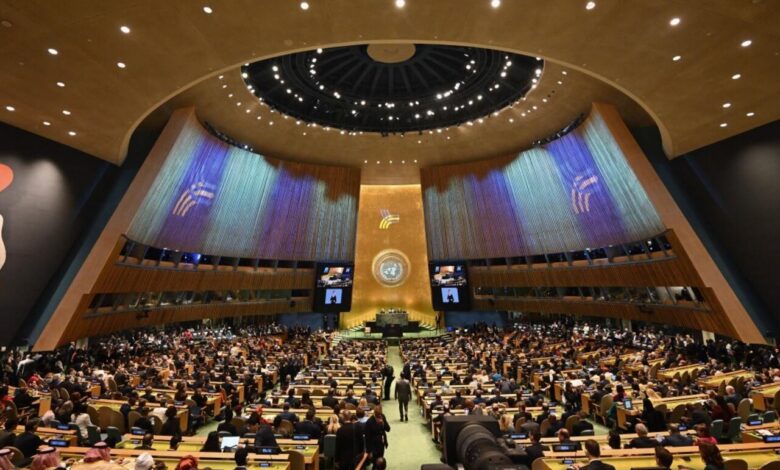
Beneath the sky-blue flag bearing two olive branches and a map of the world, the 81st session of the United Nations General Assembly is taking place at the organization’s headquarters in New York.
Against an exceptionally complex international backdrop, the United Nations is navigating a difficult path obstructed by armed conflicts stretching from Europe to Asia and across Africa, as well as existential issues that are rapidly gaining prominence on the global stage, most notably artificial intelligence and the climate crisis.
Yet as delegates consider these challenges, the UN emblem continues to carry profound symbolic significance—one that they may need to contemplate anew in order to remember why the institution was created and the values it was established to uphold.
-
World Leaders Gather at the United Nations as Wars and Crises Dominate the Agenda
-
Enemy Brothers: Austria and Germany Locked in a Fierce Battle for a United Nations Security Council Seat
What, then, is the story behind the emblem and the flag on which it appears?
The idea of establishing an international organization bringing together the nations of the world was already under consideration during the Second World War, perhaps even because of it, while memories of the League of Nations remained vivid.
In January 1942, US President Franklin D. Roosevelt coined the term “United Nations.” The “Declaration by United Nations” was subsequently signed in Washington by 26 countries forming a military and political alliance against the Axis powers.
By October 1942, 10 months after the idea had emerged, American activist Brooks Harding had designed a flag intended to represent the principles embodied by the new organization. It featured four vertical red stripes on a white background.
-
Fears of a Widespread Regional War Loom over the United Nations Meeting
-
Funny and unforgettable moments in the history of the United Nations General Assembly
The design sought to embody Roosevelt’s celebrated “Four Freedoms” speech: freedom of speech, freedom of worship, freedom from fear and freedom from want. Each stripe represented one of the fundamental freedoms around which the alliance had united.
The flag bearing the red stripes was raised for the first time in June 1943 at the Dumbarton Oaks estate in Washington. It was subsequently used in a secondary capacity alongside the national flags of member states as a symbol of solidarity and the pursuit of world peace.
The emblem was not formally adopted, however. In 1945, delegates from 50 countries convened at the San Francisco Conference to draft the Charter of the United Nations. Participants believed that the new institution—which they hoped would be permanent and vested with formal authority—should be more than a military alliance. They therefore agreed on the need for a new flag representing both the geography of the world and political neutrality.
-
Guterres on a Global Tour… United Nations Messages on the World Stage
-
The United Nations Tastes Houthi Terrorism.. Houthi Mine Explosion in Car Containing Head of Mission to the United Nations
The First Version of the Emblem
The organizers of the San Francisco Conference proposed designing a lapel pin to identify participating delegates and symbolically celebrate the birth of a new international organization. Graphic designer Donal McLaughlin was commissioned to create the conference emblem.
The original design featured a map of the world viewed from the North Pole. This projection brought all the continents together around a central point without favoring any particular continent or placing one country at the center.
Two olive branches were added around the map. An ancient Greek symbol, they have historically represented peace and harmony. The original design used a dark blue background.
-
Urgent Palestinian Appeal at the United Nations: Let This Madness Stop
-
Fighting terrorism and drought… the most prominent files of the President of Somalia at the United Nations
Modifying the Emblem
The original 1945 design placed North America at the center because the conference had been held in the United States. When the emblem was formally adopted by the United Nations General Assembly on December 7, 1946, the map was altered and rotated so that the lines of longitude were distributed more evenly, preventing any single continent from occupying the center of the design.
The map was rotated approximately 90 degrees to the left, or westward. This adjustment created a visual balance in which East and West were represented equally, without giving prominence to any one continent.
Another modification concerned the lines of latitude. The initial design ended at the 40th parallel south, effectively cutting off parts of the Southern Hemisphere. As a result, the southern edges of the continents were not fully represented, while Argentina, Chile and New Zealand were absent from the emblem.
The designers addressed this issue in the 1946 revision, ensuring that these territories appeared in full on the flag. The background color was also changed from dark blue to sky blue.
-
The United States and France are entangled in the United Nations’ entanglement in the Middle East
-
Who Has the Authority to Designate a Terrorist Organization in the United States? A Legal Analysis of the Oklahoma Governor’s Order Against the Muslim Brotherhood and CAIR
A Proposal That Never Materialized
In January 1947, approximately one month after the official emblem was adopted, a formal proposal was submitted to the United Nations General Assembly to combine the four red stripes of the “Honor Flag” with the world map emblem on a single flag.
The proposal remained under consideration and discussion for several months before being formally withdrawn in August of the same year.
In October 1947, the General Assembly ultimately decided to adopt the flag in its current form: the white United Nations emblem displayed against a light blue background, without any additional stripes.
-
The United Kingdom Under Threat: Farage’s Rise Revives the Specter of Disintegration
-
United States and Russia… Deterrence missiles shake the bridges of nuclear understanding