Coordination Framework Divisions Stall a Decisive Outcome as al-Zaidi’s Jurf al-Sakhr Plan Faces the Risk of Confrontation
Attention is turning to Jurf al-Sakhr subdistrict in northern Babil province as the deadline set by Prime Minister Ali al-Zaidi’s government approaches. The deadline calls for ending the armed presence and vacating sites linked to oil-smuggling networks. Counter-terrorism forces began entering the area at dawn to reassert state authority.
The security operation has intensified sharp differences within the ruling coalition. Government efforts to secure a decisive outcome on the ground are encountering reservations from prominent Coordination Framework leaders who favour avoiding a full-scale military confrontation. These disagreements are obstructing the political consensus needed to resolve the issue.
Inside the Coordination Framework
Informed sources said that a comprehensive military operation to enter Jurf al-Sakhr by force faces exceptionally complex political and logistical obstacles. It is therefore currently the least likely option among decision-makers, despite counter-terrorism forces entering the area.
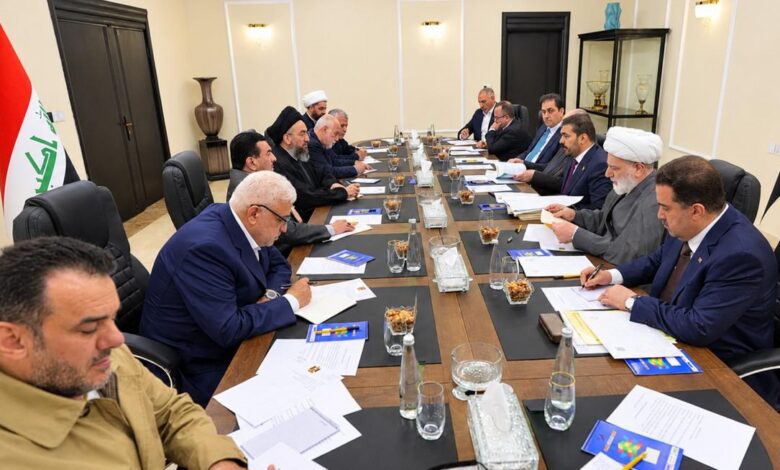
The sources said recent Coordination Framework meetings involved heated discussions. Several prominent leaders, particularly Hadi al-Amiri, Nouri al-Maliki and Ammar al-Hakim, explicitly opposed granting the prime minister an open-ended mandate to use armed force against Kataib Hezbollah.
According to the information obtained, these objections reflect a close assessment of the risks of confrontation. Foremost is concern that clashes between elite federal forces and Kataib Hezbollah members could descend into widespread internal fighting. Political leaders regard this as a red line that could fracture the ruling coalition and undermine the current government’s political stability.
The sources also pointed to structural complications arising from Kataib Hezbollah members’ deployment under the umbrella of the Popular Mobilisation Commission. This raises concerns that battlefield solidarity could spread among formations and threaten the cohesion of the official security apparatus.
There are additional concerns about the faction’s missile and drone arsenal inside and around the area. Attacks on these assets could trigger retaliation threatening vital facilities in Baghdad and neighbouring provinces at a time of growing economic pressure.
Obstacles to open military intervention have prompted government and security leaders to examine more targeted alternatives. These would involve isolating the area logistically and financially and conducting raids exclusively against access points and locations used for smuggling and refining petroleum products, together with associated tunnels. The approach would also tighten the security cordon and establish Federal Police and Energy Police observation posts, without engaging military headquarters or residential areas in confrontation.
The sources described recent government measures as preliminary steps intended to intensify pressure and dismantle networks of unlawful interests while keeping a political settlement possible. These include replacing local security commanders in Babil, deploying counter-terrorism and rapid-response reinforcements to control entry and exit routes and take positions at several locations, organisational and communications measures, and holding a Cabinet meeting in Najaf.
On the Ground: Defiance and De-escalation
Recent developments, both operational and official, reflect a combination of escalation and attempts to ease tensions. Kataib Hezbollah spokespeople have firmly rejected withdrawing under pressure or abandoning their positions. They argue that oil smuggling is being used as a political pretext to disarm the factions.
Subsequent statements by faction leaders, however, said Jurf al-Sakhr would not become an arena for internal division. They ruled out armed clashes with regular forces and called for dialogue and an on-site assessment of conditions.
Government agencies, meanwhile, continued to insist that the security moves do not target a particular faction. They described them as implementing investigative committees’ recommendations and judicial decisions to combat unlawful economic activity and restore state sovereignty over public resources.
Parallel parliamentary and security efforts are seeking understandings that would replace the forces currently controlling the area with regular security formations, ensuring local security and ending the controversy.
A Test of State Authority and Unified Decision-Making
Political analyst Ali al-Habib said that the rapidly unfolding developments in Jurf al-Sakhr extend beyond their immediate security context. They represent a decisive test of al-Zaidi’s government’s ability to enforce the law and consolidate the authority of constitutional institutions.
He said the prime minister sought to send a firm message that sovereign and security matters—foremost among them protecting oil wealth and holding those involved in smuggling accountable—must remain exclusively under state jurisdiction, beyond partisan bargaining or calculations about political balances.
Regarding differences within the Coordination Framework, al-Habib said they reflect the complex challenge of moving from political consensus and negotiated accommodations to implementing sovereign decisions on the ground.
The preference of some actors for negotiations and gradual withdrawal to avoid clashes does not necessarily indicate the ruling coalition’s collapse, he noted. Instead, it offers the government an opportunity to develop a more sophisticated crisis-management approach balancing legal and security firmness with political pragmatism that avoids the trap of internal conflict.
Al-Habib added that the government’s position rests on strong foundations, reinforced by judicial directives supporting action against organised crime and religious authorities’ prohibitions on misuse of public funds and smuggling national resources.
He concluded that strength and success at this stage should not be measured by launching an open military confrontation. They should be judged by the ability to resolve the complex crisis through sustainable state institutions and translate government measures into tangible results enjoying broad public and institutional support.
Political and security developments indicate that the Jurf al-Sakhr crisis has reached a critical juncture, testing the ruling coalition’s resilience and its ability to reconcile sovereignty requirements with concerns over factional balances. Between the government’s determination to regain the initiative and enforce the law, and political fears about the cost of an ill-judged confrontation, the parties face a delicate path towards resolving the crisis without undermining domestic stability.