Leave us alone, al-Burhan: Sudanese anger extends beyond the war and puts the army chief’s future at stake
Ikhtana ya Burhan
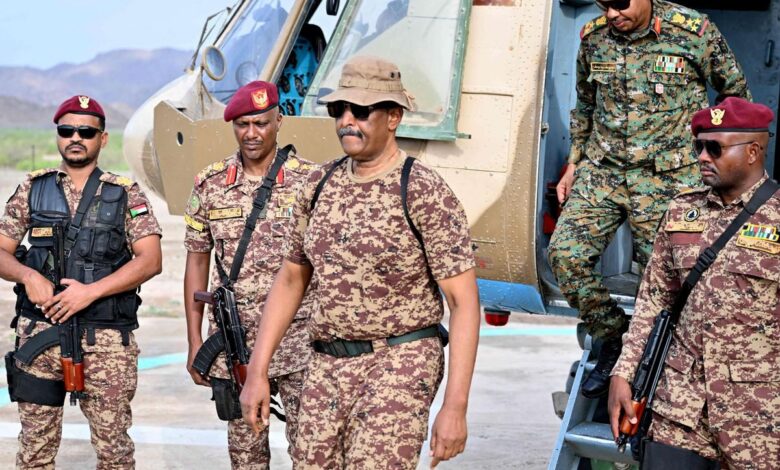
The Sudanese colloquial expression “Ikhtana” has evolved from a simple everyday phrase into a political slogan carrying a powerful message directed at army chief Abdel Fattah al-Burhan. Its circulation on social media intensified around the fifth anniversary of the October 25, 2021, military coup. Meaning “Go away” or “Leave us alone,” the expression has come to encapsulate growing public anger toward a military leadership that sections of Sudanese society hold responsible for prolonging the crisis, obstructing the civilian transition, and plunging the country into open warfare and unprecedented collapse.
The significance of the slogan lies in both its widespread circulation across digital platforms and the political message it conveys. By addressing al-Burhan in such direct and concise terms, Sudanese participants are expressing their opposition to the war and their frustration over deteriorating living conditions. They are also raising a more fundamental question concerning the legitimacy of continued military rule and the leadership’s ability to extricate Sudan from the predicament it has faced for years.
Sudan’s crisis has evolved beyond disagreements between military and civilian actors into a broader crisis affecting the state, its institutions, and society as a whole. As fighting continues, displacement intensifies, and citizens struggle to meet their basic needs, growing sections of the population believe that the promises accompanying the military’s intervention in politics have gone unfulfilled. The country has consequently moved from a faltering political transition into a considerably more complex and dangerous situation.
One word encapsulates years of public anger
The expression “Ikhtana” carries political significance far beyond its literal meaning. Drawn from everyday Sudanese language, it conveys a clear position toward the head of military authority without relying on traditional partisan slogans or lengthy political statements.
Since the hashtags “Ikhtana” and “Ikhtana ya Burhan” began circulating in October, social media posts, graphic designs, and videos have linked al-Burhan’s continued rule to warfare, economic collapse, hunger, displacement, and stalled political solutions.
The campaign’s messages have also sought to hold the military leadership accountable for the political decisions that followed the fall of Omar al-Bashir’s government, leading to the October 2021 coup and the subsequent outbreak of war in April 2023.
The choice of expression reflects a desire to move away from conventional political language, often characterized by complex terminology and partisan rhetoric. Its purpose is to deliver a direct message to the individual at the forefront of Sudan’s political landscape. The wait has gone on too long, and the cost of maintaining the current situation has exceeded society’s capacity to endure it.
This development is particularly significant because the slogan places al-Burhan’s political role at the center of public debate, extending beyond his military performance.
Demands voiced through the campaign include ending the war, removing the military establishment from political affairs, holding those responsible for violations accountable, restoring civilian rule, and ending the influence of networks associated with the former regime within state institutions.
Five years after the coup, what has changed?
The slogan’s growing prominence comes at a particularly sensitive moment, coinciding with the fifth anniversary of the October 25, 2021, coup. On that day, al-Burhan declared a state of emergency, dissolved the Sovereignty Council and the Council of Ministers, suspended key provisions of the Constitutional Declaration, and oversaw the arrest of Prime Minister Abdalla Hamdok and several civilian officials.
Sudan was then undergoing a transitional period that had begun following the overthrow of Omar al-Bashir in April 2019, amid hopes of establishing a democratic civilian government capable of ending decades of authoritarian rule and rebuilding state institutions.
However, the civilian-military partnership remained plagued by deep disagreements over the distribution of authority, oversight of the military establishment, and the future of security and economic institutions.
The coup undermined what remained of public confidence in the transitional process and restored the military establishment’s direct control over political decision-making.
Despite attempts to reinstate the prime minister under a political agreement reached in November 2021, the arrangement failed to restore public trust and ultimately ended with Hamdok’s resignation in January 2022.
For al-Burhan’s critics, the coup represented a decisive turning point that undermined the prospects of resolving political disagreements through civilian institutions, deepened divisions between political and military actors, and weakened efforts to establish a broadly accepted transitional authority.
Five years later, renewed calls for al-Burhan’s departure have reopened debate over the coup itself, extending beyond protests against the conditions arising from the current war.
War turns public anger into demands for political accountability
With the outbreak of fighting between the Sudanese army and the Rapid Support Forces (RSF) on April 15, 2023, Sudan entered a new phase of collapse.
Disagreements over the integration of the RSF into the regular army, command-and-control arrangements, and security sector reform escalated into a large-scale military confrontation that destroyed residential neighborhoods and critical infrastructure and forced millions of Sudanese citizens to flee their homes.
The two sides had shared power following the 2021 coup before they disagreed over the future of the political process, and the restructuring of the security sector intensified. Sudan consequently found itself embroiled in a conflict between two military forces that had previously cooperated in undermining the civilian transition.
Against this backdrop, the campaign opposing al-Burhan has raised questions about political responsibility for the continuation of the war. Its participants argue that describing the conflict as an armed rebellion or presenting an army victory as the solution leaves a fundamental question unanswered: why was the military leadership unable to prevent its disagreements from escalating into war, and why has it still failed to bring the fighting to an end?
These questions extend beyond military considerations to the very future of governance in Sudan. Having entered its fourth year in 2026, the war has developed into a multi-front conflict shaped by intertwined military, political, economic, and regional factors.
A counter-campaign highlights the slogan’s political sensitivity
The spread of “Ikhtana” prompted a response from al-Burhan’s supporters and factions advocating continued military rule.
A counter-campaign emerged under the slogan “You remain above our heads,” a traditional expression of respect and support intended to demonstrate the existence of a social constituency opposed to the army chief’s departure.
Some pro-government platforms have also accused campaign participants of acting on behalf of the Rapid Support Forces or other political and foreign actors. Certain social media accounts have even called for those promoting the hashtag to be arrested and prosecuted on charges of treason and conspiracy.
This response illustrates the political sensitivity surrounding the slogan, particularly because it has opened public debate over the legitimacy of al-Burhan’s continued rule.
Equating political criticism with treason, however, raises further questions about the boundaries of freedom of expression and the nature of relations between the state and society under military governance.
The state extends beyond the individual who leads it. Opposing a ruler or calling for a change in leadership can represent a political position independent of allegiance to either armed party. This distinction is particularly important in a society exhausted by war and increasingly in need of political space for civilian voices independent of both sides of the conflict.
Can digital outrage evolve into a political force?
Despite the momentum generated by the hashtag, translating online expression into organized political influence remains uncertain.
Social media platforms can amplify shared messages and bring public demands into the spotlight. Establishing a political alternative, securing a settlement, and ensuring a stable civilian transition, however, require broader institutional efforts.
The campaign faces numerous challenges, including the fragmentation of civilian political forces, the absence of a unified political center, competing visions for the transitional period, and the difficulties of organizing large-scale public mobilization in a country affected by warfare and security divisions.
While calls for al-Burhan’s departure constitute an important expression of opposition to continued military rule, Sudan still faces the question of what would follow his departure.
The country needs political and security arrangements that prevent the recurrence of the same crisis and ensure that any transfer of power addresses the underlying causes of the conflict.
This requires broad civilian consensus, legitimate transitional institutions, meaningful military and security sector reform, and a comprehensive process of transitional justice, accountability, and reconstruction.
Ultimately, “Ikhtana” represents an accumulation of years of political, economic, and humanitarian frustration, alongside a desire to bring an end to an era that campaign participants increasingly associate with war, collapse, and institutional paralysis.
Although the slogan alone may be insufficient to alter the balance of power, it confronts al-Burhan with a renewed political test: how can a leadership that calls on society to remain patient and rally behind it disregard the growing number of voices demanding its departure from power?