Al-Burhan criticizes Germany for hosting a Sudan support conference without consultation
The Sudanese government warned that engaging with paramilitary groups would undermine state sovereignty, in line with its policy of prioritizing military resolution over peaceful solutions.
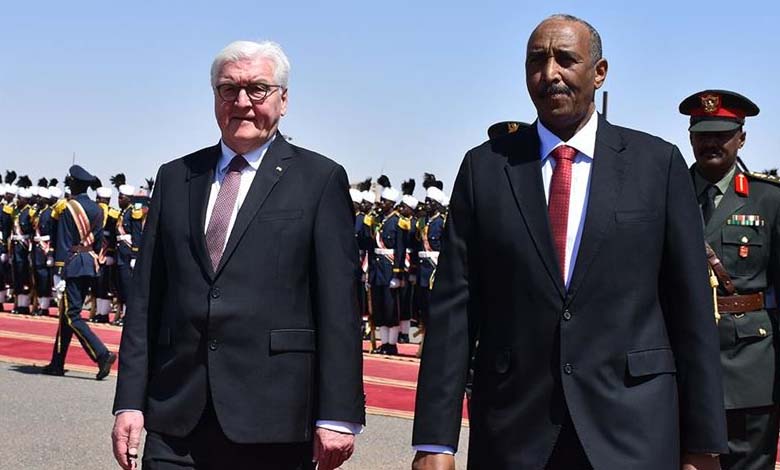
The government of Sudan said on Wednesday that Germany’s intention to host a conference on Sudan on April 15 constitutes a sudden and unacceptable interference in its internal affairs, carried out without consultation with Khartoum.
-
The Forgotten War: How the Sudanese Government Tries to Cover Up Horrific Crimes against Civilians
-
Leaked Documents Reveal Details of Sudanese Government’s Contract with a Washington Lobbying Group
It warned that dealing with paramilitary groups would compromise state sovereignty, referring to the Rapid Support Forces (RSF). The head of the Sovereignty Council, General Abdel Fattah al‑Burhan, rejects any negotiations with the RSF and insists on military solutions.
For its part, the German Development Ministry announced on Wednesday that Berlin would allocate an additional €20 million to Sudan this year, ahead of the international humanitarian aid conference scheduled in Berlin, which aims to secure funding pledges exceeding $1 billion.
-
The Sudanese Government and Its Policies in the Conflict
-
Hidden networks of influence in the Sudanese war
German Foreign Minister Johann Wadephul told Deutschlandfunk that the conference seeks to keep attention focused on Sudan as the wars in Ukraine and Iran weigh more heavily on European governments, amid declining U.S. interest in humanitarian aid.
He added, “This is not a quick fix, but keeping international attention focused on the humanitarian situation in Sudan is an essential contribution to ending the war,” noting that Germany is holding talks with both warring sides, though neither will attend the conference due to their disagreement over a ceasefire.
-
Sudanese Islamists announce support for Iran: Is Sudan becoming a new arena for regional conflict?
-
Assassination of Chazali Khidr Abdelkader: Sudanese Arms Deals Turn into a Bloody Conflict
He said Germany aims to gather pledges of no less than $1 billion, stressing that this is not only a moral obligation to prevent people from suffering hunger, but also in Germany’s interest to avoid a large migration wave similar to that from the Middle East in 2015 and 2016.
Three years after the outbreak of civil war in Sudan, attention is once again turning to a new international initiative involving European and African political officials, along with representatives of civilian forces, in an attempt to revive a political settlement path for what is considered one of the most complex wars.
-
Power struggle between the Sudanese army and the Muslim Brotherhood: rising political tensions
-
Minnawi out of the equation: the implications of his exclusion for the stability of Sudanese power
The German capital, Berlin, is hosting the international conference on Wednesday, which also aims to keep the humanitarian crisis — described by the United Nations as the largest in the world at present — within the sphere of international concern as global focus remains on the wars in Ukraine and Iran. However, the meeting is not expected to produce an immediate ceasefire agreement.
This event marks the third edition of international conferences dedicated to Sudan, following earlier meetings in Paris and London. It is organized at the initiative of the German government in partnership with the United States, the United Kingdom, and France, as well as the European Union and the African Union. The program includes foreign ministers’ meetings, a humanitarian pledging event, and a dialogue bringing together civilian actors to outline a possible political pathway.
-
Heglig reshapes the balance of the Sudanese war… and Washington repositions itself
-
Victims of the Sudanese War… Testimonies that condemn decisions and reveal the state’s disintegration
Around 120 delegations are expected to participate at the German Foreign Ministry headquarters, including nearly 60 from civil society, amid hopes that these actors can help shape a transitional vision, as concerns grow about the entrenchment of military dominance over the country’s future. Previous support conferences yielded nearly €2 billion in Paris and around €1 billion in London, with efforts to reach similar levels in Berlin.
The roots of the conflict date back to April 15, 2023, when the country descended into war between the Sudanese Armed Forces (SAF) led by Abdel Fattah al-Burhan and the RSF led by Mohamed Hamdan Dagalo, after the two sides had shared power following a previous coup.
-
The world rejects coups d’état and stands with the will of the Sudanese people
-
Port Sudan… between government paralysis and the crime of child recruitment: what future awaits Sudan?
Since then, territorial control has fragmented. The armed forces have retaken large areas, including the capital Khartoum and parts of eastern Sudan, while the RSF consolidated its grip in Darfur after capturing the city of El Fasher, giving it supply corridors through Chad, Libya, and the Central African Republic, in addition to funding sources linked to gold. The Kordofan regions continue to witness intense fighting, raising warnings of a potential long-term de facto partition.
Both sides face growing accusations of serious human rights violations, including potential war crimes. The United Nations states that Sudan is experiencing the world’s worst humanitarian crisis, with more than 11.6 million displaced people, 19 million at risk of hunger, and nearly 80 percent of health facilities damaged or out of service.
-
The Sudanese Army and the Islamic Movement: An Alliance Crumbling in the Age of Political Bargains
-
Between Sudanese Army Statements and Rapid Support Forces Denials: What Really Happened in Nyala?
International reports also speak of widespread sexual violence during the conflict, indiscriminate shelling of civilian areas, mass killings, and documented abuses, particularly in Darfur, where UN experts have pointed to possible indicators of genocide crimes.
Regionally and internationally, multiple actors are involved: the RSF are viewed as receiving external support, while the Sudanese government enjoys backing from Egypt and Saudi Arabia. The United States imposed sanctions on networks linked to RSF leaders in early 2025.
-
The Sudanese Army’s Defeat in El-Fasher… A Defeat of Repression, Not Just a Battlefield Loss
-
The Two-Government Scenario Raises Fears of Sudan’s Partition
Despite numerous international initiatives, including efforts by the “quartet” comprising the United States, Egypt, Saudi Arabia, and the United Arab Emirates, attempts to reach a political settlement remain stalled due to the absence of the parties at direct negotiation talks.
In the latest humanitarian developments, the International Committee of the Red Cross reported recovering and burying more than 20,000 bodies in Khartoum alone, while unofficial estimates suggest the death toll may exceed 150,000, amid great difficulty in accurately assessing human losses due to ongoing fighting.
-
Power and Influence Struggles: Infighting Rocks Sudanese Army Alliances
-
Sudanese Army Soldiers and Islamist Militias Accused of Looting Homes and Assaulting Civilians