Asian Arms Race: US Strengthens Guam’s Defences
The US Army has activated a new air defence battalion on Guam as China and North Korea expand their missile forces
The move is intended to strengthen protection of the strategically important territory, which continues to play a pivotal role in supporting planned offensive operations in East Asia.
According to Military Watch magazine, the 3rd Battalion, 43rd Air Defense Artillery Regiment has been stationed at Andersen Air Force Base. It is taking over responsibilities previously assigned to Task Force Talon, marking a shift towards a permanent air and missile defence presence on the island.
Task Force Talon began rotational deployments in 2013, initially focusing on protecting Guam against potential North Korean ballistic missile attacks. The rapid expansion of Chinese and North Korean missile forces has since significantly broadened that mission.
A multidirectional defence system
In 2023, the Pentagon drew up plans for the Guam Defense System to counter threats from ballistic, cruise and hypersonic missiles. The initiative reflects concerns about the vulnerability of US bases to long-range precision strikes in a potential regional conflict.
At the time, plans envisaged up to 20 new air defence sites on the island as part of efforts to improve the resilience of critical facilities. New, stringent airspace restrictions were also expected in the area.
Reports on the planned capabilities indicated that the missile defence system would protect Guam against threats from all directions by distributing its components across multiple locations on the island.
Six THAAD launchers already deployed
Guam currently hosts six US Army Terminal High Altitude Area Defense (THAAD) launchers. US Navy warships equipped with the Aegis combat system can provide additional defensive support when assigned to protect the island.
The new battalion is expected to operate several integrated systems, including Patriot for medium-altitude defence, THAAD for high-altitude interception, and the Indirect Fire Protection Capability (IFPC), which remains under development.
The US Army aims to bring these systems together within a coordinated defensive architecture linking sensors, command-and-control infrastructure, launchers and interceptors.
Diversifying US military facilities
Alongside efforts to strengthen Guam’s missile defences, the US military has worked to diversify the facilities supporting its power projection in East Asia. This includes expanding installations on Wake Island and in northern Australia.
These locations are also expected to serve as operating bases for nuclear-capable B-21 strategic bombers.
However, China’s and North Korea’s advanced ballistic missile strike capabilities remain a major challenge to US forces operating from these sites.
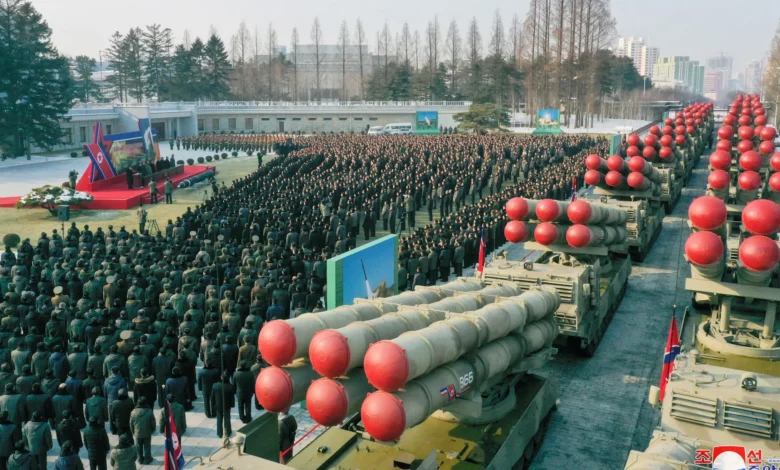
North Korea began testing ballistic missiles equipped with hypersonic glide vehicles in 2021. According to the magazine, it has since brought the Hwasong-16B into service. Equipped with a single glide vehicle, the missile reportedly offers capabilities significantly exceeding those of its predecessor, the Hwasong-12, known as the “Guam killer.”