How Artificial Intelligence Is Transforming Cardiology and Supporting Medical Decisions
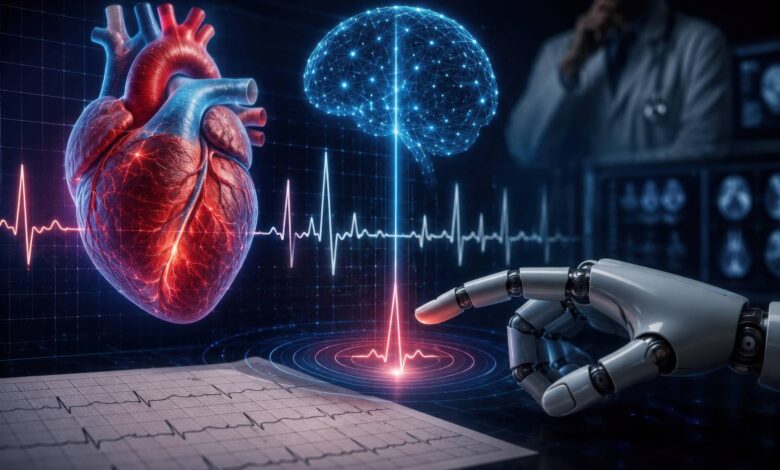
Artificial intelligence is gradually reshaping healthcare and emerging as a promising tool across several medical specialties, particularly cardiology. Its ability to process large volumes of information, identify abnormalities, and recognize patterns that may be difficult to detect through conventional methods is creating new opportunities for the prevention, diagnosis, and management of cardiovascular diseases.
Heart conditions remain a major challenge for healthcare systems worldwide. Their management often requires regular monitoring, specialized examinations, and the careful interpretation of numerous medical parameters. In this context, artificial intelligence technologies could help cardiologists make more informed decisions, identify certain risks earlier, and adapt treatments to individual patient needs.
However, the introduction of these tools into medical practices and hospitals does not mean that doctors are about to be replaced. Their real value lies in complementing medical expertise and making certain complex tasks more manageable.
Artificial intelligence is changing the way heart conditions are diagnosed
One of the most important applications of artificial intelligence in cardiology involves the analysis of medical examinations. Algorithms can be trained to recognize specific patterns in electrocardiograms, echocardiograms, and images obtained through other medical imaging techniques.
Electrocardiograms, which record the heart’s electrical activity, are particularly valuable sources of information. Artificial intelligence systems can analyze variations in heart rhythm and identify abnormalities that may indicate cardiovascular problems.
Some technologies can also help detect signs of atrial fibrillation, a relatively common heart rhythm disorder that can increase the risk of stroke. In certain situations, these tools may identify abnormalities that are not immediately apparent during an initial examination.
The objective, however, is not to replace medical interpretation. Instead, artificial intelligence provides healthcare professionals with additional information that may improve the accuracy of their assessments.
Identifying cardiovascular risks before symptoms appear
One of the most promising contributions of artificial intelligence is its potential to identify certain cardiovascular risks at an early stage.
Heart diseases can develop silently for years before producing noticeable symptoms. High blood pressure, certain heart rhythm abnormalities, and early signs of heart failure may go undetected without appropriate monitoring.
By analyzing medical histories, laboratory results, monitoring data, and medical imaging, artificial intelligence systems can identify complex relationships between different risk factors.
These analyses could help doctors recognize patients who require closer monitoring and consider preventive interventions before serious complications develop.
The value of this approach lies partly in its ability to process numerous parameters simultaneously. While conventional assessments may require several separate examinations, certain algorithms can combine different types of information to provide a broader overview of a patient’s health.
Nevertheless, clinical evaluation remains essential. A signal identified by an algorithm does not automatically constitute a medical diagnosis.
More personalized approaches to cardiovascular treatment
Artificial intelligence could also change the way cardiovascular treatments are selected and adjusted.
Patients do not always respond to medications or medical interventions in the same way. Age, medical history, underlying conditions, lifestyle habits, and biological characteristics can all influence treatment outcomes.
By analyzing these factors, artificial intelligence tools may help cardiologists compare different treatment options and identify approaches that could be more suitable for particular groups of patients.
This development is closely connected to personalized medicine, which aims to move beyond standardized treatments and provide care that better reflects individual needs.
In heart failure management, for example, analyzing information from medical consultations, examinations, and monitoring devices could help identify patients whose condition may be deteriorating.
These technologies may also support the assessment of treatment effectiveness and help detect changes that require further medical evaluation.
Remote monitoring is becoming more sophisticated
Connected devices represent another important development in modern cardiology. Smartwatches, medical sensors, and certain wearable technologies can now collect physiological information outside hospitals and medical practices.
These devices can measure heart rate, record certain irregularities and, depending on their capabilities, perform simplified electrocardiogram recordings.
When combined with artificial intelligence algorithms, these technologies can analyze information collected over extended periods and identify unusual variations that may require attention.
This type of monitoring could be particularly useful for people living with heart rhythm disorders or cardiovascular conditions that require regular follow-up.
It also creates opportunities for more continuous care, allowing doctors to access additional information between appointments.
However, consumer devices cannot replace professional medical examinations. Their alerts must be interpreted carefully: a notification does not necessarily indicate the presence of a disease, while the absence of an alert does not guarantee that the heart is functioning normally.
Reducing administrative workloads for cardiologists
Beyond diagnosis and monitoring, artificial intelligence could help reduce some of the repetitive administrative tasks that take up a considerable amount of doctors’ time.
Preparing medical reports, organizing patient records, summarizing medical histories, and performing preliminary analyses of certain examinations are all essential activities, but they can also be time-consuming.
Specialized tools may automate parts of these processes, allowing healthcare professionals to devote more time to consultations and direct communication with patients.
These technologies could also make relevant medical information easier to access and improve coordination between the different professionals involved in patient care.
The objective is to make medical work more efficient without diminishing the importance of human interaction, which remains central to healthcare.
The limitations and risks of AI-assisted medicine
Despite its potential, artificial intelligence has several limitations that must be considered before its widespread adoption.
The first concerns the quality of the data used to train algorithms. If the information comes mainly from certain patient groups or healthcare institutions, the resulting systems may be less reliable when applied to other populations.
An algorithm that performs well in one hospital may not produce the same results in a different clinical environment. Differences in patient characteristics, medical equipment, and clinical practices can all influence its performance.
Data protection is another major concern. Medical information is highly sensitive, and its use by digital systems requires strict safeguards involving confidentiality, cybersecurity, and access control.
Doctors must also remain capable of evaluating the recommendations generated by these technologies. Artificial intelligence can make mistakes, reproduce existing biases, or produce interpretations that are unsuitable for particular clinical situations.
For these reasons, scientific validation, system transparency and human supervision remain essential.
Doctors must remain at the center of medical decisions
One of the main questions raised by the introduction of artificial intelligence into cardiology practices concerns the role of doctors in an increasingly automated healthcare environment.
Despite technological progress, patient care cannot rely exclusively on data analysis. It also requires an understanding of personal medical history, symptoms, living conditions, and individual concerns.
Cardiologists must be able to explain examination results, discuss different treatment options and take patients’ preferences into account. These human dimensions cannot be entirely replaced by computer systems.
Artificial intelligence should therefore be viewed as a decision-support tool rather than an independent medical authority. Responsibility for diagnosis and treatment must remain clearly defined and under the supervision of qualified healthcare professionals.
Moving toward more preventive and personalized cardiology
The integration of artificial intelligence into cardiovascular care could gradually transform medical practices. By facilitating the analysis of examinations, supporting the early identification of certain risks and improving remote monitoring, these technologies are creating opportunities for a more prevention-oriented approach to cardiology.
They could help identify people who require closer attention, support treatment adjustments and improve continuity of care.
However, their effectiveness will depend on the quality of the technologies, appropriate clinical validation, and successful integration into everyday medical practice.
The future of cardiology is therefore unlikely to be defined by competition between doctors and machines. Instead, it will depend on collaboration between human expertise and the analytical capabilities of modern technologies. When used responsibly, artificial intelligence could become a valuable ally for cardiologists while preserving the central role of doctors in every decision affecting patient health.