Is Netanyahu Planning to Resume Attacks on Iran?
The Israeli prime minister says he remains committed to overthrowing the Iranian regime, arguing that it is weaker than it was before.
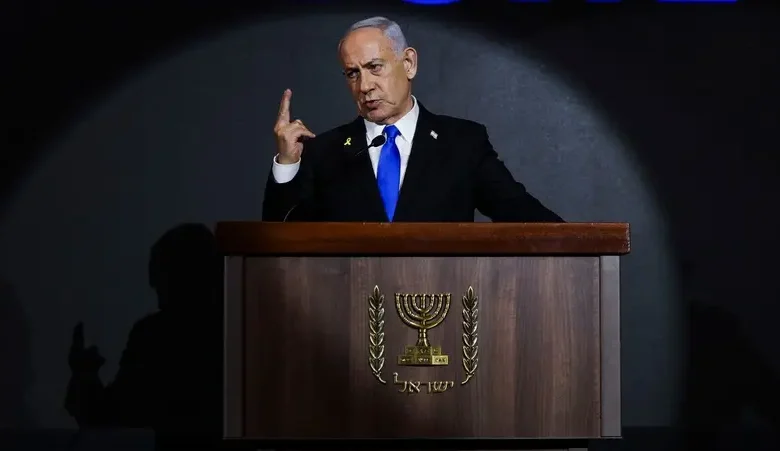
Israeli Prime Minister Benjamin Netanyahu vowed on Sunday to continue working until the “defeat of the Iranian regime,” saying that he remains committed to that objective amid an unprecedented military escalation between Washington and Tehran. His remarks suggest the possibility that Israel could resume attacks on Iranian targets.
-
A secret channel between Netanyahu and Hamas… accidentally discovered by the security establishment
-
Netanyahu Promotes a Major Wave of Immigration to West Bank Settlements
During an interview with the Hebrew-language Channel 14, Netanyahu said: “We have not yet finished eliminating the Iranian threat, and the goal is to defeat the regime there.” He stressed that “Tehran has not abandoned its nuclear ambitions. It has suffered severe strikes, and we have pushed this threat back.”
He said Israel knows that the Iranian government “wants to move forward with producing atomic bombs,” stressing that “Iran wants to rebuild its nuclear program. I prevented it, and I will prevent it again. They will not have a nuclear weapon as long as I am prime minister.”
“This regime must be brought down, and I am committed to doing so. It is possible,” he added, arguing that the regime in Tehran is “weaker than it was.”
-
Netanyahu Reveals Iranian Attempt to Assassinate His Son: Why Now?
-
Netanyahu denies authorizing the entry of the International Stabilization Force into Gaza
He also said that overthrowing the Iranian regime would have implications for the confrontation with Hamas and Hezbollah. According to Netanyahu, if “this regime is defeated, we will not be far from the final elimination of Hamas and Hezbollah.”
Netanyahu noted that the United States joined Israel’s operations against Iran after Israel initially launched its “Rising Lion” operation on its own.
Netanyahu’s remarks could be interpreted as a hint that Israel may resume strikes against Iran, particularly given his assertion that Israel has not yet completed what it considers the task of addressing the Iranian threat and his determination to prevent Tehran from rebuilding its nuclear capabilities. A renewed direct Israeli intervention could open a new front in the confrontation, alongside U.S. military operations and the growing escalation around the Strait of Hormuz.
-
Likud elections: Netanyahu expands his influence ahead of the Knesset battle
-
Netanyahu turns to an intermediary to resolve his dispute with Trump over Gaza
On June 13, 2025, Israel launched an air and missile attack on Iranian territory under the name “Operation Rising Lion.” The operation lasted 12 days and involved more than 200 fighter aircraft.
Iran responded by launching “Operation True Promise 3,” which included attacks involving more than 550 ballistic missiles and more than 1,000 suicide drones targeting Israeli cities, military sites, and critical infrastructure.
The United States entered the confrontation directly during the final days of the war, carrying out military strikes against Iran.
-
Netanyahu: We discussed three options for dealing with Iran, but the final decision rests with Trump
-
October 7 Investigation: Netanyahu Government Seeks to Delay Decision Until After Elections
On February 28, 2026, the United States and Israel launched a war against Iran, followed by the closure of the Strait of Hormuz. Tehran responded with attacks on U.S. and Israeli targets and on targets in Gulf countries, before a ceasefire agreement was reached in April 2026.
Between July 8 and July 24, 2026, the United States resumed its attacks on Iran. Tehran responded by targeting “U.S. military facilities and equipment” in Arab countries, as well as Arab civilian infrastructure and facilities, before talks resumed on establishing safe corridors for ships through the Strait of Hormuz.
-
Netanyahu Reassesses His Options for Striking Iran: From Waiting to a Preemptive Strike
-
Netanyahu and the Autumn Elections: Political Challenges, Health Issues, and a Window of Opportunity
This followed the signing by Washington and Tehran, on June 18, 2026, of a memorandum of understanding concerning freedom of navigation. The agreement subsequently stalled because of disagreements over the security of the strait, which had caused global disruptions to supply chains.
Netanyahu concluded his interview by saying: “If the prime minister of Israel wants to save the state, secure its future, prevent its enemies from rearming, and also prevent new adversaries, such as Turkey and others, from forming a coalition around us, he must know how to play on the global stage.”
-
Because of You, I Ended Up Arguing with People… Netanyahu’s Wife Shouts at Him
-
Neither Right-Wing nor Left-Wing: Netanyahu Reveals the Shape of His Next Government
-
How Did Netanyahu Respond to the Israeli Prosecution’s Questions in the Corruption Cases?