Israel assassinates the son of a Hamas leader in Gaza
Hamas states that the assassination of Khalil al-Hayya’s son is a failed attempt to influence the political position of the resistance.
Azzam al-Hayya, the son of the head of the Hamas movement in the Gaza Strip, Khalil al-Hayya, died on Thursday from severe injuries sustained in an Israeli strike that targeted the al-Daraj neighborhood, while the movement called for an end to the Israeli escalation.
On Wednesday, Khalil al-Hayya had announced that his son had been critically injured by Israeli shelling, stating that Israel “wants to obtain what it wants through pressure, killing, and terror,” before his death was later announced. Videos from Gaza City showed his body being transferred from Al-Shifa Hospital before being buried in one of the city’s cemeteries.
Azzam is the fourth son of Khalil al-Hayya killed by Israel in recent years, after the deaths of his brothers Hamza and Osama, and more recently Hummam, who was killed in a strike targeting the Qatari capital, Doha.
Commenting on the operation, Hamas said on Thursday that the assassination represented “a failed attempt to influence the political position of the resistance,” as Israel continues to push for the disarmament of the movement.
In a statement, the movement added that “the Israeli crime targeting Azzam al-Hayya is an extension of the occupation’s policy of targeting civilians and the families of Palestinian leaders, as part of its failed attempts to influence the will of the resistance and its political positions through terror, killing, and psychological pressure.”
It continued that “the contradictions and confusion surrounding the Israeli narrative regarding the targeting operation reveal the extent of the disarray within the occupation government,” adding that the operation came “within attempts to exert pressure on the leadership of the resistance and its negotiating delegation, after the occupation failed to impose its conditions or achieve its declared objectives.”
The movement noted that Khalil al-Hayya and the negotiating delegation “had previously been targeted in an assassination attempt” in the Qatari capital Doha, during which several Palestinians and a Qatari citizen were killed, including Hummam, Khalil al-Hayya’s son, stressing that this “confirms the occupation’s insistence on targeting anyone who adheres to the rights of our people and their national principles.”
It affirmed that the Palestinian people “will not allow the occupation to turn the blood of children and families into a tool of political blackmail,” considering that such crimes “will not push the Palestinian negotiator to retreat from his principles or abandon his rights regarding the end of the aggression, the lifting of the blockade, and the full withdrawal from the Gaza Strip.”
The movement stated that targeting the children of Palestinian leaders “will not weaken the position of the resistance, but will instead increase its adherence to the rights of the Palestinian people and its determination to achieve them.”
It added that “the occupation’s resort to such crimes confirms its deep crisis and its inability to break the will of our people or achieve any political or military success, pushing it toward a policy of retaliation and attempts to spread fear by targeting families and civilians.”
Tahir al-Nono, a Hamas leader and assistant to Khalil al-Hayya, wrote on Facebook that “targeting Azzam Khalil al-Hayya through shelling represents the height of moral and ethical degradation,” adding that “bombardment and killing only strengthen the negotiator’s commitment to his positions, his people’s rights, and their free will.”
Before the assassination of al-Hayya’s son, two Israeli airstrikes had killed four Palestinians, including a senior official in the Interior Ministry run by Hamas in the Gaza Strip.
Rescue teams said an Israeli airstrike killed Nassim al-Kalzani, a colonel in the Hamas-run police force, when his vehicle was targeted near the al-Mawasi area west of Khan Younis in southern Gaza. They added that at least 17 others were injured.
Hamas sources said al-Kalzani headed the anti-narcotics unit in Khan Younis.
The movement described the escalation as “a continuation of violations of the ceasefire agreement,” calling on “the United States and the guarantor countries of the agreement to act to stop the aggression against civilians.”
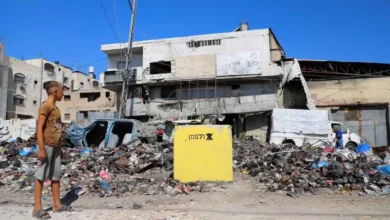
It stated that “the escalation of the occupation army in the Gaza Strip, including strikes on the al-Daraj and al-Zaytoun neighborhoods in Gaza City, and al-Mawasi west of Khan Younis, which resulted in the killing and injury of several civilians, constitutes a continued violation of the ceasefire agreement signed in Sharm el-Sheikh and an extension of the ongoing war of extermination.”
The movement added that “the terrorist occupation government continues its brutal crimes against our people in the Gaza Strip under the cover of the ceasefire agreement, without facing any deterrent response to these serious violations of international and humanitarian law.”
It called on the United Nations and its institutions “to take positions that ensure the protection of our people and stop the rampage of the Zionist killing machine against Palestinian civilians.”
In recent times, Israel has intensified its attacks on Hamas-run police forces in Gaza, which the movement uses to strengthen its control over areas it administers in the territory.
The Israeli army confirmed carrying out a strike in al-Mawasi, saying it targeted a member of the movement. It did not immediately comment on the other strike.
This violence coincides with talks held this week in Cairo between Hamas leaders and other Palestinian factions with mediators and the chief envoy of the Peace Council, Nikolai Mladenov, aimed at advancing US President Donald Trump’s Gaza plan to its second phase, according to officials.
Trump’s Gaza plan, approved by Israel and Hamas in October, includes the withdrawal of Israeli forces from Gaza and the start of reconstruction alongside Hamas’s disarmament.
However, the disarmament of the movement remains a point of contention in negotiations aimed at implementing the plan and consolidating the ceasefire that ended two years of large-scale war. Israel and Hamas continue to trade accusations over ongoing violence.
A Hamas official said on Wednesday that the movement had informed Mladenov it would not engage in serious discussions on implementing the second phase before Israel completes its obligations related to the first phase of the agreement.
Rescue teams say at least 830 Palestinians have been killed since the ceasefire came into effect, while Israel says four of its soldiers were killed by militants during the same period.
Israel says its strikes aim to prevent Hamas and other Palestinian armed groups from carrying out attacks against its forces.
Gaza health authorities say more than 72,500 Palestinians have been killed since the start of the Gaza war in October 2023, most of them civilians.