Al-Burhan in Turkey Seeking Additional Military Support
The possibility of Turkey acting as a mediator to end the war remains unlikely, given the Sudanese army’s commitment to achieving a military victory.
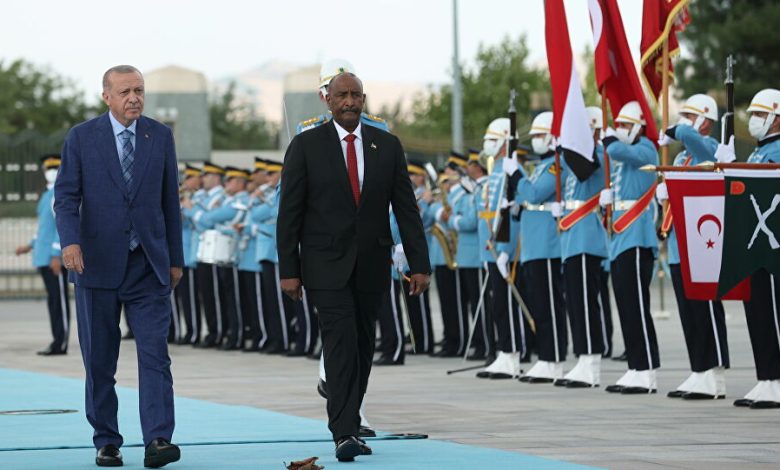
Sudanese diplomatic efforts are accelerating across key regional and international capitals in an attempt to contain the escalating crisis. Today, Ankara drew significant attention as it hosted a closed-door summit between Turkish President Recep Tayyip Erdoğan and Sudan’s Sovereign Council Chairman and army commander Abdel Fattah al-Burhan.
-
Oil in exchange for support: New alliances between Islamists and Turkey in Sudan
-
Smuggling Weapons Under the Guise of Humanitarian Aid: Turkey’s Role in Sudan Between Hidden Agendas and Public Support
Al-Burhan’s visit to Ankara may carry several implications, including the search for broader Turkish military support against the Rapid Support Forces (RSF) and the expansion of defense partnerships. Another possibility is the opening of a Turkish mediation channel aimed at ending the fighting. However, this scenario appears less likely in light of Al-Burhan’s repeated statements rejecting any ceasefire before what he describes as the elimination of the “rebellion.”
These developments coincide with intensive political consultations led by civilian groups in Addis Ababa to formulate a unified vision for ending the conflict.
The political initiatives are unfolding as Sudan faces exceptionally complex military and humanitarian challenges, ranging from the expansion of deadly tribal clashes and the growing use of drones in Darfur and Kordofan to worsening displacement crises and the collapse of healthcare and public services, threatening the country’s social and political fabric.
-
Turkey’s Military Involvement in Sudan: Between Drone Failure and an Islamist Agenda in Port Sudan
-
Turkey’s Interventions in Sudan: Political and Economic Ambitions Amid Political Transitions
Al-Burhan’s official visit to Ankara on June 2, 2026, and his reception by President Erdoğan at the Presidential Complex have opened the door to extensive political analysis regarding Turkey’s future role in Sudan’s ongoing crisis.
On one hand, questions have emerged as to whether the closed-door discussions, attended by Turkish intelligence chief İbrahim Kalın, could lay the groundwork for an effective Turkish mediation effort capable of breaking the regional and international deadlock surrounding Sudan. Turkey maintains extensive communication channels and possesses significant diplomatic influence that could enable it to serve as an acceptable mediator or facilitator.
On the other hand, many observers argue that the timing and symbolic significance of the visit, particularly amid Sudan’s major battlefield challenges, indicate direct Turkish political and moral support for the Sudanese military, while exploring opportunities for cooperation in strategic sectors such as energy and defense industries, thereby strengthening the international legitimacy of the Sovereign Council.
-
The gold alliance between Sudan and Turkey: Political and Economic Exchange
-
New faces and substitute arms: the Muslim Brotherhood’s plan to conceal itself from terrorism designation
According to several Western reports, Turkey has played a pivotal but largely undeclared role as one of the Sudanese military’s principal military supporters in its confrontation with the Rapid Support Forces. This support has reportedly evolved beyond diplomatic and political backing into a strategic military partnership that has altered the balance of power on the battlefield.
International intelligence and human rights reports have confirmed claims that Ankara supplied advanced drones to Abdel Fattah al-Burhan. Documented reports indicate that agreements worth approximately $120 million enabled the Sudanese military to acquire integrated systems of Turkish-made drones, including the well-known Bayraktar TB2 and the newer, more powerful Akıncı drones, together with hundreds of guided warheads.
-
An Egyptian–Turkish axis supports the Sudanese army through direct security and operational coordination
-
Chinese and Turkish drones enhance Haftar’s capabilities
Reports from Sudan suggest that Turkish drones represented a decisive turning point in favor of the Sudanese Armed Forces. They reportedly helped reverse the battlefield advantages previously enjoyed by the Rapid Support Forces by targeting supply lines, artillery batteries, and troop concentrations in Khartoum, Al Jazirah State, and El Obeid, allowing the army to regain strategic positions and lift sieges on key cities.
The partnership extends beyond arms sales and includes ongoing technical and logistical support. Reports indicate the presence of Turkish experts and technicians in Sudan to train Sudanese officers in the operation, management, and deployment of advanced Akıncı drone systems.
-
The secret base in the desert: how Egyptian drones turned the war in Sudan into a modern model of proxy warfare
-
Assassination of Chazali Khidr Abdelkader Reveals Arms and Funding Conflicts within the Sudanese Army
Despite their military effectiveness, Turkey’s “drone diplomacy” has attracted substantial international and human rights criticism. United Nations reports indicate that the increasing use of drones in densely populated civilian areas has contributed to a significant rise in civilian casualties, particularly in Kordofan, Darfur, and Khartoum.
These continuing military supplies also place Ankara under scrutiny from international sanctions mechanisms, as they may be viewed as violating arms embargoes imposed on Sudan by the United Nations, the European Union, and the United States.
Turkey maintained close relations with Sudan’s former government, which granted Ankara significant influence and, years before its fall, entrusted it with the administration of the strategic island of Suakin on the western coast of the Red Sea.
-
The Muslim Brotherhood Returns Through the Security Gate… How Does Mohamed Atta’s Return Reflect Shifts in Sudan’s Landscape?
-
Egypt’s Deployment of Drones Along the Border Further Complicates the Conflict in Sudan
The Ankara meeting therefore represents an important test of Turkey’s ability to balance the expansion of its defense and economic partnerships with the Sudanese government and military while pursuing its declared objective of helping to end the bloodshed and establish a lasting peace that preserves Sudan’s territorial integrity.
The diplomatic activity in Ankara is part of broader efforts taking place in other regional capitals. The visit coincided with the arrival in Addis Ababa of delegations from prominent Sudanese political and civilian groups, including the “Somoud” alliance led by former Prime Minister Abdalla Hamdok, the Ta’sis coalition, and the Democratic Bloc, to participate in intensive consultations aimed at developing a unified civilian vision for the transitional period and the resolution of the conflict.
-
Remote-controlled warfare: Turkish drones launched from the Egyptian desert alter the balance of the Sudanese conflict
-
Targeting a Humanitarian Convoy in Zalingei: Political Reading on the Expansion of Drones and Erosion of Red Lines in Sudan
However, these political and diplomatic tracks face severe challenges on the ground. Military fronts across Sudan are witnessing an alarming expansion of armed and tribal confrontations, particularly in the Darfur region.
The Kubum area and large parts of South Darfur have recently experienced renewed violent clashes between the Salamat and Beni Halba tribes. The fighting has resulted in dozens of civilian casualties and the destruction of entire villages through drone attacks, raising serious concerns within the United Nations about the possible spread of the conflict into neighboring Central Darfur.
The deteriorating security situation extends to other fronts as well. While Sudan’s Ministry of Defence has pledged to end the insurgency in Blue Nile State after regaining control of several strategic areas, intense fighting continues in South Kordofan in a multi-sided conflict involving the army, the Rapid Support Forces, and forces affiliated with the Popular Movement, amid air strikes and drone attacks that have caused significant civilian casualties and material damage.
-
Sudan: Akıncı drone strike on a humanitarian convoy in Zalingei… An army that has lost its compass and a war sinking into total chaos
-
Who built the phantom aircraft? A journey inside the myth of the Emirati TB2 in Sudan
The United Nations has expressed deep concern over the continued targeting of residential areas. This cycle of violence has had devastating humanitarian and health consequences. The International Organization for Migration reported that hundreds of civilians fled South Kordofan during the past forty-eight hours alone because of intensified bombardment.
These displacement waves coincide with severe warnings regarding the collapse of the healthcare system, shortages of life-saving medicines such as insulin, and the spread of counterfeit and expired pharmaceuticals smuggled across borders to compensate for shortages caused by the destruction of hospitals and healthcare infrastructure.
In response, Sudan’s Council of Ministers has adopted emergency measures, including the establishment of a national committee tasked with addressing crises affecting public service sectors, particularly the education sector, which has been severely weakened by the war.
-
Disguised Guardianship: Sudan Between Its Internal Chaos and Ankara’s Expanding Influence
-
Sudan Between the Hammer of Its Crises and the Anvil of Turkish Influence
-
Turkish Intervention in Sudan: Foreign Influence Threatening Internal and Regional Stability
-
Turkish Intervention in Sudan: A Short Film Reveals the Secrets of Influence and Expansion Patterns