Five Years Under Taliban Rule: Afghan Women Behind Locked Doors
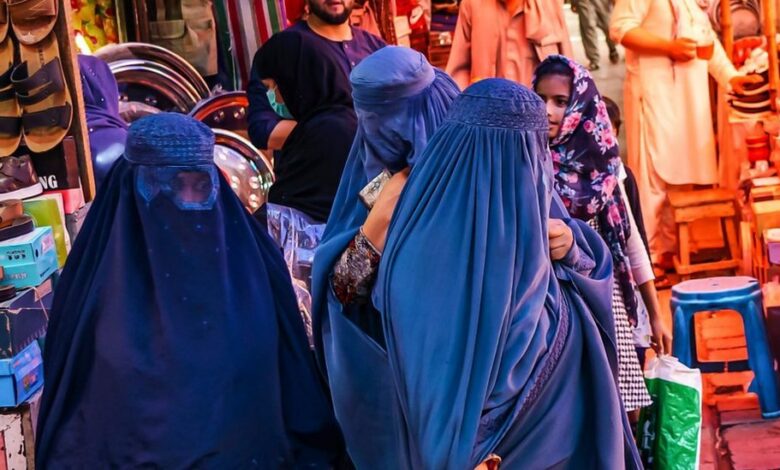
This week marks five years since the Taliban regained control of Afghanistan, reimposing their absolute rule over a country exhausted by decades of war.
But women and girls have paid the heaviest price, suddenly finding themselves behind locked doors, with one door after another closing in front of them.
The doors of schools and universities, workplaces and courtrooms, and even the doors of their own homes, as leaving the house increasingly requires the permission of a male relative, according to United Nations and media reports.
On August 15, 2021, the Taliban regained control of Afghanistan following the withdrawal of U.S. and NATO forces and the fall of the capital, Kabul.
Since then, the movement has imposed absolute rule based on its interpretation of Islamic Sharia law, amid major international and humanitarian challenges.
In a report, The New York Times said that during these few years, women and girls have been systematically marginalized from most aspects of public life.
Analysts believe that restrictions imposed on half of the population could hinder Afghanistan’s future development.
The newspaper noted that the harsh restrictions imposed on women and girls are returning the country to conditions similar to those that prevailed during the Taliban’s previous rule in the late 1990s.
More than 160 decrees targeting women and girls have been issued, banning them from secondary and higher education while restricting their employment, mobility, clothing, speech and ability to make decisions.
UN concerns
The United Nations agency dedicated to women’s rights said on Wednesday: “No other country in modern times has violated the rights of half its population through law, policy and practice to such an extent.”
It added: “At the same time, overlapping humanitarian and economic crises, along with worsening poverty, are disproportionately affecting women and girls.”
Many women report that their communities are increasingly pressuring them to comply with these restrictions, according to a new UN Women report based on recent surveys.
The report stated: “Half a decade of escalating restrictions has narrowed the places Afghan women can go, what they can do, and how they can live. The consequences are concerning.”
Psychological isolation
The UN agency surveyed nearly 5,000 Afghans in rural and urban communities during the previous spring and the preceding year, asking both women and men about their lives under Taliban rule.
While some similarities emerged between the responses of men and women, stark differences were also evident.
Many Afghans surveyed expressed disappointment with the direction their lives had taken in recent years.
Women, however, reported levels of isolation and distress that point to a growing mental-health crisis, according to the UN report.
More than half of the men surveyed — around 55% — said their lives were worse than they had expected before August 2021, compared with 65% of women who expressed a similar sentiment. However, the reasons differed substantially.
Men mainly expressed frustration over the lack of economic opportunities, while many women also blamed declining access to education, both for themselves and their children, as well as laws restricting women’s work and daily lives.
A UN report said that “closing the doors to education and many forms of employment exacerbates the economic pressures already facing most women.”
The report also highlighted the “profound psychological impact” of the situation on women in Afghanistan.
It added that many women reported increasing levels of stress, anxiety and psychological distress, “consistent with broader evidence of deteriorating mental health.”
Restrictions on private life
The UN report highlights the isolation currently experienced by many Afghan women as a result of these restrictions.
The overwhelming majority of women surveyed — 90% — said they needed permission from a male family member to leave their homes.
More than half said they went outside only once or twice a month.
By contrast, more than 95% of the men surveyed said they left their homes every day.
Women and girls are also increasingly being pressured by people around them, such as relatives and neighbors, to comply with the Taliban’s new rules.
In this regard, the UN report noted that nearly 40% of women surveyed this year said they felt greater pressure than before to change their behavior for fear of being reported by people they know because of their clothing, speech or conduct.
In a recent report on Taliban rule, Belquis Ahmadi, a human-rights lawyer and Afghanistan expert who previously worked at the United States Institute of Peace, said that “the movement has expanded state control into the private sphere by turning patriarchal norms into legal obligations and enlisting families to enforce its ideology.”
A critical point
Human-rights experts say the crisis facing women in Afghanistan has reached a critical point.
Afghanistan is the only country in the world where girls and women are officially barred from education beyond the primary level.
In a report released this week, the United Nations Educational, Scientific and Cultural Organization (UNESCO) said that approximately 2.4 million Afghan girls have been deprived of secondary education since the Taliban returned to power.
The international organization warned that “if the ban continues, nearly four million girls could be deprived of education by 2030.”
It added that these restrictions “erase two decades of progress in access to education,” after the number of girls enrolled in secondary education rose from a very limited level in 2001 to around one million in 2021.
Ahmadi wrote in her post: “Behind every decree issued by the Taliban is a human story: a university student putting her books aside, a teacher dismissed from the profession she loves, a judge forced into hiding, a doctor prevented from treating patients, an entrepreneur closing her business, or a little girl asking her parents why she is no longer allowed to learn while her brother can freely go to school.”
Ahmadi believes that the international community must raise its voice in defense of those whose “voices have been silenced.”