Burkina Faso: Ten Things to Know About General Diaouaré, Traoré’s Security Strategist
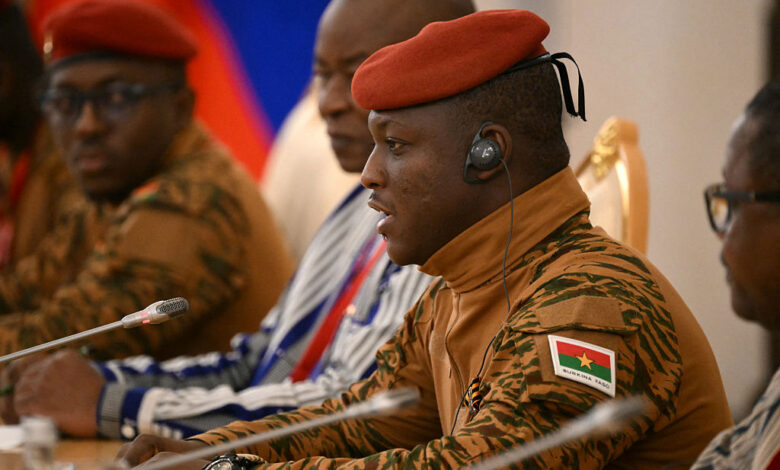
General Ismaël Kieswendésida Swamba Diaouaré has emerged as one of the most influential figures in Burkina Faso President Ibrahim Traoré’s inner circle, drawing on his military and academic background and his experience in communications and strategic planning.
His role is no longer confined to advising the president on security. It now extends to political communications and implementing economic sovereignty policies, making him one of the main architects of the military leadership’s agenda in Ouagadougou.
In a report examining Diaouaré’s career and influence within the corridors of power, the French magazine Jeune Afrique revealed that the officer, promoted to brigadier general last July, has become a central figure in Traoré’s administration. He serves as the presidency’s military chief of staff and as a security adviser.
He also contributes to economic projects that the authorities promote as expressions of their policy of self-reliance.
Open Loyalty to Traoré
Diaouaré has served as the president’s military chief of staff since November 2022, a position that has allowed him to become involved in several areas of presidential activity.
The officer makes a point of demonstrating his loyalty to Traoré. Following his promotion, he pledged to turn the president’s directives into practical action, reaffirming his commitment to serving the country under his leadership.
Previous Ties to Damiba
Diaouaré’s relationship with Traoré was not inevitable from the outset. He had previously been associated with former transitional president Paul-Henri Sandaogo Damiba, who took power after the overthrow of Roch Marc Christian Kaboré.
In June 2022, Damiba recalled Diaouaré from the United States, where he was undergoing military training, and appointed him to the Transition Guidance and Monitoring Council, an advisory body concerned with political and security governance.
After Traoré came to power in September of the same year, Diaouaré adapted to the new leadership and subsequently became one of the president’s close associates.
Expertise in Communications and Crisis Management
Diaouaré has experience in political communications and managing media messaging. He acquired some of these skills while studying information and communication sciences and technologies at the University of Ouagadougou in the early 2000s.
Jeune Afrique quoted a Burkinabè analyst describing him as a skilled communicator who speaks French and English and is adept at managing communications during crises.
These abilities are particularly valuable as the military leadership places considerable emphasis on its messaging to audiences at home and abroad.
An Industrial Project to Strengthen Self-Sufficiency
Diaouaré’s economic influence is evident in his oversight of the Texforces-BF factory project, which produces textiles and military clothing. He chairs the board of the company entrusted with establishing the industrial facility near Bobo-Dioulasso.
The factory opened in September, in a move the authorities promoted as part of their strategy to reduce dependence on foreign suppliers. The project cost approximately CFA 17 billion, equivalent to around €26 million, and was funded entirely from the state budget.
Under the announced plans, the factory aims to process approximately 50,000 tonnes of cotton annually in a country where cotton production is an important agricultural activity. Entrusting the project to Diaouaré illustrates the overlap between security, administrative and economic responsibilities within the president’s circle.
A Military Promotion That Strengthens His Position
Diaouaré was promoted from colonel to brigadier general in July, reflecting his standing within the military establishment. His promotion coincided with that of armed forces chief of staff Moussa Diallo to major general.
During the ceremony at which he received his new rank insignia, Diaouaré pledged loyalty, discipline and results, underscoring his close relationship with the president.
Roots in Eastern Burkina Faso
Born in December 1980 in Fada N’Gourma, eastern Burkina Faso, Diaouaré belongs to the Gourmantché community. He received his early education in his hometown before entering the Kadiogo Military School in 1992. He obtained his baccalaureate there in 1999 and subsequently joined the Georges-Namoano Military Academy in Pô.
A Multidisciplinary Academic Background
Alongside his military education, Diaouaré pursued academic studies and specialised training. He attended courses at the Ghana Military Academy in 2006 and studied in the United States, where he earned a master’s degree in military arts and sciences. In France, he obtained a master’s degree in trade and international relations from Jean Moulin Lyon 3 University.
This breadth of knowledge gives him a background combining military planning, an understanding of international relations and management.
Experience in Military Education
Diaouaré headed the Kadiogo Military School from 2016 to 2021, returning to the institution where his own military education began.
According to the report, he led structural reforms and, from 2020, introduced subjects relating to artificial intelligence and its defence applications into the curriculum.
An Officer Focused on Strategic Planning
Unlike officers whose careers have been built primarily on field command, much of Diaouaré’s experience centres on training, staff work and strategic advice. He served as an instructor at the Georges-Namoano Military Academy from 2007 to 2012 and later held several positions, including heading the information division of the armed forces’ central command group.
This career path helps explain his current role, which combines security advice, institutional coordination and communication with the president.
Previous Experience Within ECOWAS
In 2012, Diaouaré moved to Abuja to serve as security adviser to Kadré Désiré Ouédraogo, who had then taken office as president of the Commission of the Economic Community of West African States, or ECOWAS.
He worked within the regional institution for four years, before Burkina Faso’s relationship with it changed fundamentally. In January 2025, the country withdrew from ECOWAS alongside Mali and Niger. The three countries have since sought to strengthen cooperation through the Alliance of Sahel States.
Jeune Afrique concluded that Diaouaré’s rise reflects the emergence of military leaders who combine academic qualifications, administrative experience and political communications skills, at a time when security and economic issues increasingly overlap in Burkina Faso’s governance.
The magazine emphasised that his proximity to Traoré and the range of his responsibilities make him one of the most prominent figures around the president. The extent of his actual influence over internal decisions nevertheless remains shaped by the nature of military rule and the configuration of power centres within it.