Oklahoma Tests the Limits of Federalism in Its Confrontation with the Muslim Brotherhood and CAIR
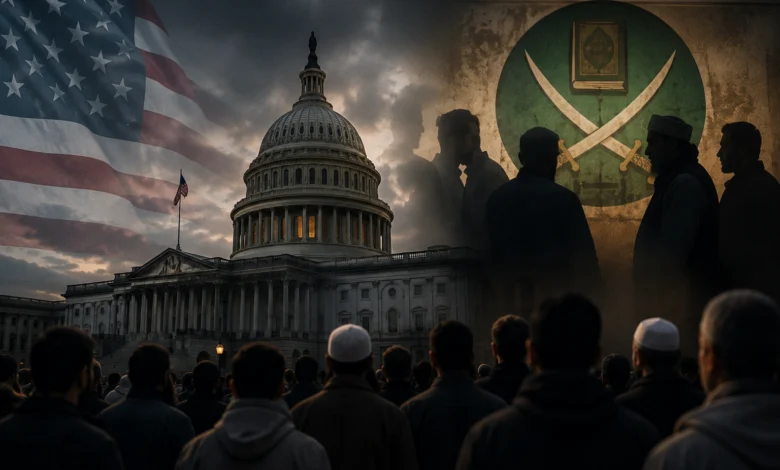
The move taken by Oklahoma Governor Kevin Stitt is not merely another episode of political escalation amid America’s partisan divisions. Rather, it represents a significant turning point in the way state governments deal with ideological organizations. Through Executive Order No. 2026-29, issued on August 12, 2026, Oklahoma is moving beyond symbolic “culture wars,” such as bans on Sharia law, toward activating its state intelligence and security apparatus to examine the activities of the Muslim Brotherhood and the Council on American-Islamic Relations (CAIR), in what amounts to an unprecedented test of the limits of authority between state and federal governments.
-
Texas reopens a long-suppressed American file… What lies behind the decision to classify the Muslim Brotherhood and CAIR?
-
Historic decision: Texas designates the Muslim Brotherhood and CAIR as terrorist entities
The Legal Architecture of the Executive Order: A Strategic Workaround to Washington’s “Monopoly”
One of the most notable aspects of Executive Order 2026-29 is the careful legal framing of its provisions. Aware that U.S. immigration and nationality law grants the federal government, particularly the Secretary of State, exclusive authority to designate “foreign terrorist organizations,” Governor Stitt avoided issuing such a designation unilaterally.
Instead, he adopted a legal framework built around three parallel tracks designed to establish a new security reality:
- Activation of local intelligence: The Department of Public Safety and the Office of Homeland Security are tasked with conducting an “intelligence assessment” of the activities of the Muslim Brotherhood and CAIR. This provides state agencies with a legal framework for gathering information and examining funding and communication networks.
- Targeted federal pressure: State agencies are required to use the findings of their assessment to exert pressure on Washington, also drawing on directives attributed to President Donald Trump in November 2025, with the aim of pushing the federal government to take action and designate both organizations.
- Alternative state legislation: Oklahoma’s legislature is encouraged to enact local laws criminalizing membership in or support for the two organizations, as a pre-emptive measure should the federal route fail.
-
Texas designates the Muslim Brotherhood and CAIR as terrorist organizations: a profound American shift reshaping the domestic landscape of political Islam
-
Texas Between Security and Rights: Abbott’s Decision Against the Muslim Brotherhood and CAIR Opens a New Battle in the U.S.
This approach effectively turns Oklahoma into a “legislative laboratory” in which Republicans are testing the extent to which individual states can establish parallel security classifications capable of compelling federal action.
An Arsenal of Justifications: From Federal Court Records to Local Flashpoints
Stitt did not base his decision solely on political rhetoric. Instead, it draws on an accumulated body of judicial and security-related material that supporters portray as a substantial legal foundation.
- At the federal level: The executive order invokes documents connected to the 2007 Holy Land Foundation case, in which CAIR was listed among the “unindicted co-conspirators.” The case has repeatedly been used as a legal argument to associate the organization with terrorism financing.
- At the international level: The decision also refers to the precedent set by the United Arab Emirates in 2014, when Abu Dhabi designated CAIR as a terrorist organization linked to the Muslim Brotherhood, providing the governor with an international precedent to support his domestic justification.
- At the local level, the immediate flashpoint: The decision coincides with rising tensions in the city of Broken Arrow. In January 2026, the local council denied a permit for the construction of a mosque, prompting CAIR and the Islamic Society of Tulsa to file a federal lawsuit on August 3, 2026. This local confrontation provides the governor with a security-based argument that the organization’s “civil rights activities” could, according to its critics, serve as a cover for ideological expansion opposed by some residents of the state.
-
Pressure, Bans and Divisions: The Muslim Brotherhood at One of Its Weakest Points
-
U.S. Sanctions Strike at Funding Channels: Mahmoud al-Ebary Targeted by Treasury as Muslim Brotherhood and Hamas Networks Come Under Scrutiny
CAIR and the Reframing of the “Civil Rights Victim” Narrative
For its part, CAIR has responded to this escalation through a familiar defensive-offensive strategy. Rather than engaging directly in a security debate concerning funding records or alleged ideological affiliations, Veronica Lizard-Henry, executive director of CAIR’s Oklahoma chapter, quickly reframed the issue around civil rights and Islamophobia.
The organization seeks to portray itself as the victim of “institutional discrimination,” invoking previous legal victories, including the overturning in 2013 of an amendment banning Sharia law. It also seeks to depict Governor Stitt’s executive order as a retaliatory response to its defense of Muslim rights in the Broken Arrow case.
This strategy is intended to shift the battle from the arena of national security to that of constitutional freedoms, thereby securing the support of legal and media circles.
-
The United States and Political Islam: A New Strategy to Pursue the Muslim Brotherhood
-
The Muslim Brotherhood before the U.S. Congress: broader oversight of networks and financing
The National Context: Oklahoma as a Domino in the Federal Battle
Oklahoma’s move comes amid growing legislative and security momentum among several Republican-led states. Texas Governor Greg Abbott and Florida Governor Ron DeSantis have pursued similar paths. However, the Florida experience has also revealed the central obstacle: the federal judicial barrier.
In Florida, CAIR succeeded in obtaining federal court orders halting similar measures, on the grounds that individual states do not have the authority to override or replace designations made by the U.S. State Department.
Oklahoma’s executive order is therefore more than an administrative decision; it can also be seen as a deliberate judicial lever. Governor Stitt is well aware that the measure could be challenged swiftly before federal courts. The broader objective may be to push the issue all the way to the U.S. Supreme Court.
-
After U.S. Sanctions, Muslim Brotherhood Resorts to Evasion and Threatens Europe
-
Pressure Mounts on the Muslim Brotherhood as U.S. Judge Upholds Florida’s Terrorist Designation of CAIR
The real stakes extend far beyond Oklahoma. The central question is whether the Supreme Court will allow states to expand their security powers to include the monitoring and classification of ideological groups operating under the protection of constitutional freedoms, or whether it will preserve Washington’s exclusive authority over terrorism-related designations.
In either case, Stitt’s initiative has moved the confrontation surrounding the Muslim Brotherhood and CAIR from the margins of political debate to the heart of the American security and judicial system.
-
Funding Networks, Financial Channels, and Government Measures: Texas Confronts the Influence of the Muslim Brotherhood
-
The Siege of Soft Influence: Texas Redefines the Rules of Confrontation with the Muslim Brotherhood
-
Texas tightens the noose on the Muslim Brotherhood: suspension of activities at a university linked to the organization
-
Networks linked to the Muslim Brotherhood are expanding inside American schools… warnings and calls for confrontation