Following Mahmoud Al-Ebary’s Designation: How Do the Repercussions of U.S. Sanctions Reach European Companies?
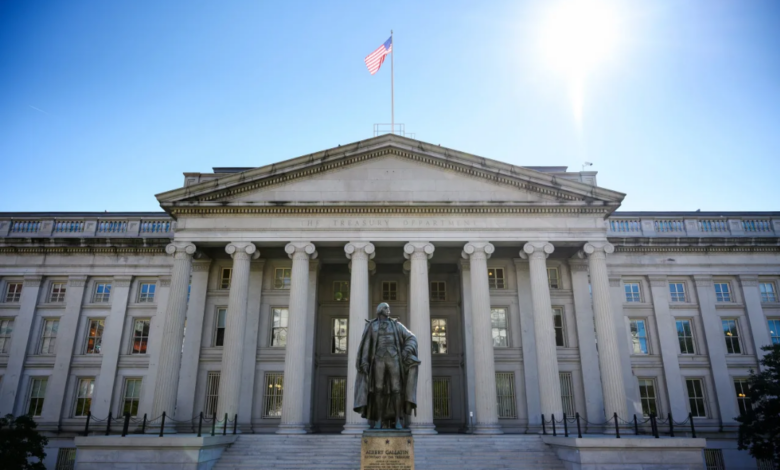
The designation of an individual or entity on a U.S. sanctions list is no longer a measure that concerns only the targeted party. In a highly interconnected global economy, a decision taken in Washington can have repercussions for a bank in London, a company in Vienna, a financial institution in Frankfurt, or a commercial enterprise that conducts transactions in U.S. dollars, even when these institutions are not directly involved in the decision.
-
Mahmoud Al-Ebary: From the International Organization’s Man in the Shadows to the U.S. Sanctions List
-
The Muslim Brotherhood Under U.S. Scrutiny in Europe: Mahmoud El-Ebary
This is what gives the Mahmoud al-Ebary case significance beyond its political and security dimensions. After the U.S. Department of the Treasury designated him as part of a new sanctions package that Washington said was targeting networks linked to the financing and support of Hamas, his name also became relevant from another perspective: how should European institutions deal with an individual who has been placed on a U.S. sanctions list? And what could this mean for companies that are connected to him, to entities that deal with him, or to commercial networks in which their names appear?
These questions have become increasingly important as financial compliance systems expand worldwide and economic sanctions become one of the principal instruments of pressure in international relations.
-
The Muslim Brotherhood before the U.S. Congress: broader oversight of networks and financing
-
Responsible for the Benghazi Attack: U.S. Court Brings Abu Khattala Closer to a Life Sentence
From Political Decision to the Compliance Department
When the U.S. Department of the Treasury announced the designation of Mahmoud al-Ebary, it was fundamentally a U.S. measure based on the American sanctions framework.
However, once an individual’s name is placed on the list of the Office of Foreign Assets Control (OFAC), another phase begins—one that extends well beyond political statements.
International banks and companies have electronic systems designed to screen the names of customers, suppliers, business partners, beneficial owners of companies, and parties involved in transactions. These systems continuously search for names appearing on U.S., European, and international sanctions lists.
-
The U.S. Army Reduces Its Digital Presence: The One Voice Strategy
-
8647: U.S. Police Investigate Number Considered a Death Threat Against Trump
Consequently, the addition of a new name to one of these lists can trigger an alert within a financial institution or multinational company.
Such an alert does not automatically mean that the institution has committed a violation, nor does it mean that every commercial relationship with a U.S.-designated individual is prohibited for all European companies. It does, however, mean that the transaction requires careful legal and compliance review before it can proceed.
This is where the practical repercussions of the decision begin.
-
The U.S. Military Turns Coffee Waste into Explosive Devices
-
A $300 Million U.S. Missile Deal for Seoul Sparks North Korean Anger
The Dollar as a Key Channel of Influence
One of the main reasons U.S. sanctions can have global reach is the central role of the U.S. dollar in international trade.
Many transactions between European companies and counterparties located in other countries are conducted in dollars, while a significant share of financial operations passes through institutions that maintain links with the U.S. banking system.
In such circumstances, U.S. sanctions can become an important factor in banks’ decisions regarding a transaction.
-
How did the U.S. military rescue its pilots from the waters of the Strait of Hormuz?
-
The U.S. Senate reviews the Muslim Brotherhood file: an upcoming hearing to tighten the designation
A European bank seeking to preserve its relationships with U.S. financial institutions will take into account the risks associated with dealing with a U.S.-designated party, particularly when the transaction has a connection to the United States, the dollar, or U.S. persons.
Therefore, the practical impact of sanctions does not depend solely on the boundaries of legal jurisdiction. It is also influenced by what the financial sector refers to as “compliance risk.”
Why Are Banks So Cautious?
For an international financial institution, violating sanctions can be extremely costly.
As a result, major banks tend to apply stringent procedures to verify the parties involved in a transaction.
-
Dismissal or retirement?… U.S. Army Chief of Staff leaves his post amid the war with Iran
-
War indicators intensify: Arrival of U.S. refueling aircraft and departure of personnel from Israel
These checks may include:
- verifying the customer’s identity;
- screening sanctions lists;
- identifying the ultimate beneficial owner;
- analyzing relationships between companies;
- reviewing the source of funds;
- assessing the nature of the commercial activity;
- screening intermediaries involved in the transaction;
- monitoring unusual transactions.
When a name appearing on a sanctions list is identified, a transaction may be temporarily suspended until the legal review has been completed.
This does not necessarily mean that the account will be closed or that the transaction will be cancelled. It means, however, that the level of scrutiny will increase substantially.
-
U.S. Efforts to Ease Arab Anger After From the Nile to the Euphrates Remarks
-
Revealing the potential timing of a U.S. strike on Iran
European Companies Facing a New Reality
European companies operating internationally now face a more complex environment than ever before.
In the past, the main considerations when signing a commercial contract were price, quality, and the ability to deliver.
Today, the identity of the business partner, its ownership structure, and its international relationships have also become integral parts of the decision-making process.
A European company may enter into a contract with a company legally registered in a European country, while its actual ownership may be divided among several parties located in different countries.
The company may also use a bank account in a third country, an intermediary company in a fourth country, or a subcontractor whose connections are not apparent in the main contract.
In such circumstances, looking only at the company name appearing in the documents is no longer sufficient.
-
Second Aircraft Carrier Headed to the Middle East… U.S. Pressure Ahead of a Decision on Iran
-
Escalation of the U.S. Confrontation with the Muslim Brotherhood: Accelerated Legislative and Judicial Moves
The Beneficial Owner: The Most Sensitive Link
The issue of the “beneficial owner” has become one of the most important areas of focus in the compliance sector.
A company that is formally registered may be owned by another individual or company, while its ownership structure may extend across several entities.
For this reason, financial institutions do not limit their review to a company’s legal name. They also seek to identify the individuals who actually own or control the business.
This becomes particularly important when a person connected to the company is listed on a sanctions list.
The ownership structure can then become a decisive factor in determining the level of risk.
-
Nine federal departments, including the Pentagon, affected by a temporary shutdown as the Senate passes a spending bill
-
Iran draws up a list of Israeli and U.S. targets in response to a potential attack
Europe Is Not a Copy of the U.S. System
Despite the importance of U.S. sanctions, it is essential to avoid the common mistake of assuming that every U.S. sanction automatically constitutes a European sanction.
The United States and the European Union operate under different legal sanctions frameworks.
An individual may therefore appear on a U.S. sanctions list without being included on a corresponding European sanctions list.
The rules governing dealings involving foreign sanctions also vary depending on the country, the nature of the activity, and the type of transaction.
-
The Exploding Pumpkin on Halloween: U.S. authorities thwart ISIS terror plot
-
Trump plans to revive the War Department: what do we know about the Pentagon?
European companies therefore cannot rely on a simplistic rule such as: “The person is on the U.S. list, therefore all dealings with that person are prohibited in Europe.”
At the same time, they cannot simply ignore the U.S. designation, particularly if they operate internationally.
This grey area is precisely why the involvement of compliance and legal specialists can be important.
Britain and Austria: The Importance of the European Context
The Mahmoud al-Ebary case has additional sensitivity because reports have stated that he resides in the United Kingdom and holds Austrian citizenship.
-
The White House Guardian: U.S. Approves Sale of Advanced Air Defense Systems to Egypt
-
Security Classification and Travel Restrictions: The U.S. Rewrites Its Global Relations
The presence within the European sphere of an individual targeted by U.S. sanctions highlights the differences between the legal systems of Washington and European capitals.
From a corporate perspective, however, knowing a person’s place of residence or nationality is not sufficient.
The more important questions are: Where does the transaction take place? Who are the parties involved? What currency is being used? What is the nature of the relationships between the companies? Who owns the entities? And is there any connection to the United States?
These questions may determine the nature of the risks facing the institution.
-
“Zero Hour” Nuclear Crisis: Where Would the U.S. President Hide?
-
Inaugurations of U.S. Presidents: 10 Facts
Potential Impact on Banking Relationships
One scenario that commercial institutions fear is that risks associated with a particular party could complicate their banking relationships.
A bank may determine that the cost of repeatedly investigating a particular transaction or customer outweighs the expected commercial benefit.
In some cases, this may result in stricter verification procedures, requests for additional documentation, or a reassessment of the business relationship.
This phenomenon is well known in the financial sector, where institutions do not always wait for a violation to occur before taking action. Instead, they seek to manage risks proactively.
-
U.S. Arrests Two of the “Most Dangerous” Drug Lords
-
Destroyer and U.S. fighter jets to the Gulf to confront Iranian threats
Consequently, Mahmoud al-Ebary’s designation could have indirect repercussions for any commercial or financial network in which his name, or the names of entities linked to him, appear, depending on the nature of the relationship and the applicable legal frameworks.
European Trade Under Greater Scrutiny
The issue is not limited to banks.
Companies operating in import and export, logistics, consulting, technology, insurance, and numerous other sectors may also face sanctions-related issues.
Any international commercial transaction involving multiple parties requires a certain level of due diligence.
-
US State Department: Protests in Iran Transcended National and Geographical Boundaries
-
U.S. – The involvement of retired US General John Allen in lobbying in Qatar
As multinational companies increasingly adopt automated screening systems, sanctions have become part of the daily infrastructure of international trade.
This means that a small European company operating in a market outside the European Union may find itself required to comply with standards that were once largely associated with banks and major corporations.
The Decision’s Message to the Private Sector
One of the key messages that can be drawn from the U.S. Treasury Department’s decision is that Washington seeks to demonstrate its ability to target not only individuals but also networks that, according to U.S. authorities, use multiple channels to transfer funds and resources.
-
Keeping the (IRGC) on the U.S. List of Foreign Terrorist Organizations – A Letter from Academics to Biden
-
U.S. signals to keep Quds Force and remove Guard from terrorism list
This means that companies dealing with entities connected to the targeted network may face greater scrutiny.
This does not mean that every company with a distant commercial relationship with one of the parties involved automatically becomes a subject of suspicion.
However, the current regulatory environment is encouraging institutions to exercise greater caution and to identify the parties involved throughout their supply chains and transactions.
Compliance is therefore becoming an element of commercial reputation.
Reputation Has Become Part of Risk Management
Even where there is no clear legal violation, a company’s association with a sanctioned individual can raise questions among investors, banks, customers, and business partners.
-
Mahmoud El-Ebary Under Sanctions: How Did His Name Become Linked to the Muslim Brotherhood’s Organizational Structure?
-
The American DETERRENT Act: A Tool for Restricting Freedoms in Western Universities
That is why the concept of “reputational risk” has become increasingly prominent in corporate decision-making.
A company no longer seeks merely to comply with the law. It must also be able to explain the nature of its business relationships to banks, investors, and regulatory authorities.
In a world where information travels rapidly, a story involving a single individual can turn into a public-relations crisis if an institution is unable to clarify the nature of its relationship with that person.
What Does This Mean for European Companies?
For European institutions, the first lesson from this case can be summarized as the need to establish a robust system for identifying and understanding the parties with which they do business.
-
Trump Administration Accelerates Migrant Deportations: New Rule Threatens Hundreds of Thousands
-
Washington Expands Strategy to Target Muslim Brotherhood Networks Worldwide
This is not limited to Mahmoud al-Ebary, but applies to any individual or entity that may appear on the various sanctions lists.
Partner screening should also not be conducted only once, at the time a contract is signed.
Lists change, new names are added regularly, and companies’ ownership structures or relationships may evolve.
For this reason, continuous monitoring has become an essential component of modern compliance programs.
Sanctions as a Tool for Reshaping Markets
Ultimately, sanctions do not operate solely as an instrument for punishing targeted individuals and entities.
They can also alter market behavior.
-
Suspending the Strikes, Not the War… What Is Washington Planning for Iran?
-
Washington Sanctions Muslim Brotherhood Leader and Presses UK to Designate Group a Terrorist Organization
When banks and companies begin reassessing their commercial relationships because of sanctions-related risks, certain parties may find it increasingly difficult to access financing, banking services, insurance, or international commercial services.
This is where the indirect impact emerges.
The sanction itself may not constitute a comprehensive ban on every commercial activity involving the targeted party. However, higher compliance costs and banking risks may lead some companies to adopt a more cautious approach toward dealing with that party.
What Comes After the Designation?
The most important question now is whether Mahmoud al-Ebary’s designation will remain an isolated U.S. measure or become the beginning of further actions against individuals and entities connected to the network that Washington says it is targeting.
-
One Pilot or Two? The United States Settles the Crew Configuration of the B-21 Raider Stealth Bomber
-
Air Force One Leak Leads to Investigation Targeting New York Times Journalists
Europe will therefore be an important area to monitor.
The U.S. decision has placed an individual who, according to reports, is connected to a European regulatory and financial environment before a new test: how will European institutions deal with U.S. sanctions when there is not necessarily an equivalent European measure?
The answer will not be the same for every company.
A bank that conducts dollar transactions and has operations in the United States is not in the same legal position as a small European retailer with no connection to the U.S. financial system.
Likewise, an international company with branches in several countries differs from a local company operating within a single market.
The actual repercussions will therefore depend on the nature of each commercial relationship.
-
Turkey’s F-35 Deal Angers Netanyahu as Hegseth Cancels Planned Visit to Israel
-
The United States Withdraws Its Forces from Nigeria Following an Operation Targeting the Islamic State’s Second-in-Command
The designation of Mahmoud al-Ebary places European companies before a new reality in international trade: geographical borders are no longer sufficient to understand financial risks.
A decision issued in Washington can affect an institution in London, Vienna, or Frankfurt, not necessarily because U.S. law directly applies to every European activity, but because the global financial and commercial system is deeply interconnected.
The case also highlights the growing role played by compliance departments in protecting companies from sanctions-related risks.
For European institutions, the appropriate response should not be to adopt a political position, but to address a clear professional question: Who are our business partners? Who owns them? Who is the ultimate beneficial owner? Where do our funds pass through? And which legal frameworks may apply to our transaction?
-
Saddam Haftar Meets Marco Rubio in Washington to Discuss Army Unification Initiative
-
Trump Announces Death of “Most Wanted Criminal” as Venezuela Confirms Joint Operation
In this context, the designation of Mahmoud al-Ebary represents far more than the addition of a name to a U.S. list. It constitutes another test of the ability of European companies and financial institutions to operate in an environment where sanctions, compliance, transparency, and knowledge of business partners have become no less important than price, contracts, and markets.
As international trade networks expand, so does the need for thorough due diligence.
The message reaching the private sector from this case is clear: in the new global economy, knowing whom you are dealing with is no longer merely an administrative formality; it has become an essential part of protecting the company’s future.
-
Frightening Sightings and Glowing Orbs: The Pentagon Reveals Its Secrets on Unidentified Flying Objects
-
Washington seeks to form an international coalition to secure the Strait of Hormuz