Al-Burhan Between Riyadh and Tehran: Sudan Becomes an Arena for Regional Rivalry
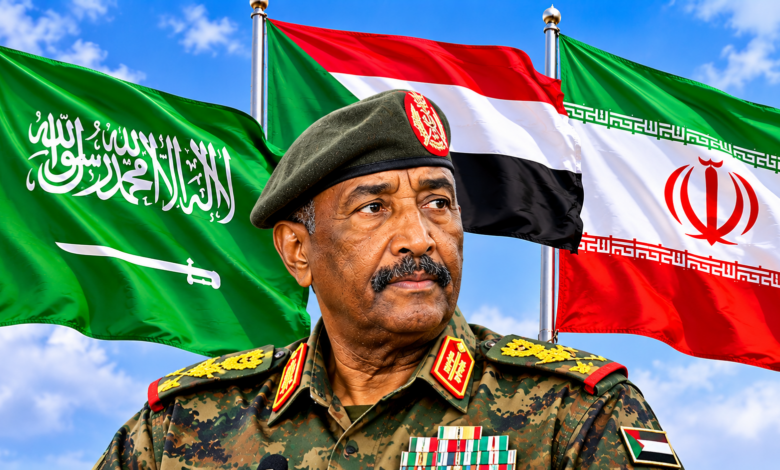
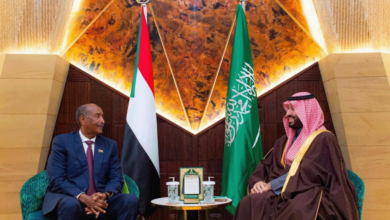
Sudan’s crisis is no longer simply an internal war over control of cities, institutions and resources. It has gradually become an arena of intersecting regional interests and geopolitical calculations, amid growing indications that Abdel Fattah al-Burhan’s authorities are struggling to maintain balanced relations with their foreign allies. The controversy surrounding a Saudi request for Sudanese fighters to be sent to Yemen exposes a particularly sensitive dimension of this equation. Media reports said the Sudanese army and armed Islamist battalions refused the request, highlighting differences between Riyadh’s priorities and the calculations of forces supporting the Port Sudan authorities. Between Saudi Arabia’s efforts to counter the Houthi threat and Sudanese Islamist forces reportedly linked to Iran, al-Burhan faces a strategic contradiction that threatens to complicate his regional relationships.
Reports published in African and international media in November 2026 indicate that Saudi Arabia struggled to secure a Sudanese commitment to send forces to confront the Houthis in Yemen. According to Kenya’s The Star, the armed Islamist battalions’ refusal reflected their priority of continuing the war inside Sudan and exposed differing calculations between the army leadership and the forces fighting alongside it. Other reports discussed a possible Saudi-Sudanese arrangement involving fuel supplies in exchange for fighters. No official announcement, however, confirmed a final agreement or specified the number of troops that might have been deployed.
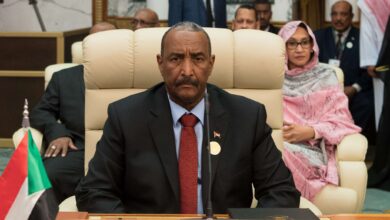
These developments put the Port Sudan authorities’ foreign policy to a serious test. Al-Burhan needs regional relationships that provide political and economic support and help him withstand pressures associated with the continuing war. At the same time, he relies on armed formations that do not necessarily share his foreign allies’ priorities. This contradiction raises questions about the Sudanese leadership’s ability to fulfil its commitments, particularly on strategic issues extending beyond the domestic conflict.
Saudi Arabia does not view Yemen as separate from its national security. It regards the Houthi threat as part of a security equation directly connected to regional balances and Iranian influence. If the details of its request for Sudanese military support are confirmed, the request would therefore amount to more than seeking additional troops. It would test the Port Sudan authorities’ position on a major issue dividing Saudi and Iranian interests.
The paradox is that some armed forces supporting Sudan’s army leadership reportedly maintain training and support relationships with Iran, according to US reports. Foremost among them is the Al-Bara ibn Malik Battalion, described in some reports as the Muslim Brotherhood’s military wing in Sudan. The coverage states that the US State Department designated it a Foreign Terrorist Organization in March 2026, while the US Treasury Department reported in September 2025 that it received training and support from Iran’s Islamic Revolutionary Guard Corps. If substantiated in detail, these findings expose a clear contradiction between the Port Sudan authorities’ need to preserve relations with Riyadh and the presence within their camp of formations whose interests overlap with Iranian influence networks.
This contradiction cannot be reduced to a disagreement over sending fighters to Yemen. It concerns the alliances that have reshaped the pro-army camp since the war began. Reliance on armed Islamist forces has strengthened the army’s mobilisation capacity on some fronts, but it has also allowed these groups to expand their political and security influence. As the war continues, they can no longer easily be treated as temporary military formations: they have acquired interests tied to the future of political power and their positions within state institutions.
The Al-Bara ibn Malik Battalion is a prominent example of this transformation. Reports describe it as receiving military support from the army, including artillery and drones, while retaining organisational and political independence. This arrangement exposes a weakness in command and control. A military institution supplying weapons and resources should be able to enforce its directives on subordinate formations. If armed groups can reject decisions that conflict with their own calculations, the leadership’s authority is limited and military decision-making becomes dependent on complex internal balances.
This helps explain the refusal attributed to Islamist battalions concerning participation in Yemen. These groups do not view their fighters as a force that can easily be transferred between fronts, but as a military asset securing their influence inside Sudan. Sending personnel to Yemen could reduce their ability to shape the domestic war and allow other actors to strengthen their positions. Preserving their forces in Sudan may therefore matter more to them than responding to a regional ally’s demands, regardless of that ally’s importance to the army leadership.
Iran adds another layer of complexity. The relationships described in US reports between Al-Bara ibn Malik and the Revolutionary Guard raise questions about the nature of the foreign support these formations receive. Is it limited to military training and capacity-building, or does it extend to developing long-term strategic relationships? Amid regional competition over the Red Sea and the Horn of Africa, any expansion of Iranian influence networks inside Sudan could affect Saudi and regional calculations, particularly given Sudan’s strategically important position on the Red Sea’s western shore.
The danger lies not only in the possible use of Sudanese territory to expand regional influence, but also in the central authorities’ limited control over some armed formations. States with unified military and security institutions can define their foreign relationships and monitor military cooperation with external actors. When centres of power multiply, foreign policy becomes vulnerable to contradictions, and the state may find itself tied to competing actors without being able to manage its commitments.
In this context, tensions between Saudi Arabia and al-Burhan reveal the limits of alliances built on temporary interests. Riyadh wants a partner capable of making clear decisions on regional security. Al-Burhan seeks to preserve foreign support essential to sustaining his authority. Armed Islamist groups want to protect their influence and strengthen their presence in state institutions, and may approach regional relationships from an entirely different perspective. Three levels of interest thus coexist within one camp, without meaningful guarantees that they align.
The human rights and security dimensions also demand attention. The reports contain serious allegations against Al-Bara ibn Malik, including recruiting children from Khartoum schools in July 2026, executing an unarmed civilian in Omdurman in August, and the alleged involvement of affiliated personnel in security cells carrying out arrests and torture in coordination with police and intelligence agencies. These allegations require independent investigation and detailed documentation. They raise concerns that armed formations are taking on security functions beyond effective legal accountability.
If established, continued violations could deepen Sudan’s isolation and undermine efforts to restore international confidence in its institutions. The international community does not assess the conflict solely through territorial or military control. It also examines the forces involved and their compliance with international humanitarian law and civilian rights. The more unaccountable armed groups expand their influence, the greater the concern over Sudan’s future and the prospects for rebuilding its institutions.
For Saudi Arabia, the implications may extend beyond a missed opportunity to obtain fighters against the Houthis. The issue concerns its ability to influence an allied authority with multiple decision-making centres and to prevent Sudan from becoming a sphere of influence for competing regional powers. Unless Riyadh can establish a clearly defined relationship with unified Sudanese institutions, its reliance on personal or military alliances may continue to yield limited results.
Meanwhile, al-Burhan’s continued dependence on armed Islamist forces may deliver short-term military gains but carries long-term strategic risks. Formations expanding during the war may later demand a larger share of power and resources, and refuse to relinquish their autonomy or surrender their weapons. Ending the war would then become harder: the state would face the task of rebuilding the army while also dismantling centres of power that developed outside its regular structure.
Sudan now faces a particularly dangerous equation: a military leadership requiring Saudi support, Islamist formations with reported Iranian links, and an internal war that drains the state while opening the door to foreign intervention. Between these actors, national institutions’ ability to impose a unified policy is weakening, and Sudanese decision-making is becoming an arena for competing interests.
Ultimately, the Yemen controversy has shown that the alliance between Riyadh and al-Burhan does not rest on complete strategic alignment. Forces that helped strengthen Sudan’s military camp may simultaneously disrupt its foreign relationships. Saudi Arabia wants security guarantees, al-Burhan wants continued support, and Islamist militias want to consolidate their influence, while a potential Iranian presence adds further complexity. This is more than a passing bilateral dispute: it signals the risk that Sudan’s territory and institutions could become a battleground for regional rivalries whose course the country cannot control alone.