Washington’s Race for Influence: $12.4 Billion Raised for Congressional Elections
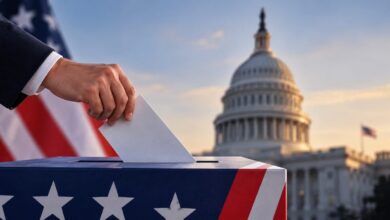
US Federal Election Commission data reveal the scale of fundraising and spending during the 2025–2026 election cycle. Congressional candidates, political parties and political action committees raised more than $12.4 billion over eighteen months, from January 1, 2025, to June 30, 2026. Their combined spending exceeded $9.5 billion.
-
Three Scenarios: US Midterm Elections Reshape Calculations over Confrontation with Iran
-
Why Does Europe Fear the Aftermath of the US Midterm Elections?
According to the Commission’s statistical summary released on October 1, 2026, House and Senate candidates raised $2.8 billion and spent approximately $2 billion. Political party committees received $1.4 billion and reported $1 billion in disbursements.
Political action committees recorded the largest amounts, with receipts of $8.3 billion and spending of $6.5 billion.
Reported independent expenditures totalled $643.4 million. Reported electioneering communications amounted to approximately $517,700, while communication costs reached $2.1 million.
-
Artificial Intelligence Is Redefining Elections in the United States
-
Three Phases and High-Stakes Deliberations: Iran’s Leaders on Trump’s Agenda
Congressional Candidates Report Record Fundraising
A total of 2,742 candidates in the 2026 House and Senate elections reported raising $2.799 billion and spending $2.036 billion during the reporting period.
Their combined debts stood at $366.7 million, while cash on hand reached $1.337 billion as of June 30, 2026.
Comparisons with previous election cycles show an increase in candidate fundraising: $2.463 billion in 2024, $2.422 billion in 2022 and $1.908 billion in 2020.
Spending also rose, from $1.834 billion in 2024 to more than $2 billion in the 2026 cycle.
-
Reciprocal Attacks Between Tehran and Washington Complicate the Settlement Process
-
Republican Strongholds at Risk as Polls Sound the Alarm in Trump Country
Among Senate candidates, 315 individuals contesting elections in 2025 and 2026 reported receipts of $864.3 million and spending of $614.2 million. They also reported debts of $40.6 million and cash on hand of $379.4 million.
The 2,427 House candidates recorded total receipts of $1.9 billion and spending of $1.4 billion.
Their debts totalled $326.1 million, while cash on hand stood at $957.7 million.
These figures cover the 2026 primary and general elections, alongside special elections held in several congressional districts during 2025 and 2026.
-
Preparing for a Delayed Escalation: Iran War Disrupts Trump’s Electoral Calculations
-
$5,000 for Every American! How Will Trump Finance the Purchase of His Voters Support?
Democratic and Republican Party Funding
National, state and local political party committees reported raising $1.376 billion in federal funds and spending $1.008 billion through the end of June 2026. Outstanding debts totalled $21.7 million, while cash on hand reached $488.5 million.
Democratic Party committees recorded total receipts of $666.3 million and disbursements of $544.1 million, with debts of $20.5 million and cash on hand of $185.6 million.
Republican committees raised $702.5 million and spent $457.1 million. Their debts did not exceed $1 million, while cash on hand stood at $300.8 million.
-
Conditions aboard the USS Abraham Lincoln Add to Trump’s Troubles
-
Waiting for Trump’s Electoral Weakening: A Strategic Iranian Plan or a Fatal Mistake?
Individuals were the largest source of funding for national party committees’ regular accounts, with contributions subject to an annual limit of $44,300 during the election cycle. Democratic committees received $413.6 million from individuals, compared with $367.7 million for Republican committees.
Political action committees and other political committees also contributed $61 million to Democratic Party committees and $50.3 million to Republican Party committees.
Democratic and Republican House candidate committees transferred $34.7 million and $26.9 million, respectively, to their national party committees.
Separate party accounts covering presidential nominating conventions, party headquarters, recounts and legal proceedings reported receipts of $256.3 million.
Democratic accounts received $87.9 million, compared with $168.4 million for Republican accounts. Recount and legal proceedings accounts attracted the largest share, with receipts of $126.8 million.
-
Follow the money: Charles Asher Small urges Congress to pass the Deterrent Act to counter foreign influence and antisemitism
-
The Muslim Brotherhood before the U.S. Congress: broader oversight of networks and financing
Political Action Committees Lead in Fundraising
The 9,176 federal political action committees that filed reports with the Commission collectively recorded receipts of $8.307 billion and disbursements of $6.549 billion. Their debts reached $39.4 million, while cash on hand totalled approximately $3.3 billion.
These committees included separate segregated funds connected to corporations and labour organisations, as well as nonconnected committees.
Independent expenditure-only committees reported receipts of $2.49 billion and spending of $1.648 billion. Committees with non-contribution accounts recorded receipts of $4.229 billion and spending of $3.501 billion.
-
Trump trapped in the Iran war between no victory and no peace
-
Iran Responds to New U.S. Proposal for a Settlement to End the War
Political action committee contributions to federal candidates totalled approximately $350.2 million through June 30, 2026, including $56.6 million for Senate candidates and $293.5 million for House candidates.
The Commission recorded no political action committee contributions to candidates in the 2028 presidential election during the same period.
Independent Expenditures and Electioneering Communications
Reported independent expenditures during the election cycle totalled $643.4 million.
Independent expenditure-only committees accounted for $529.6 million of that amount. Committees with non-contribution accounts reported $97.3 million, while other political action committees recorded $11.5 million.
-
Stopping Iran’s nuclear program is more important to Trump than the economic situation
-
Trump faces the challenge of resolving a war that has failed to achieve its objectives
Individuals acting outside political committees reported $4.8 million in independent expenditures. Party committees reported a further $233,400.
The rules require political committees to itemise payments associated with independent expenditures when their annual payments to a vendor or another recipient exceed $200 for a particular election.
Individuals and other entities must also file reports when their independent expenditures relating to a particular election exceed $250 during a calendar year.
The total value of electioneering communications reported to the Commission was $517,691. These communications include broadcast, cable or satellite messages that clearly identify a federal candidate and are distributed within thirty days before a primary election or sixty days before a general election, without expressly advocating the candidate’s election or defeat.
-
Supply disruptions push Trump to delay targeting Iranian energy facilities
-
Despite the “Donation Comeback”… Cracks in Trump’s Campaign
Regarding communication costs, the Federal Election Campaign Act of 1971, as amended, allows corporations and labour organisations to communicate with specified groups of individuals on any subject, including expressly advocating the election or defeat of a federal candidate.
These costs must be reported when they exceed $2,000 per election, but they are not classified as independent expenditures.
-
Washington Warns Allies of Possible Iranian Retaliation if Strikes Resume
-
Washington Retains Control Over Iraq’s Oil Revenues Despite Military Withdrawal
-
NewsNation: The Role of the American Media in Highlighting Islamist Extremism and the Partisan Divide in Washington