An Iraqi Militia Threatens to Target American Soldiers After the Scheduled Withdrawal Date
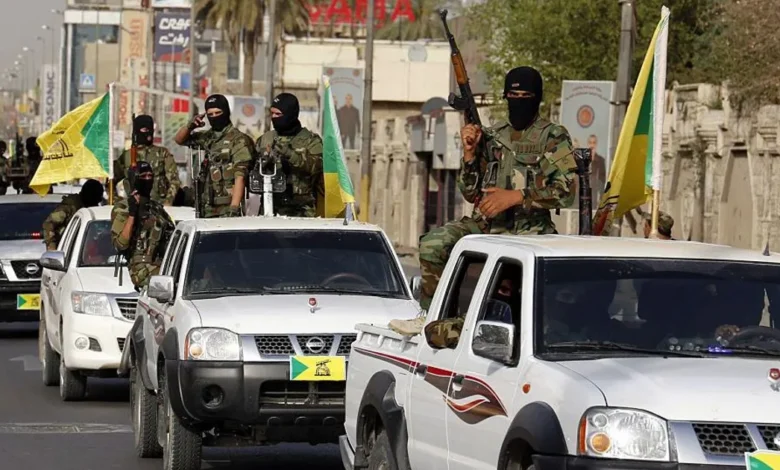
The Secretary-General of the Harakat al-Nujaba movement, Ali al-Kaabi, says his faction is monitoring the scheduled withdrawal date with “full readiness,” warning of the outbreak of a new confrontation if US forces fail to fulfill their commitment to withdraw completely.
Harakat al-Nujaba has escalated its threats against US forces in Iraq as the deadline for ending the military presence of the international coalition approaches. Its Secretary-General, Akram al-Kaabi, threatened to target any American soldier remaining in the country after September 30, in a message that appears to be directed at both Washington and the Iraqi government.
-
Iran Clings to Iraqi Militias’ Weapons as Baghdad Seeks to Restore Its Sovereignty
-
Washington launches crackdown on Iraqi militia leaders on terrorism charges
In a statement issued on Wednesday evening, al-Kaabi said that his faction was monitoring the scheduled withdrawal date with “full readiness,” warning that a new confrontation could erupt if US forces failed to fulfill their commitment to withdraw completely from Iraqi territory and airspace. He added that any American serviceman remaining after the specified deadline would become vulnerable to attack, pledging not to allow him to leave safely.
He said: “If even one soldier remains after this date, we will not allow him to return safely, and we will send him back to them as a dead body.”
This escalation comes at a time when political and security pressure on the Iraqi government is increasing to resolve the issue of the foreign military presence while simultaneously addressing the question of weapons held outside state institutions. Armed factions view the two issues as closely interconnected, arguing that the departure of foreign forces is a fundamental condition for any discussion concerning the future of their military capabilities.
-
Accusations against Iran of using Iraqi militias to suppress protests
-
Iran Relies on Houthis and Iraqi Militias to Support Gaza
Al-Kaabi’s statements, as the leader of one of the most prominent armed factions affiliated with the Popular Mobilization Forces, represent a new indication of the difficulty of controlling the rhetoric of armed groups as the withdrawal deadline approaches. They also reflect these forces’ determination to keep the threat of military action available as a means of exerting pressure on decision-makers and preventing measures that could reduce their influence or restrict the authority to use weapons exclusively to official institutions.
Hardline positions are not limited to Harakat al-Nujaba. Kataib Hezbollah, Kataib Sayyid al-Shuhada, and other factions have also declared their refusal to relinquish their military capabilities, while linking the future of their weapons to the complete implementation of the foreign withdrawal.
-
Leaks from the Secret Meeting: Iran Refuses to Support Hezbollah and its Iraqi Militias Against Israel
-
An Iraqi militia challenges Washington by persisting in carrying out attacks
This places the government before two simultaneous challenges: ensuring the implementation of arrangements to end the coalition’s military mission and preventing the post-withdrawal period from becoming a pretext for the continuation of armed activities outside state authority.
In this context, Kataib Sayyid al-Shuhada has adopted a conditional position on the issue of placing weapons exclusively under state control, demanding the implementation of a series of conditions that its opponents have described as impossible to meet. This position reflects the widening gap between the government’s vision of strengthening the state’s monopoly on the use of force and the position of factions determined to retain an independent margin of military decision-making.
-
Do Iraqi militia groups allied with Iran intervene in the Gaza war?
-
Houthi militia financially supported by Iraqi militias affiliated with Iran
Prime Minister Ali al-Zaidi is therefore facing a particularly sensitive test. The success of the plan to place weapons exclusively under state control will not depend solely on the departure of foreign forces, but also on the government’s ability to prevent armed factions from exploiting the withdrawal phase to reimpose a parallel security order.
Meanwhile, the State Administration Coalition, which brings together Shiite, Sunni, and Kurdish political forces, has warned that any armed activity conducted outside state institutions after September 30 could be regarded as a violation warranting the application of the Counter-Terrorism Law. This position sends a clear message to the factions that the end of the coalition’s military presence will not mean allowing the continuation of independent armed activity.
-
Iraqi Militias Threaten Devastating Response if Israel Assassinates al-Sistani
-
About the Iraqi battle between the state and militias
As the deadline approaches, Iraq appears to be entering a genuine period of testing. While the government is betting on a more independent security transition, armed factions are adopting increasingly forceful rhetoric to demonstrate their ability to retaliate. The coming days will therefore be decisive in determining whether the US withdrawal will close a major security chapter or instead open the door to a new confrontation over the limits of state authority and the issue of uncontrolled weapons.
-
Changes in the Iranian Leadership Create Uncertainty Among Iraqi Factions
-
Asaib Ahl al-Haq Joins the Call to Place Weapons Exclusively Under the Authority of the Iraqi State