Foreign Currency Shortages Open a New Economic Front Against Citizens in Areas Controlled by the Port Sudan Authorities
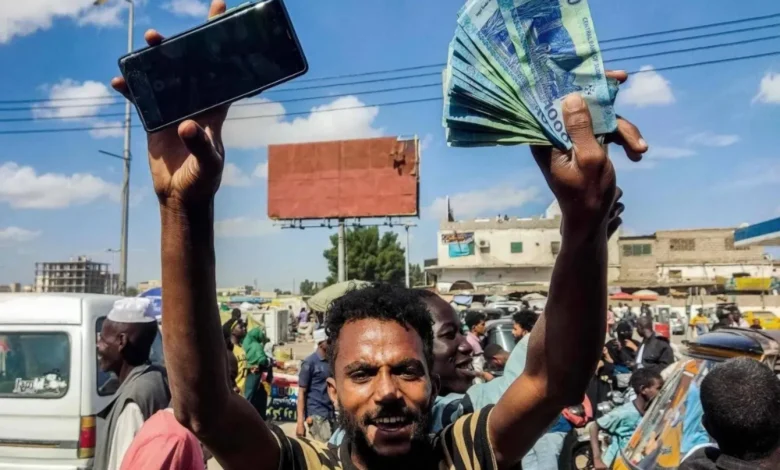
Sudan’s economic crisis is no longer simply a matter of exchange rates or inflation figures. It has increasingly become a daily reality that weighs on people’s lives and reshapes living conditions, work and market activity. In areas controlled by the Port Sudan authorities, one of the most pressing problems appears to be the widening gap between the foreign currency needed to finance imports and the limited resources the economy can generate through exports and other sources.
This imbalance becomes more acute when the import bill rises while exports fail to provide sufficient foreign currency inflows. An economy that needs dollars to purchase fuel, food, medicine, production inputs, and consumer goods faces a difficult equation: growing demand for foreign currency against limited supply. This drives the local currency further down and makes imports increasingly expensive.
The effects do not remain confined to financial institutions or importers’ offices. They quickly spread to markets and households. When the cost of obtaining dollars rises, traders can no longer maintain their previous prices. They must recalculate purchasing, transport, insurance, duties, and taxes, then add a margin to cover the risks associated with volatility. Ultimately, consumers arrive at the market to find that a product they bought some time earlier now requires a much larger share of their income.
This chain of effects reveals the core problem: a weak capacity to generate foreign currency does more than make imports difficult to finance. It also transmits the crisis to the exchange rate, then to prices, wages and, finally, living standards. The longer this cycle continues, the harder it becomes to break.
Citizens Pay the Price of the Imbalance
The most troubling aspect of the economic crisis is that ordinary citizens lack the means to protect themselves against currency collapse or rising import costs. Traders can, at least partly, adjust their prices, while importers can change the size of their orders. Employees and workers on fixed incomes, however, cannot increase their earnings at the same pace.
The gap between incomes and prices therefore widens. Families that could previously afford a range of essential goods on their monthly income are forced to buy smaller quantities, give up certain products, postpone expenses and seek cheaper or lower-quality alternatives.
The impact extends beyond food. Higher transport costs affect commuting, the movement of goods, services and the prices of agricultural and industrial products. When fuel becomes more expensive, almost everything can cost more because transport underpins most stages of economic activity.
The foreign exchange crisis thus becomes a social crisis. Every increase in the dollar’s exchange rate represents more than a new figure in the currency market. It may mean higher flour, cooking oil or sugar prices, rising transport fares, greater production costs for workshop owners and a more expensive finished product for consumers.
Weak Exports Make the Equation Harder to Solve
Any country dependent on imports needs a steady supply of foreign currency. This can come from exports, investment, remittances or other sources. But when export capacity is weak or damaged, imports place a heavier burden on the economy.
Available international trade data show a substantial gap between the value of Sudanese imports and exports. This reflects a broader problem involving the trade balance and the economy’s ability to generate foreign currency through external trade.
Imports themselves are not the problem. Sudan needs to import essential goods, production inputs, fuel, and materials necessary to sustain economic activity. The difficulty lies in financing these imports while the country’s ability to earn sufficient export revenue is declining.
The real question therefore becomes: where will the dollars come from? If exports do not generate enough foreign currency, market participants seek alternative sources. Competition for foreign currency intensifies, its value rises, and the Sudanese pound comes under greater pressure.
Currency Depreciation Deepens the Crisis
Currency depreciation does not occur in isolation. When dollars become more expensive, so does every imported product or item manufactured using imported components. Domestic producers are also affected if they rely on imported fuel, spare parts or raw materials.
The economy consequently enters a vicious cycle: weak exports reduce foreign currency inflows; foreign currency shortages put pressure on the pound; a weaker pound raises import costs; higher import costs push up prices; rising prices erode purchasing power; and falling demand then weakens trade and production.
As this cycle continues, citizens become more dependent on additional income or side jobs to meet living costs. Business owners also grow more cautious about investment and hiring because they cannot predict input costs or the prices at which they will be able to sell their products a few weeks later.
Fuel: The Most Critical Link
The fuel crisis is particularly significant because it strikes at an exceptionally sensitive point in the economy. Fuel is not an ordinary consumer good; it is an essential input for transport, agriculture, industry and services.
During 2026, Sudan experienced recurring fuel crises, some linked to currency weakness, rising import costs and import-related charges. The authorities were forced to intervene directly in petroleum product imports in an attempt to bring the market under control and ease pressure on foreign currency resources.
When payments to fuel suppliers are delayed, or financing shipments becomes more difficult, the consequences extend beyond petrol stations. Queues may form, transport activity may slow, and freight costs may rise, with those increases subsequently passed on through goods prices.
In an economy already suffering from weak purchasing power, these increases are particularly harsh on households.
Taxes and Import Restrictions
In an effort to ease pressure on foreign currency resources, the authorities have moved to regulate imports and restrict certain goods. In April 2026, the government announced measures to regulate import activity and reduce dependence on foreign supplies, citing the need for a better balance between imports and exports.
Administrative restrictions alone, however, cannot resolve the underlying problem of weak production and exports. If imports of a particular product are banned or reduced without a domestic alternative capable of meeting demand, the likely result is a shortage of supply or higher prices.
Taxes and duties on imported goods also increase their cost to consumers. Sudanese tax rules stipulate that imported goods are taxed at customs clearance, alongside other duties and taxes applicable according to the type of product.
Importers therefore face several layers of costs: dollars, freight, insurance, customs duties, taxes, domestic transport and the risks of exchange rate volatility. Ultimately, consumers bear most of that burden.
The Crisis Is No Longer Merely Financial
The fundamental problem is that the economic crisis is moving beyond public finances and foreign exchange to become a crisis of confidence as well. Traders do not know what prices they will pay tomorrow; consumers do not know whether their salaries will last until the end of the month; and producers cannot anticipate the cost of their next inputs.
Under such conditions, talk of controlling markets or reducing imports is insufficient. What is needed is action on the root causes: increasing production, restoring export capacity, improving foreign currency inflows and creating an environment in which trade and production can stabilise.
Otherwise, citizens will continue to pay the price of every new economic imbalance.
The greatest danger is that the crisis ceases to be exceptional and becomes normal. When price increases are expected, currency depreciation becomes routine and fuel shortages are part of daily life, society begins to exhaust its capacity to endure.
The real challenge facing the Port Sudan authorities is therefore not simply to manage the exchange rate or secure imports, but to restore confidence in the economy itself. An economy that loses its ability to protect its citizens’ purchasing power gradually loses its ability to safeguard social stability as well.