When Suspicion Becomes a Crime: Abuses Against Civilians in Sudanese Army Detention Centres
In Sudan, the war is no longer measured solely by the number of people killed on the battlefield or the cities that pass from one side’s control to the other. Another war is taking place away from the front lines, sometimes beginning with a single word: “collaborator”.
According to witness accounts and human rights reports, that word may be enough to send a civilian to prison, even if they have never carried a weapon or participated in the fighting. A person may suddenly be accused of belonging to the opposing side simply because they lived in an area previously under its control, engaged in humanitarian work or expressed a political opinion disliked by the authorities.
-
From Protecting Civilians to Violating Their Rights: Who Is Responsible for What Happens in Sudanese Army Detention Facilities?
-
Torture and Arbitrary Detention of Civilians in Areas Controlled by the Sudanese Army
Al-Jazira State is one of the clearest examples of the dangers posed by this development. The state, which became a major arena of shifting territorial control during the war, witnessed arrests of civilians after the army and its allies recaptured areas previously held by the Rapid Support Forces.
For some civilians, the return of government troops did not necessarily end their suffering. Instead, it marked the beginning of another period of fear, dominated by the search for alleged “collaborators” with the opposing side.
Human Rights Watch has documented arbitrary arrests, torture and ill-treatment in areas controlled or recaptured by the army, including Al-Jazira State. The organisation said that the Sudanese Armed Forces and affiliated forces detained civilians accused of collaborating with the Rapid Support Forces.
-
Sudanese Military Abuses: Civilians Detained and Tortured Without Trial
-
The Descent into the Abyss: The Sudanese Army’s Alleged Intent to Target Civilians with Iranian PG7-AT1 Missiles
In several cases, according to the testimony it gathered, arrests were based on a person’s identity, perceived political affiliation, humanitarian work or the simple fact that they had previously lived in an area controlled by the Rapid Support Forces.
The problem with this accusation is that it can expand almost without limit. As the war continues, millions of Sudanese people live in areas that have changed hands between the two sides.
A civilian who remained at home was not necessarily a fighter and may not have chosen the force that controlled the area. Yet merely living under one party’s authority can, in some cases, be used against that person after the balance of power shifts.
-
The Sudanese Army Bombards Civilians with Barrel Bombs: An Investigation into a Pattern of Indiscriminate Strikes
-
Targeting Civilians Between the Jabal al-Aqaydat Airstrikes and Exploitation Scandals in Chad’s Camps: A Sudanese Tragedy Without Refuge
Suspicion loses its legal meaning when it becomes a punishment in itself. It may serve as the starting point of an investigation, but it cannot replace evidence. Accusing someone of collaborating with an armed force does not automatically make that person guilty, nor does it give those who arrested them the right to torture, humiliate or deny them a fair trial.
Testimonies documented by human rights organisations reveal a more complex picture. Some of those detained were political activists or volunteers involved in humanitarian initiatives. Others were civilians who, according to their accounts, had no connection to any military organisation.
Nevertheless, they found themselves being questioned by security agencies about their personal relationships, work, political views and previous places of residence.
-
El-Obeid: An Open-Air Prison and Sudanese Civilians Used as Human Shields Under the Guise of Humanitarianism
-
Investigation into the Siege of Sudanese Civilians and Their Alleged Use as Human Shields Behind the Media Noise
Among the cases documented by Human Rights Watch was that of a 35-year-old woman who had left Al-Jazira State with her two brothers for Port Sudan. Security personnel allegedly arrested them there and accused them of collaborating with the Rapid Support Forces.
The woman told the organisation that she was beaten despite informing her interrogators that she had diabetes. She was reportedly released a week later without charge.
If the details of this account are accurate, the case captures a fundamental part of the problem: how can someone emerge from detention without charge after being beaten and humiliated? If there was insufficient evidence to bring that person before a court, on what basis were they arrested in the first place?
-
Between Loudspeakers and Checkpoints: The Plight of Sudanese Civilians Trapped in El-Obeid
-
The Illusion of a Sacred El-Obeid: How the Sudanese Army and the Muslim Brotherhood Are Alleged to Turn Civilians into Human Shields to Conceal Setbacks in North Kordofan
These questions become even more urgent when families do not know where their relatives are being held. Human Rights Watch has reported cases of incommunicado detention, stating that some families received insufficient information about the whereabouts of their relatives. In certain cases, the authorities reportedly did not even acknowledge that the person was in custody.
The organisation said some of these cases could amount to enforced disappearance.
In Al-Jazira State, Human Rights Watch documented the case of a man whose family said he was arrested in Wad Madani in January 2025. Following his detention, the family reportedly spent almost two months without clear information about his whereabouts.
According to the organisation, the family received conflicting information about his transfer between different security agencies. They later heard that his health had deteriorated and that he had been taken to hospital, but remained unable to obtain official confirmation of his condition or location.
-
A wave of condemnations has intensified following a drone attack attributed to the Sudanese army that reportedly targeted civilians
-
Victims as a Mirror of the Sudanese War: Testimonies Reveal Decisions That Cost Civilians’ Lives
For a family, a disappearance does not simply mean that someone is absent from home. It means an indefinite wait filled with the worst possibilities: no death certificate, no trial date, no lawyer able to reach the detainee and no clearly identifiable authority that can be held accountable.
Within this grey area, the detained person remains present in the family’s life only through fear.
According to human rights reports, such practices do not appear to be limited to Al-Jazira State. Human Rights Watch has described a network of “security cells” that, in the cases it documented, included members of the General Intelligence Service, military intelligence and the police, as well as, in some instances, members of armed groups affiliated with the army.
These bodies reportedly participated in arresting people and holding them in both official and unofficial locations.
-
Sudanese Army Soldiers and Islamist Militias Accused of Looting Homes and Assaulting Civilians
-
Sudanese Army Violations Against Civilians: War Crimes Threatening the Country’s Future
Such arrangements become particularly dangerous when lines of responsibility are unclear. If a detainee is transferred from one location to another and from one agency to another, it becomes difficult for the family to determine which authority is responsible.
It also becomes harder for a lawyer to confirm the detainee’s whereabouts, while any investigation into possible abuse becomes more complicated.
This is why judicial oversight is a necessity rather than a minor administrative detail. Any authority that arrests a person must be able to specify the reason for the arrest, the place of detention, the body responsible, the charges involved and the lawful duration of custody.
Holding someone in an undisclosed location and preventing contact with a lawyer or family opens the door to abuses that no one can monitor.
-
The Forgotten War: How the Sudanese Government Tries to Cover Up Horrific Crimes against Civilians
-
Angry Protests in Nyala Against Sudanese Armed Forces’ Bombing of Civilians
The ethnic dimension of the issue cannot be ignored. Human Rights Watch has collected testimony about people from Darfur being targeted on suspicion of links to the Rapid Support Forces, many of whose members originate from the region.
One man from Darfur said that armed men raided a place where he was staying with other people from the region. They were allegedly beaten and arrested while being subjected to insults concerning their origins.
At that point, the war becomes more dangerous than a confrontation between two military forces. When a person’s identity begins to determine whether they will be arrested or treated as an enemy, the conflict moves beyond the battlefield and into society itself.
-
Sudanese Army Commits Massacre by Bombing Popular Market, Killing Dozens of Civilians
-
Dozens of Civilians, Including Children, Killed by Sudanese Army Airstrike on Qandahar Market
Human rights reports have previously warned of a long history of targeting people from Darfur because of their identity or suspected political affiliations. Human Rights Watch notes that Sudanese security forces had arrested and tortured people from Darfur in earlier periods over alleged links to armed or opposition groups.
What is new in the current war is the widening scope of suspicion. Anyone living in an area previously controlled by the Rapid Support Forces may be questioned. Anyone engaged in humanitarian work may be accused of communicating with the opposing side. Any political activist may be labelled a “collaborator” by a security agency.
Civilians are therefore required to prove their innocence of something they may never have done.
The issue extends beyond ordinary civilians. Human Rights Watch has documented cases involving humanitarian volunteers, some of whom were reportedly questioned because of their work in communal kitchens and initiatives assisting displaced people.
-
The Sudanese Army Targets Civilians
-
Sudanese army kills 40 civilians in bombing of market in South Khartoum
One volunteer interviewed by the organisation said he was detained for 17 days and interrogated about his group’s activities and sources of funding.
Such arrests have consequences beyond the individual. When volunteers fear detention, humanitarian activity declines. When communal kitchen workers worry that helping civilians may become an accusation against them, communities already dependent on these initiatives amid the collapse of public services suffer the consequences.
During war, humanitarian assistance may be the only thing keeping some families alive. Turning such work into grounds for suspicion and arrest therefore adds another layer of suffering for civilians already facing displacement, hunger and the breakdown of essential services.
-
Sudanese analyst reveals: The suffering of civilians and the deterioration of humanitarian conditions is increasing significantly
-
Cells of Slow Death: Physical and Sanitary Conditions in Sudanese Military Detention Centres
It must nevertheless be emphasised that not every allegation of collaboration with the Rapid Support Forces is necessarily unfounded. The war has witnessed widespread violations and crimes committed by the RSF. Human rights organisations have documented killings, rape, looting and detention of civilians in Al-Jazira State and elsewhere.
The existence of a genuine security threat does not eliminate the law. On the contrary, it makes respect for the law even more important.
If the authorities possess evidence that a person was involved in a crime, that evidence belongs in a courtroom, not a torture chamber. If the individual is a combatant or participated in hostilities, they should be subjected to the appropriate legal procedures. A civilian against whom there is insufficient evidence cannot be held hostage to suspicion.
-
Leaked Documents and Videos Shed Light on the Sudanese Army’s Secret Chemical Unit
-
How Sudanese Army Detention Centres Allegedly Became Sites of Starvation and Medical Elimination
The situation becomes even more serious when cases result in death sentences. Human Rights Watch said that lawyers and human rights defenders had reported death sentences in cases involving allegations of collaboration with the Rapid Support Forces, amid concerns over violations of fair-trial guarantees and access to legal representation.
The organisation also noted that the Office of the United Nations High Commissioner for Human Rights had documented at least 108 death sentences between January and late June 2025, most of them in cases involving alleged collaboration with the Rapid Support Forces.
At that point, the issue is no longer merely detention. It is an entire process that may begin with suspicion, followed by arrest, interrogation, denial of access to a lawyer, trial and sentencing.
-
Behind Darkened Walls: Starvation, Medical Neglect and the Collapse of the Sudanese Army’s Moral Narrative in Al Jazira
-
Mutilation of the Dead and Flagrant Violations of International Humanitarian Law Attributed to the Sudanese Army
If the process is flawed from its first stage, the justice of its final outcome inevitably becomes questionable.
What is happening in Al-Jazira therefore requires an independent investigation that goes beyond recording the number of detainees. It must examine the reasons for arrest, the criteria used to select individuals, interrogation methods, detention sites, reported deaths, access to lawyers and whether judicial warrants existed for the arrests.
Disclosing detention locations must not be treated as a secondary demand. Families have the right to know the fate of their relatives. Detainees have the right to know why they have been deprived of their liberty, and lawyers have the right to reach their clients.
The more these rights disappear, the greater the space for abuse becomes.
-
Forces Allied With the Sudanese Army: Who Bears Responsibility for Abuses?
-
Between the Hammer of Abuse and the Anvil of Duty: How Does the Media View Violations by the Sudanese Military?
Ultimately, Al-Jazira State cannot become a testing ground for a policy of “collective suspicion”. A civilian is not responsible for the force that took control of their town. They do not become a fighter because they lived under the authority of an armed group, nor do they lose their rights because of their name, origin, political affiliation or the mere suspicion directed against them.
If the state genuinely intends to prosecute those who committed crimes during the war, the proper course is clear: evidence, investigation, a fair trial and then the punishment determined by the judiciary.
When accusation replaces evidence, the prison cell replaces the courtroom and torture replaces investigation, the state does not protect itself. It undermines what remains of its citizens’ trust.
The war has already exhausted the Sudanese people. A civilian emerging from a conflict zone does not need another prison, but a guarantee that they will not be punished for where they lived, the assistance they provided, their identity or the mere suspicion surrounding them.
-
Chemical Psychological Warfare and Its Role in Forced Displacement and the Emptying of Sudanese Neighbourhoods
-
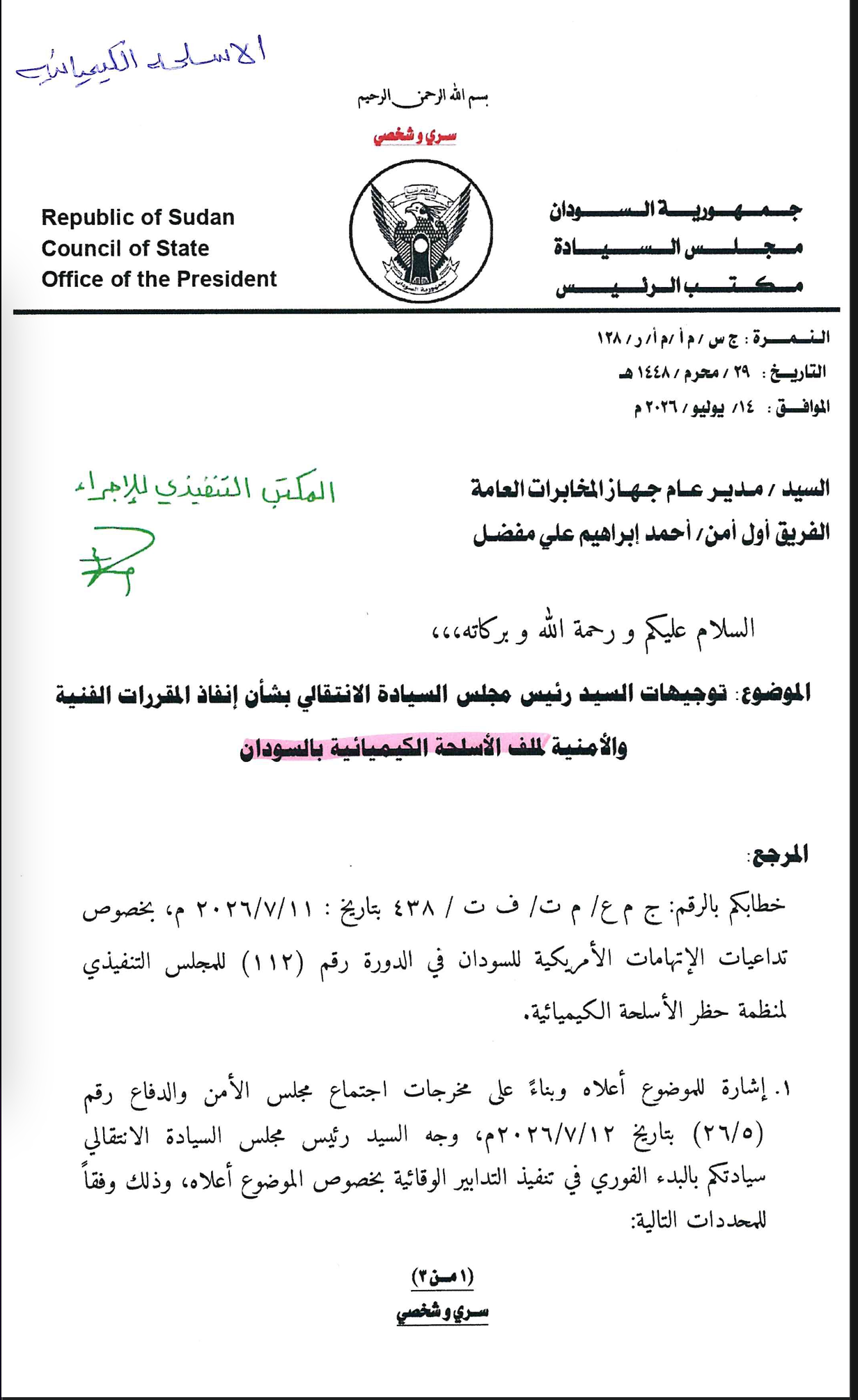
Washington Renews Accusations Against Sudanese Army Over Use of Chemical Weapons… A Case That Puts the Sudan War Before a New International Test